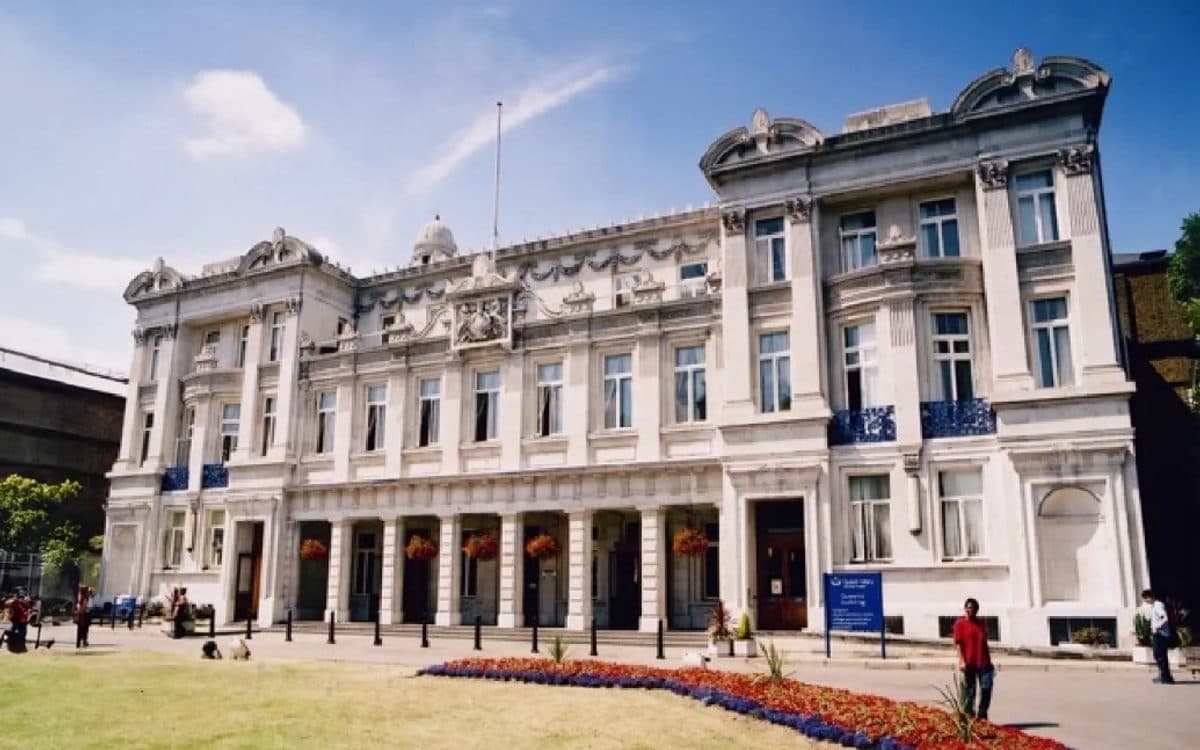
In 1897, a doctor working in Secunderabad identified the malaria parasite in the gut of a mosquito, proving how the disease spreads and opening the door to controlling it. Sir Ronald Ross won the 1902 Nobel Prize in Medicine for that work — carried out in India, by a graduate of St Bartholomew's, one of the historic institutions that today make up Queen Mary University of London.
Ross is one of nine Nobel laureates connected to Queen Mary. Another is Sir Peter Mansfield, who took his BSc in Physics here in 1959 and his PhD in 1962 before going on to invent practical MRI scanning.
For Indian students planning to study in the UK, Queen Mary offers something no other London university quite matches: a Russell Group education and a genuine campus — one where you live, study and socialise on a single site — ten minutes from the City of London. On QS's own three-year movement, it is also the fastest-rising Russell Group university, up 42 places. This guide explains exactly how to study at Queen Mary University of London as an international student.
Queen Mary at a Glance
Queen Mary is the product of four historic institutions: the London Hospital Medical College (1785), St Bartholomew's Hospital Medical College (1843), Westfield College (1882) — founded as a residential college for women — and Queen Mary College, whose roots trace to the People's Palace of 1887. Queen Mary and Westfield merged in 1989; the two medical colleges joined in 1995 to form Barts and The London School of Medicine and Dentistry.
A note on the medical heritage: you will see Barts described as England's oldest medical school. The accurate version is more interesting — Queen Mary's medical school descends from England's first formal medical school, founded in 1785, and from St Bartholomew's Hospital, founded in 1123 and still the oldest hospital in England, on its original Smithfield site.
What Can You Study at Queen Mary?
1. Law — and the UK's Largest LLM
This is Queen Mary's headline draw for Indian postgraduates, and deservedly so. The School of Law combines the Department of Law with the Centre for Commercial Law Studies (CCLS), a globally recognised centre for commercial, intellectual property and technology law. Queen Mary places its Law provision in the global top 40 (QS by Subject 2026) and 8th in the UK (THE 2025).
- The largest and most diverse LLM in the UK, with over 20 specialisms — including Commercial and Corporate Law, Intellectual Property, Comparative and International Dispute Resolution, International Business Law, Technology/Media/Telecommunications Law, Energy and Climate Change Law, and Art, Business and Law.
- Postgraduate law is taught at Lincoln's Inn Fields in Holborn — the historic legal centre of London, beside the Royal Courts of Justice — not at Mile End. For an aspiring commercial lawyer, that location is part of the education.
- qLegal — a student-run legal advice clinic advising tech start-ups under practitioner supervision, giving you real client work on your CV.
- CCLS Postgraduate Law Mentoring Programme paired more than 150 mentees with practitioner mentors in a single recent year.
- Entry: the Laws LLM asks a 2:1 in law or a degree with substantial law content, plus IELTS 7.0 with 6.5 in Writing. Fee £33,000, or £37,950 with SQE preparation.
2. Medicine & Dentistry — Barts and The London
Dentistry ranks 12th in the world (QS by Subject 2026), Queen Mary's single strongest subject result, and 1st in London in the Guardian University Guide 2026. Medicine ranks joint 62nd globally, and remarkably 8th in the world for research citations per paper. Teaching runs through the Blizard Institute, Barts Cancer Institute, William Harvey Research Institute, Wolfson Institute of Population Health and Institute of Dentistry, across campuses at Whitechapel, West Smithfield and Charterhouse Square — with direct integration into NHS teaching hospitals.
3. Engineering & Computer Science
- Computer Science and Information Systems: 78th in the world, 8th in the UK (QS 2026, up from 84th).
- Data Science and Artificial Intelligence: global top 100.
- Electrical and Electronic Engineering: 11th in the UK.
- Taught through the School of Electronic Engineering and Computer Science and the School of Engineering and Materials Science.
4. Business & Economics
The School of Business and Management is AACSB accredited and ranked 1st in London for Marketing in the Complete University Guide 2026. The School of Economics and Finance reports strong outcomes — an average UK salary of £38,495, with 92% of graduates in work or further study and 81% in highly skilled roles.
Most Popular Courses for Indian Students: the Laws LLM and its specialisms, MSc Computer Science and Data Science, MSc Finance and Economics, Business Analytics, Marketing, and the Barts postgraduate medical and public health programmes.
Entry Requirements for International Students
For Undergraduate Study
- Class XII conversion (CBSE / ISC): A*AA = 90% · AAA = 85% · AAB = 80% · ABB = 75% · BBB = 70%. West Bengal students are asked around five points less; other state boards around five points more.
- Worked examples: LLB Law asks A*AA (90% CBSE); BSc Computer Science asks AAA (85%) and must include Maths, Computer Science or Physics.
- Economics and Finance separately specifies 85% overall including 85% in Mathematics — 90% for other state boards.
- MBBS Medicine: A*AA in one sitting, plus UCAT in the fourth decile or above and SJT Bands 1–3.
- Queen Mary notes that actual offers may differ slightly from the published table.
For Postgraduate Study
- UK 2:1 equivalent — the standard master's requirement — is roughly 60–70%.
- UK First Class equivalent: 75–80%. UK 2:2: 50–60%.
- Queen Mary notes that for India, offers may also be made on the GPA scale.
- No public tier list. Unlike some universities, Queen Mary does not publish a tiered ranking of Indian institutions, but states that requirements vary by institution — so graduates of the IITs, NITs and other highly regarded universities may be considered at the lower end of the band. Confirm your own offer conditions rather than relying on a general figure.
English Language Requirements
- Band 3 — IELTS 6.0 (5.5 each) or TOEFL iBT 79: undergraduate biological sciences, electronic engineering and computer science, engineering and materials, mathematics, physical and chemical sciences.
- Band 4 — IELTS 6.5 (6.0 each) or TOEFL iBT 92: business and management, economics and finance, society and environment, and most postgraduate medical and dental institutes.
- Band 5 — IELTS 7.0 (6.0 each) or TOEFL iBT 100: School of the Arts, Blizard Institute, Institute of Dentistry.
- The School of Law is non-standard — the Laws LLM requires IELTS 7.0 overall with 6.5 in Writing and 6.0 elsewhere.
- PTE Academic, Cambridge Advanced/Proficiency and Trinity ISE are accepted. Results must be under two years old.
Pathway routes: Queen Mary runs its International Foundation Year in-house, designed and taught by its own academics rather than outsourced to a partner — entry is 60% from CBSE or a central board, 65% from a state board, with IELTS 5.0–5.5 depending on stream. Streams cover Biological Sciences, Chemical Sciences, Engineering, Mathematics, Physics, Business and Management, Law, and Humanities and Social Sciences, at a fee of £25,500. Pre-Masters programmes lead into more than 200 degree programmes.
Tuition Fees for 2026/27
- Undergraduate: typically £29,450 to £33,000 a year. LLB Law £29,450; BSc Computer Science £32,950. Humanities and law sit at the bottom of the range, lab-based science and engineering at the top.
- Postgraduate taught: typically £33,000 to £35,500 a year, rising to £37,950 for the Laws LLM with SQE preparation — worth budgeting for if you are targeting that route. The standard Laws LLM is £33,000; MSc Advanced Computer Science £35,250.
- International Foundation Year: £25,500.
- MBBS Medicine: £53,950 a year across five years — roughly 60–80% above a standard undergraduate degree, and something to plan for well ahead.
Payment terms matter here. Queen Mary requires international students to pay at least 50% of tuition upfront, and offers a 1% discount for paying in full before enrolment where fees are £10,000 or more. It has also committed to capping international fee increases at 10% for 2026/27. Build the upfront requirement into your funding plan early — it catches families out, and planning ahead makes it far easier to manage. Talk to us before you finalise your budget.
Scholarships for Indian Students
Queen Mary has no India-specific scholarship — its President's Global Scholarships for South Asia name Bangladesh, Nepal and Sri Lanka, and India is not included. That sounds like bad news, but the general international awards are genuinely substantial and Indian students compete for all of them.
- 1. Global Talent Scholarship — Postgraduate Taught, £5,000
- The most accessible award by volume, with 700 scholarships available. You need a 2:1 equivalent, overseas fee status, and to be fully self-funded. It requires a separate application after you hold an offer, and is allocated on a rolling basis — so apply early rather than waiting.
- 2. Global Excellence Scholarship — Postgraduate Taught, £7,000
- For high-achieving international postgraduate offer holders starting in September. More competitive than the Global Talent award, and correspondingly more valuable.
- 3. President's Global Scholarships — Postgraduate Taught, £10,000
- Queen Mary's flagship merit award, typically requiring a first-class equivalent and an unconditional offer. India is eligible for the general President's Global Scholarships, though not for the separate South Asia stream.
- 4. Global Talent Scholarship — Undergraduate, up to £12,000
- The largest single award available to international undergraduates for September 2026 entry. There are also International Foundation Scholarships worth £3,000 each.
- 5. Law and LLM Awards
- Worth targeting if you are applying to the School of Law: the Roy Goode Scholarship (a half tuition fee waiver for postgraduate law), the Norman Palmer Partial Scholarship (one third of tuition, for the LLM in Art, Business and Law), and two Energy and Climate Change Law Institute Scholarships worth £7,500 each.
- 6. Chevening and Commonwealth
- Queen Mary hosts around 50 Chevening Scholars a year with no institutional cap, covering full tuition, a monthly stipend and return flights. It also co-funds Commonwealth Master's Scholarships with the FCDO — India is an eligible country, and you apply both through the CSC and to Queen Mary for admission.
- 7. Alumni Loyalty Award
- A 10% tuition discount for Queen Mary graduates returning for further study — worth remembering if you complete an undergraduate degree here.
Ignore the GREAT Scholarship claims. Queen Mary does not appear among the participating institutions for GREAT Scholarships India 2026/27. Several Indian aggregator sites suggest otherwise — build your funding plan around the Global Talent, Global Excellence and President's awards, plus Chevening.
Life at Queen Mary — A Real Campus in London
This is Queen Mary's most underrated advantage. Most London universities are collections of buildings scattered across the city; Queen Mary has the largest self-contained campus of any London university, on Mile End Road beside the Regent's Canal, with nearly 2,500 rooms on or near campus. You get the student-village experience — shops, cafés, restaurants, a bar, the Qmotion gym, library, bookshop, launderette, the People's Palace and the Students' Union all on one site — inside Zone 2.
- Transport is excellent: Mile End is served by the Central, District and Hammersmith & City lines — an unusually good interchange for Zone 2. The City of London and Bank are about 10 minutes away on the Central line, and Canary Wharf roughly 12–20 minutes. Whitechapel, two stops away, puts you on the Elizabeth line direct to Liverpool Street, Bond Street, Paddington, Southall and all Heathrow terminals.
- Living costs: Queen Mary's own Money Advice Service estimates £575 a month excluding rent. Halls run £6,571–£16,476 for the academic year. A realistic all-in figure is £1,400–£1,600 a month — roughly £200–£400 less than living in Zone 1, almost entirely on rent.
- Visa maintenance: the UKVI requirement for London is £1,529 a month (£13,761 for nine months), held for 28 consecutive days. Many agent websites still quote the older, lower figure — use the current one.
- Societies: among 300+ groups, the Students' Union hosts the Queen Mary Indian Society (founded 2012, known for its Indian Food Truck Festival and boat parties), plus Tamil, Malayali, Sri Lankan, Nepalese, Pakistan and Bangladeshi societies, an NHSF Hindu Society, a Sikh Society, a Bhangra society and a Bollywood Dance Society.
Indian Food and Groceries — Where to Actually Go
East London is one of the best places in Britain to be an Indian student who wants to eat well, but the geography is often reported badly, so here is the accurate version.
- Green Street, East Ham — lead with this. Direct on the District line, six stops and around 12 minutes from Mile End. Known as *Little India* since the 1990s, with Queens Market, and renowned for saree, fashion and gold retail. It is the closest major South Asian hub to campus.
- Whitechapel Market — two stops, about four minutes, or a 25-minute walk. Established in 1904, open Monday to Saturday, with fresh produce, spices and cultural wear.
- **Brick Lane is *Banglatown*, not Little India** — it is rooted in Bangladeshi Sylheti migration and was officially branded as such in 1997. It is worth visiting, but be aware that more than half its Bangladeshi restaurants have closed over the last twenty years amid heavy gentrification.
- Southall, the largest Punjabi and Sikh hub in London, is a direct Elizabeth line ride from Whitechapel — a comfortable weekend trip. Tooting is the destination for South Indian and Sri Lankan food.
- Halal food is the default rather than the exception around Mile End Road and Whitechapel, and the East London Mosque is about fifteen minutes' walk from the Whitechapel campus.
On safety — the honest picture. Tower Hamlets records around 143.8 crimes per 1,000 residents against a London average of 125.9, which is modestly above average and typical of inner London boroughs. Much of it is acquisitive crime around transport hubs and nightlife rather than the residential streets by campus, and Queen Mary's own top warning to students is phone snatching near stations. The university runs 24-hour security on the residential campus, a security emergency line, CCTV and patrols, and a Safe Spaces scheme of designated buildings where students who feel unsafe can get help.
Career Outcomes
- 16th in the UK in The Graduate Market in 2026 (High Fliers Research), which measures which universities the country's leading employers actively target — up from 17th.
- 89% of graduates in work or further study 15 months after graduating (Graduate Outcomes, 2022/23 cohort).
- Strong salary outcomes in quantitative fields — the School of Economics and Finance reports an average UK salary of £38,495, with 81% of graduates in highly skilled roles.
- Law recruiters who engage with Queen Mary's postgraduate law students include Clifford Chance, Freshfields and Ashurst, alongside international bodies such as UNCTAD and INSOL International.
- Medicine is structurally integrated with the Royal London and St Bartholomew's hospitals — among the most direct NHS pipelines of any UK medical school.
Queen Mary also runs an unusually concrete set of London work schemes: QTemps (paid temporary work), QConsult (student teams delivering real consultancy projects for London businesses and charities), QProjects (charity placements), QInterns and the Aspire programme. Two details matter especially for Indian students — Queen Mary Careers and Enterprise remains accessible for up to three years after you graduate, and the university subscribes to Student Circus, which lists over 1,000 visa-sponsored roles, also available for three years post-graduation.
Two of Queen Mary's eight international alumni chapters are in India — Delhi and Mumbai — alongside Beijing, Kuala Lumpur, Lahore, New York, Paris and Shanghai. Its best-known Indian alumnus is Prannoy Roy, co-founder of NDTV, who graduated in Economics with first class honours in 1973.
Book Your Free Counselling SessionOn the UK Graduate Route, bachelor's and master's graduates get 18 months in the UK after finishing, and PhD graduates three years, with no sponsorship or job offer required. Here is the timing insight that puts you ahead: the duration depends on your *application* date, and anyone applying from 1 January 2027 receives 18 months rather than the older two-year allowance. That makes the three-year careers access and the Student Circus subscription genuinely valuable rather than incidental — and timing decisions like this are precisely where good counselling earns its keep, so talk to us before you lock in your start date.
Is Queen Mary Right for You?
Queen Mary is an outstanding choice if you want London without London's fragmentation — a real campus, a Zone 2 address, and the City ten minutes away. For LLM applicants it is close to a first-choice institution: the largest and most varied LLM in the country, taught in Holborn, at £33,000 rather than the higher fees charged elsewhere in London. Dentistry and medicine are similarly strong.
Go in clear-eyed about the trade-offs — knowing them early is how you choose with confidence. Queen Mary sits at 103rd in the world, below London peers such as UCL, Imperial and King's — although it is climbing faster than any other Russell Group university. There is no India-specific scholarship here, so your funding plan rests on the general awards or Chevening — and with 700 Global Talent Scholarships at postgraduate level alone, an early, well-prepared application has a genuine route to funding. If brand prestige matters most to you, those London peers deserve a serious look; if you want a real campus, strong value and the largest LLM in the country, Queen Mary makes a case few universities can match.
Your Queen Mary Plan Starts with a Free Conversation
Queen Mary rewards applicants who move early — the £5,000 Global Talent Scholarship is allocated on a rolling basis, and LLM specialisms fill fast. Falcon Nova Consultants has helped hundreds of Indian students secure places at top UK universities, and our counsellors will help you choose the right specialism, meet the entry requirements and build a funding route that fits your family. Book your free, no-obligation counselling session today — the earlier we start planning, the stronger your application.
Book Your Free Counselling Session