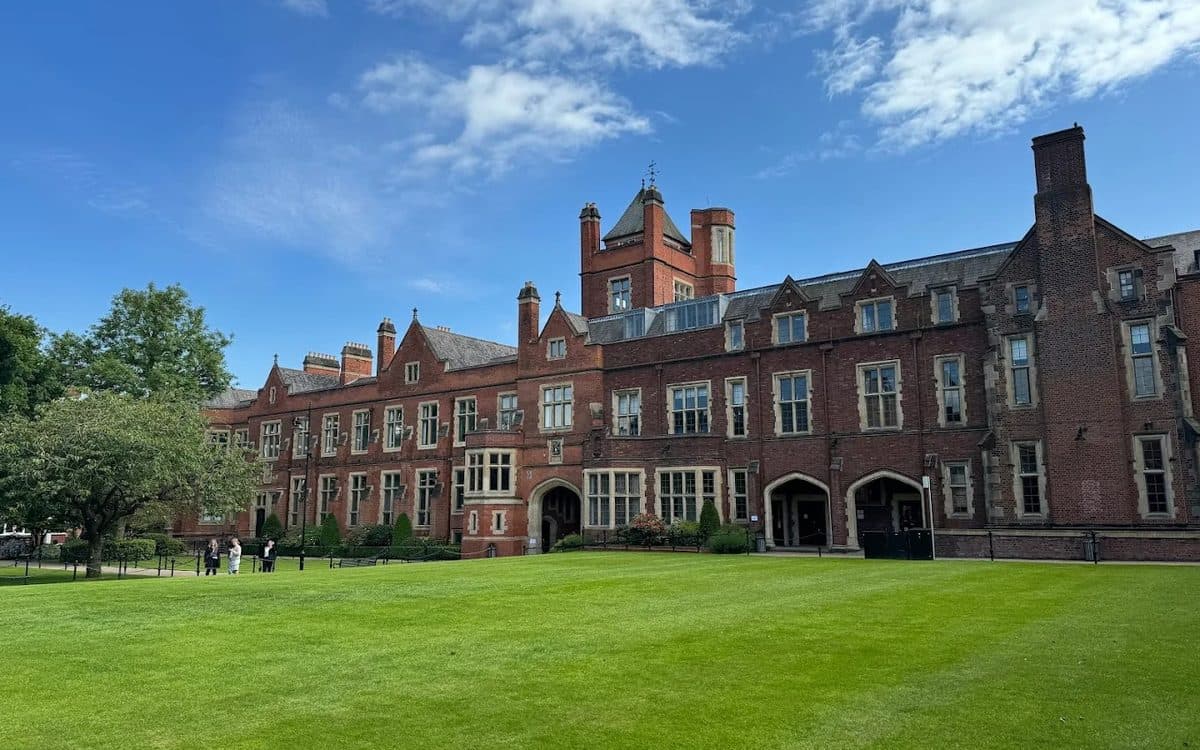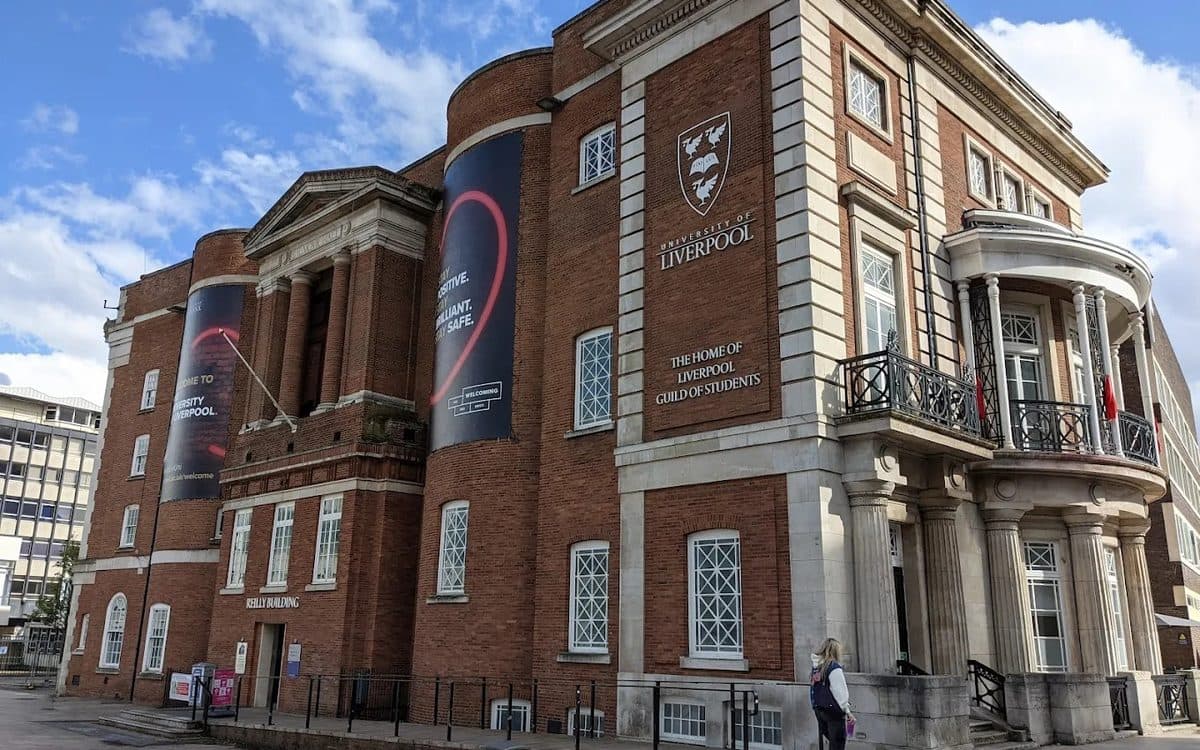
Every time somebody says "red brick university", they are describing this building. The phrase was coined by Edgar Allison Peers, Professor of Spanish at Liverpool from 1922 to 1952, writing under the pen name Bruce Truscot in his 1943 book *Redbrick University* — and the walls he had in mind were the Victoria Building, Alfred Waterhouse's Gothic pile of ordinary brick and terracotta dressings, opened by Lord Spencer on 13 December 1892. It was estimated at £35,000 and came in at £53,000. The University of Liverpool still signs off its own website with two words: *The Original Redbrick*.
It began in 1881 as University College, Liverpool; the Liverpool merchant William Rathbone VI helped raise the first £80,000, and the college opened in 1882 to 45 students in a converted asylum on Ashton Street. The Royal Charter came in 1903. Liverpool's own history page counts nine Nobel laureates associated with the University — and one of them matters more to an Indian reader than any ranking. Har Gobind Khorana was the son of a *patwari*, a village agricultural taxation clerk, in Raipur in Punjab. In the Nobel Foundation's own words, he "lived in India until 1945, when the award of a Government of India Fellowship made it possible for him to go to England and he studied for a Ph.D. degree at the University of Liverpool." He won the Nobel Prize in Physiology or Medicine in 1968 for helping to crack the genetic code.
For Indian families weighing where to study in the UK, Liverpool poses a specific question: *could a mid-table Russell Group university in one of Britain's cheapest big cities be a smarter bet than a higher-ranked name that strains the family budget?* This guide answers exactly that — how to study at University of Liverpool as an international student, what it actually costs in 2026/27, and where the marketing and the evidence part company.
The University of Liverpool at a Glance
Two of those numbers deserve a second look. Liverpool has climbed more than 50 places in QS over the last four years — 139th in the 2027 table, 20th in the Russell Group and 22nd of the 90 UK universities listed — and 11 of its subjects sit in the UK top ten. It is a university on the way up rather than one coasting on Victorian prestige.
A correction worth making early. The Liverpool School of Tropical Medicine is not a department of the University of Liverpool, whatever a dozen study-abroad guides tell you. LSTM was founded in 1898 — by its own account the first institution in the world dedicated to research and teaching in tropical medicine — and although it leaned on University College's facilities in its early decades, it was awarded higher education institution status in 2013 and its own degree-awarding powers in 2017. Separate governance, separate website, separate admissions. If tropical medicine or global health is your field, you apply to LSTM directly, not through the University. One genuine overlap: Sir Ronald Ross, who joined LSTM in 1899 and won the 1902 Nobel Prize, appears on the University's list of nine laureates — and he made the discovery it recognised in India, in the Indian Medical Service, before he ever came to Liverpool.
What Can You Study at Liverpool?
Liverpool is a broad research university, but its genuine peaks are narrower and more specific than its overall rank suggests. Four areas stand out.
1. Veterinary Science — the strongest thing here
This is Liverpool's best subject by some distance. Veterinary Medicine ranks 2nd in the UK in the Times and Sunday Times Good University Guide 2026, the school reports being the 1st ranked veterinary school in the Sunday Times Rankings 2025 and 11th in the world in the QS World University Rankings by Subject 2024, and it was the top return for four-star overall research in the Agriculture, Food and Veterinary Sciences unit in REF 2021. Teaching runs across the city campus and the Leahurst campus on the Wirral, which houses equine facilities and a Small Animal Teaching Hospital. Animal Science ranks 5th in the UK alongside it.
2. Medicine, Dentistry and the Health Professions
The School of Medicine describes itself as one of the largest medical education providers in the UK, with 250 expert clinicians and more than 15 specialist clinical sites. Medicine climbed to 14th in the UK in the Guardian 2026 from 27th the year before. Around it sits an unusually deep allied-health cluster: Dentistry 6th, Physiotherapy 6th and Radiography 5th in the UK (Times and Sunday Times 2026), with Nursing and Midwifery, Medical Technology and Bioengineering, and Counselling, Psychotherapy and Occupational Therapy also in the Complete University Guide 2027's national top ten.
3. Architecture — the UK's first
The Liverpool School of Architecture was established in 1894 and was the first UK university to award a RIBA-validated degree in the subject. It ranks 10th in the UK (Guardian 2026) and in the world's top 150 (QS World University Rankings by Subject 2026). A £23 million new-build addition of more than 2,000 square metres, designed by Dublin practice O'Donnell + Tuomey, is expected to complete in 2026. Town and Country Planning and Landscape also sits 10th nationally.
4. Management School and Computer Science
The University of Liverpool Management School holds the full triple accreditation — AACSB, AMBA and EQUIS — which it describes, fairly, as the gold standard. Accounting and Finance ranks 8th in the UK (Times and Sunday Times 2026) and 9th in the Guardian 2026, and Marketing sits in the Complete University Guide 2027's top ten. On the computing side, the School of Computer Science and Informatics runs nine research groups from the Ashton Building, and Physics jumped to 10th in the UK in the Guardian 2026 from 25th — one of the sharpest single-year rises in that table.
Most Popular Courses for Indian Students: MSc Computer Science, MSc Data Science and Artificial Intelligence, MSc Business Analytics and Big Data, MSc Finance, MSc International Business, Master in Management, MSc Accounting and Finance, the Liverpool MBA, and undergraduate Computer Science and Business Management.
Entry Requirements for International Students
Undergraduate — Class XII Is Accepted Directly
- Class XII range: roughly 70% to 85%, depending on the course and your exam board, calculated from your best four core subjects including English.
- The published anchor: AAA at A-Level = 85% from four core subjects, with a minimum of 70% in English. Work backwards from your course's A-Level offer to estimate your target.
- Excluded subjects matter more here than at most universities. Liverpool will not count Physical Education, Painting, Fashion Studies, Home Science, Dance, Fine Arts and Music (unless directly relevant), Work Education, General Studies, Yoga, Entrepreneurship, Cookery, Hospitality and Tourism, or local and regional languages towards your four.
- Subject grades count: BSc Computer Science asks AAB to include Mathematics or Computer Science — and explicitly does not accept A-Level IT.
- Medicine (A100) is a different exam altogether: 85% overall from four core subjects, 80% in Chemistry, 80% in one of Biology, Physics or Mathematics, and 75% in English (Hindi, regional languages, Environmental Education and PE excluded), plus the UCAT — or the GAMSAT if you already hold a degree. Deferred entry is not considered for international places.
- Foundation route: the University of Liverpool International College, run with Kaplan, offers Foundation Certificates from £22,640 (Business, Law and Social Sciences) and £24,250 (Science and Engineering) for 2026/27. Kaplan reports that 98% of students who passed at the required level received an unconditional offer from the University in 2025.
Postgraduate — Liverpool Quietly Lowered the Bar
This is the single most useful thing in this guide, and almost no Indian site reports it. Liverpool's own course pages carry a one-line notice: "The entry requirements for most postgraduate taught courses were updated from 2:1 to 2:2 in May 2024." A 2:2 is the UK's lower second class. For an Indian graduate whose percentage sits in the 55–60% band, that changes what is realistically achievable at a Russell Group university.
- Three-year Indian bachelor's degrees are accepted. The requirement is 55%, or a CGPA of 5.5/10, 4.5/8.0, 3.0/5.0 or 2.5/4.0, from a recognised institution. Bachelor of Vocation degrees are assessed case by case.
- Some courses still ask for more — check the individual course page rather than assuming the 55% floor applies to you.
- First Class equivalence, which unlocks the biggest scholarship: 78% for BTech, BEng or BE; 75% for BSc, BCom, BBA or BMS; 70% for BA. These are the thresholds that put you in line for the £7,000 award.
- No published institution tiers. Unlike Southampton, Liverpool does not band Indian universities into tiers with different percentage requirements. It sets thresholds by degree type instead — which is simpler, and means a graduate of a lesser-known college is not automatically penalised.
- PhD: a master's with strong results — a First Class or 60%-plus — plus a research proposal.
- Pre-Master's route: available through the International College for graduates who fall short, from £24,180 to £25,780 for 2026/27, with guaranteed progression on successful completion.
English Language Requirements
- IELTS 6.0, nothing below 5.5: BSc Computer Science. Genuinely low for a Russell Group computing degree, and worth knowing.
- IELTS 6.5, nothing below 5.5 or 6.0: most undergraduate humanities, Law, Economics, and the great majority of taught master's including MSc Computer Science, MSc Finance, MSc International Business and the MBA.
- IELTS 7.0, nothing below 6.5: BSc Psychology.
- IELTS 7.0 with no component below 7.0: Veterinary Science and Medicine. That is the ceiling — no Liverpool course requires more.
- Beyond IELTS, on the 6.5 band: TOEFL iBT 88 if you sat it on or before 20 January 2026, or 4.5 overall with 4 or above in every component on the new scale introduced on 21 January 2026; PTE Academic 61, nothing below 59; and Duolingo 125, with speaking, reading and writing at 105 and listening at 100. TOEFL Home Edition is not accepted. Check which TOEFL scale your test date falls under before you book.
- Class XII English can replace IELTS — but only from some boards. Liverpool accepts 75% or above from CBSE or CISCE, and 80% or above from an accepted State Board, provided you were taught in English medium. NIOS and the State Boards of Punjab, Haryana, Gujarat, Uttar Pradesh and Uttarakhand are not accepted. If that is your board, book the test.
- Medicine accepts IELTS and nothing else — no TOEFL, no PTE, no Duolingo, no Class XII substitution. If Medicine is your goal, book IELTS from day one.
Tuition Fees and Living Costs for 2026/27
- Undergraduate, band one — £27,000: humanities, social sciences, BSc Economics and LLB Law.
- Undergraduate, band two — £32,000: BSc Computer Science, BA Architecture, BSc Psychology and the laboratory sciences.
- BVSc Veterinary Science — £44,850. MBChB Medicine and Surgery — £50,000 a year.
- Taught master's — £32,000 to £34,000: MSc Finance and MSc International Business at £32,000; MSc Computer Science and MSc Data Science and Artificial Intelligence at £34,000 (£17,000 part-time).
- The Liverpool MBA — £35,500 full-time, £17,750 part-time.
- Year abroad in China at partner XJTLU costs international undergraduates a reduced fee — £16,000 on the Architecture programme, £13,500 on Law.
The fee on your offer letter is year one only. Liverpool raises international tuition annually in line with CPI inflation — the increase applied to continuing international students for 2026/27 was 3.4%. Over a three-year undergraduate degree that adds up to thousands of pounds — build it into your budget from day one and it will never catch you off guard. Add one more line while you are planning: international students starting a full-time taught master's in 2026/27 must pay a tuition deposit, and the University deliberately does not publish a flat figure — Admissions tell you your amount, and it can only be paid through Flywire or CIBC International Student Pay. Putting together a realistic full-course budget is exactly the kind of work our counsellors do with families before they commit — talk to us and we will build yours with you.
Accommodation is where Liverpool starts to look genuinely good value. The University has over 4,500 rooms across Greenbank Student Village and its city-campus residences, and — unusually — charges no accommodation deposit at all. Its own wording: *we no longer request a deposit from students to secure their room*.
- Weekly rents start at £181.93 (Tudor Close, Melville Grove), rising through £197.33 (Crown Place), £204.33 (Dover Court, on 51-week contracts), £216.16 (Vine Court), £219.03 (Greenbank Student Village) to £224.63 (Philharmonic Court).
- What the rent covers: all fuel bills, basic contents insurance, high-speed internet and campus-wide WiFi, council tax exemption, and the Halls Life events programme.
- What it does not: laundry, billed separately at £2.50 a wash and £1.50 a dry for 2026 entry.
- Greenbank sits three miles from campus, served by the dedicated 699 bus — a 15-minute journey in.
- Visa maintenance: UKVI requires £1,171 a month outside London against £1,529 inside it, for up to nine months.
Scholarships for Indian Students
Two corrections before you build a budget. First, the "Vice-Chancellor's International Attainment Scholarship" worth £2,500 — quoted on Indian scholarship-listing site after Indian scholarship-listing site as Liverpool's headline award for postgraduates — appears nowhere in Liverpool's 2026/27 scholarship pages or its scholarship finder. We searched the finder: the words "Vice-Chancellor" do not appear on it, and the only award with "Attainment" in its name is the Liverpool Attainment Scholarship for India. The live scheme is the Liverpool Scholarships family, where the India awards are worth £2,000, £5,000 and £7,000. Anyone planning around £2,500 is quoting a superseded scheme and under-claiming by thousands. Second, several sites list a GREAT Scholarship at Liverpool. Liverpool's own scholarship finder lists no GREAT award — it lists Chevening and Commonwealth, and not GREAT. The Liverpool Scholarships family below is the live scheme to build your plan on — and the India awards in it are automatic.
- 1. Liverpool Achievement Scholarship for India — £5,000
- Liverpool's dedicated India award for 2026/27. A £5,000 tuition discount for Indian nationals starting a full or part-time taught master's or MRes at the Liverpool campus, holding a 2:1 or equivalent and paying their own international fees. No application — it is awarded automatically to everyone who qualifies, confirmed in writing once your results are processed. You must accept your offer and pay your deposit by the advertised deadline.
- 2. Liverpool Excellence Scholarship for Postgraduates — £7,000
- The larger award, for international master's students with a First Class or equivalent undergraduate degree. For Indian graduates that means 78% for BTech/BE, 75% for BSc/BCom/BBA/BMS or 70% for BA. It replaces the £5,000 India award rather than adding to it, so the practical question is whether your percentage clears the First Class line.
- 3. Liverpool Attainment Scholarship for India — £2,000
- The baseline. £2,000 off tuition for any new Indian postgraduate taught student who meets all the conditions of their offer, pays their own fees and accepts by the deadline. Awarded automatically. Pro-rata for part-time study. This is the floor — if you qualify for the £5,000 or £7,000 award, you get that instead.
- 4. Liverpool Subject Scholarships — £2,000, and stackable
- £2,000 for high-achieving applicants from India on five named courses: Master in Management, MSc International Business, MSc Business Analytics and Big Data, MSc Data Science and Artificial Intelligence, and MSc Advanced Data Science and Artificial Intelligence. Crucially, this one can be combined with the Excellence, Achievement or Attainment awards and with early-bird deposit discounts, up to a total of £9,000 — the largest realistic package for an Indian master's applicant at Liverpool.
- 5. Undergraduate and MBA awards — £7,500 and up to 50%
- International undergraduates achieving AAA at A-Level or equivalent can receive the £7,500 Liverpool Excellence Scholarship for Undergraduates. MBA offer holders with four or more years of professional or managerial experience can be considered for the Management School's MBA Excellence Scholarship, worth up to 50% of tuition, for the September 2026 and January 2027 intakes.
- 6. Chevening and Commonwealth
- Liverpool is a Chevening partner university and participates in the Commonwealth Shared Scholarship Scheme. Both are applied for externally rather than through the University, both are fully funded, and both have autumn deadlines the year before you start. There is also a £5,000 Graduate Loyalty Scholarship for international students returning to Liverpool for a master's.
Read the exclusions carefully — they are unusually broad. The India scholarships are closed to you if you previously studied at the University of Liverpool International College or at XJTLU, if you study online, if your fees are sponsored by a government, employer or organisation, or if your programme is a PGCert, Professional Doctorate, MPhil, MArch or PhD. Note also that the £5,000 Liverpool Advancement Scholarship, which some sites list as an open international award, covers Indonesia, Malaysia, Nigeria, Pakistan, South Korea, Thailand, Turkey and Vietnam — India is not on that list. The India-specific awards above are the ones designed for you — build your plan around those.
The Bengaluru Campus — A Second Route to the Same Degree
If you are reading this from Bengaluru, this section may matter more than everything above it. The campus site states plainly that University of Liverpool Bengaluru is now University Grants Commission (UGC) approved, and it appears on the UGC's published register of foreign higher education institutions in India at Alembic City, Kadugodi Road, Whitefield. Teaching begins with the inaugural cohort in September 2026. Of the UK universities on that UGC register — Southampton in Gurugram, Bristol and York in Mumbai — Liverpool's is the only one in South India.
- Undergraduate (3 years, September 2026 start): Computer Science BSc, Computer Science with Software Development BSc, Business Management BA, Accounting and Finance BSc, Biomedical Sciences BSc and Game Design BSc — the last a first for a UK campus in India.
- Postgraduate (1 year): Computer Science MSc and Accounting and Finance MSc.
- Fees are a fraction of the UK figure. Computer Science BSc costs ₹11,50,000 a year for domestic students and ₹13,00,000 for international students (foreign nationals, NRIs and OCIs), against £32,000 a year for the same subject on the Liverpool campus.
- Undergraduate entry: Class XII at a minimum 75% average across four core subjects, or A-Levels at ABB, or IB 32 points. Computer Science additionally wants at least 75% in Mathematics at Class X. English is met by 70% in Standard XII English from CBSE, CISCE or a State Board. There is no separate admission test, but there is a virtual interview and a statement of purpose.
- Postgraduate entry: a recognised bachelor's degree at 55% overall, with 75% in Standard XII English from CBSE, CISCE or Cambridge A Level, plus a statement of purpose.
- Costs beyond tuition: an application fee of ₹2,000, waived until 17 August 2026; a ₹50,000 admission fee and a ₹50,000 security deposit, both payable on offer acceptance and both refundable. Tuition is staged 20% on accepting your offer, 30% before semester one (July–September 2026) and 50% before semester two (January–February 2027).
- Scholarships up to ₹5 lakh a year, merit and need-based, covering academic achievement, financial need, leadership, sport, arts and community work.
- You can still see Liverpool. The campus states that India-based students "may spend a semester at our home campus (included in tuition) or transfer seamlessly for their final year". Get the current terms of that in writing before you build a plan on it.
Liverpool has done this before, and that is the reassuring part. Xi'an Jiaotong-Liverpool University opened in Suzhou in 2006, and its 2+2 programme — two years in China, two in Liverpool, with both an XJTLU and a University of Liverpool degree at the end — has been taken by over 16,000 students. Of the 2022 cohort, 94% went on to postgraduate study and 75% to a QS world top-50 university. One trade-off to know: XJTLU graduates are excluded from Liverpool's India scholarships.
Life in Liverpool — An Honest Picture
Liverpool is a city of roughly 486,100 people on the Mersey, with a genuinely distinctive culture, a compact campus in the Knowledge Quarter and a cost base that makes London look absurd. On the ONS Price Index of Private Rents, the average monthly private rent in Liverpool was £905 in June 2026 — against £961 across the North West, £1,446 across England and £2,302 in London. That is the single strongest argument for studying here. The one caveat: Liverpool rents rose 5.9% in the year to June 2026, faster than the region as a whole.
The most honest thing we can tell you about Liverpool. It is not a South Asian city. In the 2021 Census, 5.7% of Liverpool residents identified as Asian, Asian British or Asian Welsh — up from 4.2% in 2011, but a long way from Manchester's 20.9%, a direct train down the line. And at the time of writing, the Liverpool Guild of Students directory lists a Hindu Society, a Sikh Society, a Sikh Medical Society, an Islamic Society and Pak Soc — but no standalone Indian or Desi society. Compare that with Leeds or Birmingham, where those societies are among the largest on campus. If a big, organised Indian student community is central to how you want to live, weigh this before you accept rather than after you land — knowing it now is what lets you choose with your eyes open. How much it matters is different for every student, and it is exactly the kind of fit question we help families think through — talk to us before you decide.
- What is here: an unusually international student body — more than 7,700 international students, from over 135 countries — and an alumni network of 270,000 across 187 countries, in a city long shaped by shipping and migration.
- Sport: more than 50 organised sports clubs through the University, plus two Premier League football clubs in a city that takes the game more seriously than almost anywhere on earth.
- Getting to Manchester: direct trains run from Liverpool Lime Street throughout the day, which is close enough to treat Manchester's restaurants, temples, gurdwaras and grocers as part of your options rather than a day trip.
- Flying home: Liverpool John Lennon Airport is a short-haul airport with no services to India, so Manchester Airport is your realistic gateway and a Gulf connection your realistic route. Direct Manchester–India services have been launched and withdrawn more than once in recent years — check live schedules for your travel dates rather than trusting any guide, this one included.
- Budget honestly: halls at £182–£225 a week plus the UKVI £1,171-a-month maintenance standard is a realistic frame. Liverpool is cheap by British standards — the savings are real when you plan for the full picture.
Career Outcomes
- 92% of graduates in employment or further study 15 months after graduating.
- 20th in the UK among universities targeted by the largest number of top graduate employers (High Fliers, The Graduate Market in 2026) — a strong result for a university ranked 18th to 22nd academically.
- For the balanced picture: the Complete University Guide 2027 places Liverpool 32nd of 130 for graduate outcomes (78.8/100) and 50th on its "on track" measure (75.9/100) — solidly above average, and worth reading alongside that High Fliers result. It also ranks Liverpool 35th for student satisfaction and 39th for entry standards.
- Careers support runs through the Handshake job board, one-to-one coaching, an International+ programme aimed at international students, and an Enterprise Opportunities strand for founders.
- Liverpool does not publish a median graduate salary, for home or international leavers. Treat any site quoting one for Liverpool with suspicion — we could not find a source for it and have therefore not given a figure.
On the UK Graduate Route, bachelor's and master's graduates can stay and work for 18 months after finishing, and PhD graduates for three years. No job offer, sponsor or salary threshold is required. The duration is set by your *application* date rather than your course dates: two years if you apply on or before 31 December 2026, and 18 months from 1 January 2027 onward. A one-year master's starting in September 2026 finishes in late 2027, so plan on 18 months — and on switching to a Skilled Worker visa if you want to stay longer.
Is Liverpool Right for You?
Liverpool is a strong, unfussy choice if your subject is one of its real strengths — Veterinary Science above all, then Dentistry, Physiotherapy, Architecture, Accounting and Finance, or Computer Science. A Russell Group founding member, TEF Gold, 18th in the UK, 11 subjects in the national top ten, tuition starting at £27,000 rather than £35,000, halls with no deposit, and average city rents at £905 a month against £1,446 across England. Add three automatic India scholarships, a master's entry bar that dropped to a 2:2, and a new Bengaluru campus that lets you take the same degree at Indian prices, and the value case is unusually coherent.
Go in clear-eyed about the trade-offs — knowing them is what lets you choose with confidence. Liverpool is 139th in the world (QS 2027), not top-100, so if the ranking on the certificate is what matters most to you, compare it against Manchester, a direct train down the line. The South Asian community is small by British urban standards, the Guild has no Indian society at present, and the Complete University Guide 2027 puts graduate outcomes at 32nd and entry standards at 39th — good rather than elite. If prestige and a large Indian network on your doorstep top your list, other cities will serve you better — and finding that out now is a head start, not a setback. If you want a serious research university, a specific subject strength and a budget that actually works, Liverpool is one of the best answers in Britain.
Your Liverpool Plan Starts with One Conversation
Liverpool rewards applicants who know the small print — the 2:2 master's threshold that puts a Russell Group degree within reach, the boards whose Class XII English can replace IELTS, and which of the three automatic India scholarships is yours to claim. Falcon Nova Consultants has helped hundreds of Indian students secure places at top UK universities, and we would be glad to map your route — Liverpool campus or Bengaluru. Book your free counselling session — no obligation, just a clear, personal plan for the details that decide Liverpool offers.
Book Your Free Counselling Session