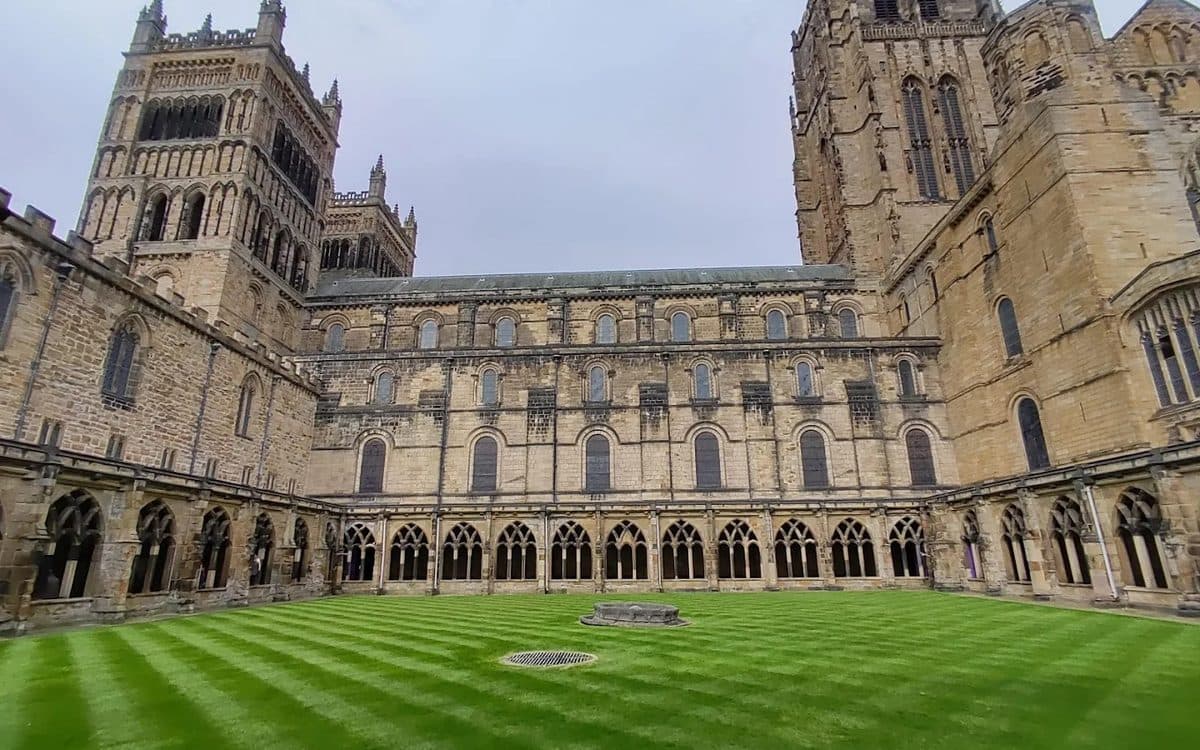
There are very few universities in the world where your college is a Norman castle. Durham's oldest and founding college — University College, known universally as "Castle" — has occupied Durham Castle since 1832, sharing Palace Green with Durham Cathedral. Together the two buildings were inscribed as a UNESCO World Heritage Site in 1986, among the first seven sites in the United Kingdom ever listed.
Durham was established by Act of Parliament in 1832 and received its Royal Charter in 1837 — the first new university founded in England in roughly six hundred years. It is often called England's third-oldest university, though University College London disputes that on the basis of its own 1836 charter, so treat the claim as contested rather than settled.
For Indian students planning to study in the UK, Durham is the natural answer to a specific question: *what if I want the collegiate, historic, highly selective experience of Oxford or Cambridge, but with a realistic chance of getting in?* This guide covers exactly how to study at Durham University as an international student — including the parts other guides get wrong.
Durham University at a Glance
Durham has been a world top-100 university every year since 2010, and its strongest single QS indicator is one that matters directly to you: 49th in the world for employer reputation, up fifteen places in a single year.
The Collegiate System — And How It Differs from Oxbridge
Durham has 17 colleges. Sixteen admit undergraduates; Ustinov College is postgraduate-only. Every student belongs to one, and your college provides your accommodation, dining, social life, sport and pastoral support for the duration of your degree.
The key structural difference from Oxford and Cambridge: at Durham, your academic department admits you, not your college. You receive an offer from the department first, then express college preferences. Colleges are multidisciplinary and none is tied to a subject — and, unlike at Oxbridge, Durham's colleges are not teaching bodies. Your teaching comes entirely from your department. (Two colleges, St Chad's and St John's, are independently governed "Recognised Colleges" with some of their own staff and charges.)
- Formals: every college holds formal dinners, often themed — Burns' Night, Valentine's Day — some gowned, some black tie, alongside college balls and annual College Days.
- JCRs and MCRs: each college has student-run Junior (undergraduate) and Middle (postgraduate) Common Rooms with elected executive committees, which run most of college life.
- College sport is enormous — Durham operates the largest college sport structure in the UK, with somewhere between 550 and 650+ teams across 18 sports, 60+ leagues and over 2,500 matches a year. The Floodlit Cup final at Maiden Castle regularly draws several hundred spectators.
- Beyond college: 80+ music societies and 30+ student-run theatre companies.
What Can You Study at Durham?
Durham placed 22 subjects in the world top 100 in the QS subject rankings 2026 — its best ever result — with three in the top ten and ten in the top fifty.
1. Business — Durham University Business School
DUBS holds the full triple accreditation — AACSB, AMBA and EQUIS — and has done since 2009, placing it in roughly the top 1% of business schools worldwide. Founded as a research unit in 1960 and one of the UK's first business schools in 1965, it became Durham's fourth faculty in 2019 and is currently marking its sixtieth anniversary. Accounting and Finance ranks joint 58th in the world. Departments cover Accounting, Economics, Finance, and Management and Marketing.
2. Law — Durham Law School
Durham Law ranks joint 49th in the world (QS 2026), 3rd in the UK in the Complete University Guide 2026 and 4th in the Guardian 2026. It is also the only undergraduate subject at Durham requiring English Band A (IELTS 7.0) — a fair signal of how competitive it is.
3. Physics & Astronomy
One of the largest physics departments in the UK, ranked joint 67th in the world after rising more than twenty places in a single year. Its home is the Ogden Centre for Fundamental Physics — an £11.5 million building designed by Studio Libeskind and opened in 2016 — which houses the Institute for Computational Cosmology, running supercomputer simulations of the evolution of the universe including dark matter and dark energy, alongside the Centre for Extragalactic Astronomy and the Centre for Advanced Instrumentation.
4. Humanities, Theology & Social Sciences
This is where Durham is genuinely world-leading. Theology and Religion ranks 4th in the world — and 1st in the UK — with Archaeology 5th and Geography 6th. Behind them sit Anthropology (25th), English (26th), Classics and Ancient History (29th), Philosophy (39th), Modern Languages (40th) and History (44th). If your field is in the humanities or social sciences, very few universities anywhere can match this depth.
Most Popular Courses for Indian Students: MSc Finance and its variants, MSc Management, Marketing and International Business at DUBS, the Durham MBA, LLM programmes, MSc Computer Science and Data Science, Engineering, and Economics.
Entry Requirements for International Students
For Undergraduate Study — Class XII Is Accepted Directly
- **A-Level range: AAB to A*A*A** (IB 35–38). AAB for Anthropology, Criminology, Sociology and Music; AAA for Philosophy, Psychology, Politics, Classics and Biological Sciences; A*AA for History, English, Law, Chemistry, Computer Science, Engineering and Natural Sciences; **A*A*A for Physics and Mathematics**.
- Class XII conversion: A*A*A = 89% · A*AA = 87% · AAA = 85% · AAB = 80%.
- How it is calculated: the average of your best four academic subjects, excluding Physical Education.
- Know your board's position early — it is an easy edge. Durham states that CBSE and CISCE are accepted for entry, while State Boards are considered on a case-by-case basis — so if you studied under a State Board, confirm your eligibility with Durham first and you can build the rest of your application with full confidence.
- Foundation route: the Durham University International Study Centre — operated by Study Group rather than in-house — runs an International Foundation Year across three pathways, with Indian entry at 50% minimum and IELTS 5.5, plus a Pre-Masters programme.
For Postgraduate Study
- Three, four and five-year Indian bachelor's degrees are all accepted — the three-year acceptance is genuinely useful, as several UK universities insist on four.
- The requirement is 55% to 65% depending on your institution, benchmarked against a UK 2:1.
- No published tier list. Durham clearly bands institutions — that is what "depending on the institution" means — but it does not publish the list, so there is no public IIT or NIT concession to rely on. Contact Durham's India admissions team early to establish your band — then you can plan around a figure you know is right.
English Language Requirements
- Band B — IELTS 6.5 with nothing below 6.0, or TOEFL iBT 80: most undergraduate subjects, plus Business School, science and engineering master's.
- Band A — IELTS 7.0 with nothing below 6.5, or TOEFL iBT 90: Durham Law School at undergraduate level, and the humanities master's — Archaeology, Classics, English, History, Philosophy, Theology, Modern Languages and Medical Humanities.
- Band A+ adds a specific 7.0 in Writing; Band C is IELTS 6.0.
- Durham's ceiling is IELTS 7.0, not 7.5 — a common error on study-abroad sites. No Durham course requires 7.5.
- Note that TOEFL changed its scoring from 21 January 2026 — check which scale applies to your test date.
Tuition Fees and College Costs
- Undergraduate: £28,000 for Anthropology, Criminology, Politics and Sociology; £28,500 for humanities; £29,250 for Law; £31,500 for Mathematics; £34,500 for laboratory sciences, engineering and psychology; £35,000 for Computer Science.
- Postgraduate taught, outside the Business School: roughly £28,750 to £34,500.
- Business School master's: MSc Economics £29,500 · most MSc programmes (Management, Marketing, HRM, International Business, Supply Chain) £33,500 · Business Analytics £35,000 · the finance and accounting cluster £36,500.
- The Durham MBA: £41,000 full-time, or £17,000 online.
- No clinical premium — Durham has no medical, dental or veterinary school.
Here is the fee insight that puts you ahead — most guides miss it. For 2025/26 entry onwards, the fee Durham publishes is year one only. Fees then rise annually by up to the greater of 6% or CPI, so a three-year Durham degree will cost meaningfully more than three times the headline number. Families who build that into the budget from day one plan with real confidence — it is exactly the kind of calculation our counsellors work through with students, so talk to us before you finalise your numbers.
On college costs — good news, and a common misconception. Unlike Oxford and Cambridge, Durham charges no separate college fee. Your college charge *is* your accommodation charge, and it includes utilities, broadband, basic room insurance and 24-hour security. Only optional extras cost more, such as common-room memberships and sports teams.
- Undergraduate, 39-week contract: roughly £6,600–£11,900 self-catered, or £9,500–£12,250 catered. The catering component works out at about £107 a week for 21 meals — roughly £5.10 per meal, which is hard to beat.
- Postgraduate, 50-week contract: roughly £8,000–£15,900 self-catered, or £11,200–£15,400 catered.
- Do not compare the two directly — postgraduate contracts run 50 weeks against 39 for undergraduates, which is why they look so much more expensive.
- Pricing is uniform across colleges for the same room type and contract length, except at St Chad's and St John's, which set their own.
- Deposit: international taught postgraduates pay a £2,000 tuition deposit once the offer is unconditional, due by 31 July — no CAS is issued without it. There is no undergraduate deposit.
Scholarships for Indian Students
Two clarifications that will save you weeks of wasted effort. First, the "Vice-Chancellor's Scholarship for India" worth around £5,000 does not exist — it appears on numerous Indian aggregator sites with no scheme page, no application route and no presence in Durham's official scholarship tables. Nor can it be "stacked" with Inspiring Excellence, which explicitly disqualifies anyone holding another award. Second, Durham's GREAT Scholarships cover France, Ghana and Mexico only, so they do not form part of an Indian applicant's plan. Knowing this up front means every hour you spend on funding goes into the genuine awards below.
- 1. Durham Inspiring Excellence Scholarships — £5,000 or £10,000
- Durham's flagship international award. For taught postgraduates it is a one-off £5,000 or £10,000 tuition discount — but for undergraduates it is awarded per year, meaning up to £15,000 or £30,000 across a three-year degree. You must hold overseas fee status, be self-funded, and not hold any other scholarship. The MBA, MSW and MA Theology and Ministry are excluded at postgraduate level.
- 2. Business School Masters Achievement Scholarships — up to £12,500
- Up to 100 awards, with automatic consideration for offer holders — up to £12,500 for students from developing countries and up to £10,000 for others. MSc Business Analytics and MSc Law and Finance are excluded, and it cannot be combined with Inspiring Excellence, so compare the two before accepting either.
- 3. MBA Scholarships — up to £20,500
- The Executive Dean's Scholarship is worth £20,500, a full 50% of the £41,000 MBA fee. There is also an Executive Dean's Women in Business award at £20,000 and Achievement Scholarships up to £18,000. The online MBA has an equivalent set, with the Executive Dean's award at £17,000 — again 50% of tuition.
- 4. Commonwealth Scholarships
- India is eligible for both schemes. The Commonwealth Master's Scholarship covers full fees, return airfare and a monthly stipend of around £1,452 — but you cannot apply directly, and must be nominated through India's Ministry of Education, External Scholarships Division. Durham also participates in Commonwealth Shared Scholarships across four named courses in conflict prevention, defence and diplomacy, and climate risk. Note the CSC does not fund MBA programmes.
- 5. Chevening Scholarships
- Durham is a Chevening partner and additionally holds ten Chevening Partnership Awards, covering full tuition, a living allowance and return economy airfare for a one-year taught master's. Applications go through Chevening directly, with a deadline in the autumn before your intake.
- 6. Alumni Fee Scholarship — 10%
- An automatic 10% tuition discount for Durham graduates returning for a taught master's, PGCE, MBA or research degree, for self-funding students.
Worth knowing: Durham's eye-catching £50,000 Engineers and Scientists in Business Fellowship requires UK citizenship and is not open to Indian students, despite being widely quoted in study-abroad content. Among external Indian funders, note that the Inlaks Shivdasani Foundation excludes Business, Computer Science, Engineering and Medicine — which rules out most of Durham's popular master's programmes — one more reason to make the Durham-administered awards above the backbone of your funding plan.
Life in Durham — An Honest Picture
Durham is a small cathedral city on a loop of the River Wear, with over 630 listed buildings and a city parish population of only about 23,000 people. The university dominates it. That is exactly what many students love — it is beautiful, walkable, safe-feeling and intensely social, with college life at its centre. It is emphatically not a metropolis, though — and knowing that early is an advantage, because Durham is at its best for students who choose it for exactly what it is.
The most honest thing we can tell you about Durham. The Asian and Asian British population of County Durham is around 1.5%, against 11.4% in Newcastle and 9.6% across England. Durham states that just over 400 of its 21,588 students come from across Central and South Asia. There is a real and active Indian community here — but it is small. There is no Hindu mandir in the city (the Hindu Society runs trips to the Newcastle temple), and no dedicated South Asian supermarket, though the Durham Halal Superstore on Damson Way stocks South Asian and halal ingredients. Durham's own Indian restaurant scene is small, and Newcastle — twelve minutes up the railway line — has many times more. For many students that is a perfectly good answer: the train puts Newcastle's larger community, restaurants and temple within easy reach of college life. Weighing how much this matters for you and your family is exactly the kind of conversation to have before you decide — talk to us and we will think it through with you, honestly.
- Societies: the Students' Union hosts an Indian Society, a Desi Society, a Durham Hindu Society, a Tamil Society, a Pakistan Society, a British-Asian Society, an Asian Society, a Bollywood Dance society and an Islamic Society.
- Restaurants worth knowing: Shaheen's Indian on North Bailey has been running for over thirty years and is walking distance from the Bailey colleges; Spice Lounge is the other established option.
- Living costs are well below London. The clearest official comparison is the UKVI maintenance requirement: £1,171 a month outside London against £1,529 inside it — about 31% higher in London on the government's own measure. Durham quotes unlimited day bus travel at £1.50 and a meal out at £5–10 with a student discount.
- Transport is genuinely excellent for a small city. Durham sits on the East Coast Main Line: London in 2 hours 37 minutes direct, Edinburgh in 1 hour 41, and Newcastle in 12 minutes.
- Flying home: Newcastle International is about an hour door-to-gate. There are no direct flights to India, but Emirates flies Newcastle to Dubai daily, connecting onward to Delhi, Mumbai and Bengaluru.
On safety, the evidence is genuinely mixed and we would rather say so. Police data for a one-mile radius of the city centre in early 2026 recorded 873 crimes in Durham, against 1,884 in York, 1,935 in Exeter and 2,368 in Newcastle — a favourable comparison. But the Complete University Guide's student-postcode crime measure places Durham mid-table, around 82nd of roughly 130 institutions. Ignore any site claiming Durham is the "9th safest student city" — that figure comes from a study published in 2015.
Career Outcomes
- 49th in the world for employer reputation (QS 2027), up fifteen places — Durham's strongest global indicator.
- 14th in the UK among universities targeted by the largest number of top graduate employers (High Fliers, The Graduate Market in 2026). For context, that places Durham above Oxford at 18th and just behind Cambridge at 12th — though it is down from 10th the previous year.
- 88% of graduates in work or further study 15 months after graduating (Graduate Outcomes 2026, covering 2023-24 leavers).
- **£35,000 median starting salary for Durham's *international* graduates** in a graduate-level role — a rare figure to find published, and directly relevant to you.
- Joint runner-up for University of the Year for Graduate Employment, Times and Sunday Times 2026.
- Over 230,000 alumni worldwide.
Durham runs sector-specific Careers Weeks each October — Law, STEM, and Business, Finance and Consulting — which are the main on-campus recruitment moments of the year. Durham graduates go into law, science, business, finance, government and politics, and journalism. One insider note that protects you: Durham does not publish careers-fair attendee lists, so treat any guide that names specific firms as Durham recruiters with scepticism — those claims are rarely sourced. Where we name recruiters for other universities in this series, the names come from that university's own careers service.
On the UK Graduate Route, bachelor's and master's graduates get 18 months to live and work in the UK, and PhD graduates three years. The duration is set by your *application* date: two years if you apply on or before 31 December 2026, and 18 months from 1 January 2027 onward. In practice, if you start a one-year master's in September 2026 you will graduate in late 2027 and apply then — so plan on 18 months, not two years. Knowing the real timeline from day one means you can begin your job search early and make every month count.
Is Durham Right for You?
Durham is the strongest choice on this list if you want prestige and tradition without Oxbridge's admission odds. Third in the UK, University of the Year 2026, 31 of 32 subjects in the national top ten, a castle for a college, and a top-50 world employer reputation — that is a formidable package. It is outstanding for business, law, physics and the humanities, and the fact that it takes Class XII directly for undergraduate entry makes it far more accessible to Indian students than many realise.
Go in with a clear-eyed view of the trade-offs: Durham is a small city with a small South Asian community, there is no India-specific scholarship, and the annual fee escalation means your costs will climb each year — all of it entirely plannable once you know it. If you want a large Indian community and a big-city job market on your doorstep, compare Durham against Manchester or Queen Mary. If what you want is the collegiate experience and the name, very little else in England comes close.
Ready to Build Your Durham Application?
Durham rewards students who get the details right early — the right Class XII subject average, confirmation that your board is accepted, an early read on your institutional band, and a budget built on the true multi-year cost. Those are exactly the details we check with you, in a single conversation. Falcon Nova Consultants has helped hundreds of Indian students secure places at top UK universities, and we would be glad to help you map your route to a Durham offer — course shortlist, scholarship strategy and timeline included. Book your free, no-obligation counselling session and start your Durham plan with people who know the details that decide it.
Book Your Free Counselling Session