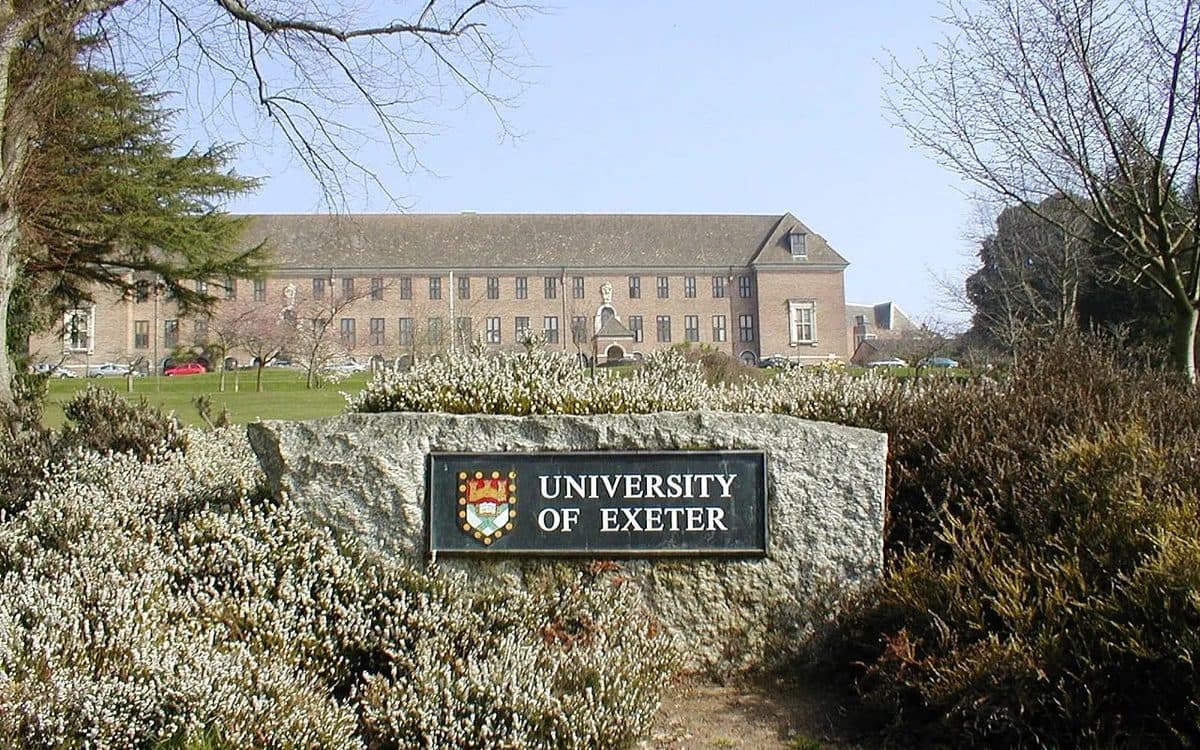
When Carbon Brief published its ranking of the world's most-cited climate scientists in July 2026, four of the global top 100 worked at the University of Exeter — more top-100 researchers than any other university on earth. Professor Pierre Friedlingstein came 9th, Professor Neil Adger 24th, Professor Stephen Sitch 31st and Professor Peter Cox 71st. Ten Exeter names sit in the top 500, three of them holding joint appointments with the UK Met Office, whose headquarters is in the same city. On Carbon Brief's IPCC-only list, Exeter has two researchers in the world's top ten.
That is not an accident of geography. Exeter received its Royal Charter on 21 December 1955 and joined the Russell Group only in 2012, making it one of the newest members of that group of 24 research-intensive universities — and its trajectory since has been steep. Exeter's world-leading research impact grew by 72% between 2014 and 2021, more than any other Russell Group university. It holds Gold in the Teaching Excellence Framework (2023) and ranks first in the Russell Group for world-leading research in Sport Science and in Theology and Religious Studies.
For Indian students planning to study in the UK, Exeter also poses a question almost no other UK university does: *which campus?* Your degree may be taught in Devon, or 100 miles away in Cornwall on a site shared with a different institution. This guide covers how to study at the University of Exeter as an international student — the campus split, what it actually costs, the two India-specific scholarships, the board rule most summaries get wrong, and the enrolment number Exeter publishes but nobody quotes.
The University of Exeter at a Glance
Read those first three rows carefully, because they disagree — 11th, 14th and 17th across the three main UK tables. Anyone telling you Exeter is simply "top 10" has picked the table that suits them. The honest summary is that Exeter sits reliably in the UK top 20 and usually the top 15, and that its world ranking (#136 in QS 2027) trails its domestic one, as it does for most research-strong universities outside the largest cities.
Three Campuses — And Which One You Get Is Decided by Your Course
This is the most important structural fact about Exeter, and the one most often glossed over. The university runs three campuses, and you do not choose between them: your programme decides. Two are in the city of Exeter, in Devon. The third is in Cornwall, roughly a two-hour drive away.
Where the students actually are (2025/26): Streatham 22,849 · St Luke's 4,295 · Penryn 2,632. Streatham is the main campus — a Registered Botanic Garden of lakes and parkland fifteen minutes' walk from the city centre, which The Times called the best-gardened campus in Britain. Its hub, The Forum, holds the library, student services and a 400-seat lecture theatre. St Luke's, across the city centre, houses Sport and Health Sciences, the Medical School and the Academy of Nursing — with medical students spending part of years 3 to 5 at the Knowledge Spa in Truro, Cornwall.
- Penryn Campus, Cornwall sits on 100 acres above the Fal estuary near Falmouth, and is shared with Falmouth University — roughly 6,000 students from two universities on one site.
- What is taught there: environment and sustainability, ecology and conservation, geology and mining through the Camborne School of Mines, renewable energy engineering, and some law and business. It holds the £30 million Environment and Sustainability Institute and the £12 million Stella Turk Building.
- Getting there: Penryn station is a 15-minute walk; Exeter is about two hours by road. This is genuinely rural Cornwall — beautiful, close-knit, a long way from a large city.
- Some subjects run on more than one campus with different syllabuses — Law is offered at both Streatham and Penryn. Exeter warns applicants about this explicitly.
- One point worth knowing before you budget: Cornwall is not the cheap option. The cheapest self-catered room at Penryn is £149.66 a week, against £124.74 in Exeter — build your budget around the right number from day one.
And a fourth campus that does not exist: Exeter has no campus in India. That is worth saying because several UK universities now do. Southampton opened first, in Gurugram; the University of Liverpool has UGC approval for a campus at Alembic City, Whitefield, Bengaluru, taking its first cohort in 2026; York Mumbai opens in September 2026. Exeter has no India campus, branch or announced UGC application — nothing on its own site, its India pages or its news archive. An Exeter degree means living in Devon or Cornwall for all of it. If a UK degree at Indian living costs belongs on your shortlist, read our Liverpool guide alongside this one.
None of this is a criticism. Penryn is an outstanding place to study environmental science, and Exeter is a genuinely lovely small city. But check the campus line on your programme page before you apply, not after you have an offer.
What Can You Study at Exeter?
1. University of Exeter Business School
Exeter's Business School holds the full triple crown — AACSB, EQUIS and AMBA — held by around 1% of business schools worldwide, and retained when its AACSB accreditation was extended for a further six years. It ranks 8th in the UK for Business and Management Studies (Complete University Guide 2027), and placed 7th in the UK in the QS International Trade Rankings 2026, with MSc International Business 20th in the world.
The One Planet MBA is the signature programme and deliberately unusual: built around sustainability, ranked 1st in the UK and 10th globally in Corporate Knights' Better World MBA ranking, twelve months full time and in person, £34,500 for 2026/27, and requiring three years' managerial experience minimum (GMAT welcome, not required). Note that it is excluded from the £7,500 India postgraduate scholarship — but it runs its own Better World Scholarship, worth up to a further 10% off tuition for outstanding applicants, which is the award to ask about instead.
2. Climate, Environment and Sustainability
This is where Exeter is world-class rather than merely strong. Beyond the Carbon Brief result, the university states it is joint 20th globally for its work towards the UN Sustainable Development Goals, and its Global Systems Institute concentrates climate risk and adaptation research in one place. The joint appointments with the Met Office — Richard Betts, Peter Stott and Adam Scaife among them — mean researchers here work alongside the people producing the UK's national climate projections.
3. Camborne School of Mines and Geology (Penryn)
Exeter runs the UK's mining school, and it is not a small operation. Camborne School of Mines is 2nd in the UK and inside the world's top 30 for Mineral and Mining Engineering (QS World University Subject Rankings 2026), sitting within the £100 million Penryn campus with £2 million analytical mineralogy laboratories and an automated QEMSCAN electron microscope. Geology ranks 6th in the UK (Times and Sunday Times Good University Guide 2026) and 8th in the Complete University Guide 2027.
The master's portfolio is hard to find elsewhere: MSc Mining Engineering (£28,900 for 2026/27), Minerals Processing, Mining Environmental Management, Exploration and Mining Geology, and Geotechnical Engineering. For Indian students targeting mining, metals or exploration careers, this is one of the strongest destinations in the world — and one of the least crowded.
4. Sport and Health Sciences, and Medicine (St Luke's)
Exeter is 1st in the Russell Group for world-leading research in Sport Science on the REF 2021 results, and the department sits at St Luke's alongside the Medical School and the Academy of Nursing. BMBS Medicine is open to international students but is by far the most expensive course at Exeter — £48,900 a year, with placements split between Exeter and Truro in years 3 to 5, and it is excluded from the India undergraduate scholarship.
5. Law and the Humanities
Exeter Law School ranks 14th in the UK (Complete University Guide 2026) and inside the UK top 10 for Law graduate prospects in the same table, with its research top 20 nationally on 4* output in REF 2021. Law is taught at both Streatham and Penryn. Exeter is also 1st in the Russell Group for world-leading research in Theology and Religious Studies.
The Exeter programmes Indian applicants ask us about most: the Business School master's cluster — MSc Finance, Financial Technology, Investment Banking, Business Analytics, International Business, Management and Accounting — plus MSc Data Science, engineering and computer science, the LLM programmes, and Camborne School of Mines. Exeter publishes that more than 850 students from India currently study across its three campuses.
Entry Requirements for International Students
Undergraduate — Class XII Is Accepted, and the Board Rule Is Worth Reading Twice
Get this rule the right way round — it is easy to invert, and inverting it costs Karnataka students five percentage points they do not owe. Exeter lists the Indian qualifications it accepts, then sets one aggregate for the entire list: 80%, with a single exception at 70% for the West Bengal Board Standard XII. The list includes ICSE/CBSE, Maharashtra Junior Year, the National Institute of Open Schooling and ten named State Boards: West Bengal, Karnataka, Delhi Board of Senior Secondary Education, Tamil Nadu, Andhra Pradesh, Kerala, Goa, Gujarat, Mizoram and Jammu & Kashmir. The **85% figure applies only to boards Exeter does *not* name — what it calls "other regional board Standard XII exams", considered on an individual basis. If you are sitting Karnataka PUC in Bangalore, your floor is 80%, exactly the same as a CBSE student's. If your board is not on the list, plan on 85%** and confirm it with india@exeter.ac.uk before you build an application around it.
- Maharashtra is narrower than it looks. Exeter accepts Maharashtra Junior Year from nine named centres only — Pune, Mumbai, Chhatrapati Sambhajinagar, Nasik, Kolhapur, Amravati, Latur, Nagpur and Ratnagiri.
- Boards Exeter does not name need about 85%, assessed individually. Telangana, Rajasthan, Uttar Pradesh, Bihar, Madhya Pradesh, Punjab, Haryana, Odisha and Assam are among them.
- One caveat on the source itself: Exeter marks "State Boards" with an asterisk it never defines. Where five percentage points are at stake, ask the India office to confirm your board in writing rather than relying on our reading or anyone else's.
- No published conversion table. Unlike Durham or Leeds, Exeter does not map individual A-Level offers onto Class XII percentages — its international qualifications page carries IB equivalencies only (A*AA = IB 38, AAA = IB 36, AAB = IB 34). The figures above are floors for the least competitive courses; a programme asking A*AA will want considerably more, plus strong Maths and Physics marks in the sciences.
- Foundation route: the University of Exeter International Study Centre, run by INTO University Partnerships on Streatham Campus, offers an International Foundation (£16,950–£21,250 for 2026/27), an International Year One (£24,250–£24,950) and a Pre-Master's (£19,950). ISC Foundation progressors are not eligible for the India undergraduate scholarship.
Postgraduate — And the Question Exeter Does Not Answer Publicly
- The published requirement is a degree class, not a degree length: a relevant bachelor's equivalent to a UK second-class honours, 2:1 or 2:2, with a 2:2 as the general minimum and a 2:1 needed for the main funding bodies. Nothing on Exeter's site explicitly accepts or rejects a three-year Indian bachelor's, so we will not claim it does either.
- There is no published Indian tier list and no published percentage — unlike Southampton, which bands Indian universities into tiers, or Leeds and Nottingham, which publish tables. There is no public IIT or NIT concession to plan around.
- So get it in writing — this is where prepared applicants pull ahead. Email india@exeter.ac.uk with your institution, your degree length and your aggregate before you apply — Exeter staffs a dedicated India team across Delhi and Mumbai, and points applicants to ECCTIS for formal qualification comparison. And if you fall just short, there is still a route in: a Graduate Diploma at its International Study Centre. Getting this confirmation right is exactly the kind of thing our counsellors can help you with — talk to us before you assume a number.
- Doctoral study: a relevant master's degree supported by a strong research proposal.
English Language Requirements
- Exeter uses lettered Profiles A to G, attached to each programme, rather than one university-wide score.
- The common band is IELTS 6.5. Profile B1 is 6.5 with nothing below 5.5 (TOEFL iBT 90, PTE 67); B2 is 6.5 with nothing below 6.0 (TOEFL iBT 90 with 21 in each, PTE 67 with 64); B3 is 6.5 with 6.0 in writing.
- Profile A is the floor at IELTS 6.0 (TOEFL iBT 87, PTE 64). Profiles E and F are IELTS 7.0 — E needs 6.5 in writing, F needs 6.5 in every section (TOEFL iBT 100, PTE 70).
- Profile G is Exeter's ceiling: IELTS 7.5, with 7.0 in speaking and listening (TOEFL iBT 110, PTE 75). It covers only the most demanding programmes — do not treat 7.5 as a general Exeter requirement, as several study-abroad sites imply. MSc Data Science, to take one example, sits at Profile B1.
- TOEFL iBT changed its scoring on 21 January 2026 and Exeter publishes both scales — Profile B2 is 90 on the old scale and 4.5 on the new one. Scores are valid for two years before your start date.
- Undergraduate applicants must also meet Exeter's standard GCSE English Language requirement.
Tuition Fees and Living Costs for 2026/27
- Accounting, Finance, Business and Management, Economics, Marketing: £24,900 — Exeter's cheapest band, and, unusually, marginally cheaper than humanities.
- Arts, Humanities and Social Sciences, including Law: £24,950 · Flexible Combined Honours: £25,750.
- Sport and Health Sciences: £29,900 · Mathematics and Statistics: £30,100.
- Computer Science, Engineering, Physics, Geology, Mining, Natural Sciences: £31,200, as are Biosciences, Biomedical Sciences, Ecology and Conservation, Geography, Medical Imaging, Nursing, Neuroscience and Psychology.
- BMBS Medicine: £48,900 — in a different universe from everything else.
- A year abroad or a year in industry is charged at a discount — roughly 15% of the maximum fee for a full year studying abroad, 20% for a full year on placement. On a £31,200 course that is a meaningful saving in year three.
Taught master's fees are set per programme rather than by band. For 2026/27 they run from roughly £25,550 (MA English Literary Studies) through £28,900 (MSc Mining Engineering), £30,300 (MSc Data Science) and £31,000 (MSc Business and Management) to £35,000 (MSc Finance, plus a further £7,000 for the with-industrial-experience year), with the One Planet MBA at £34,500. The spread inside the Business School alone is nearly £10,000, so check your own programme page. As of August 2026, Exeter had not yet set its fees for 2027 entry.
Two costs to build into your plan from the start — families who see them early stay firmly in control. First, Exeter's stated policy is to increase tuition fees in every year of study, in line with Consumer Price Inflation — so the number on your undergraduate offer covers year one only, and a three-year degree costs more than three times it. Exeter's own pages even disagree on which month CPI is measured in, which is reason enough to ask for your projected total in writing. Second, taught master's offer-holders must pay a £2,500 tuition fee deposit, and no CAS is issued until it clears. Deadlines are staged by offer date — 1 April 2026 for offers made between September 2025 and 31 January 2026, 1 July 2026 for offers made from 1 February to 31 May 2026. Payments take up to ten working days to clear plus five more to reach UKVI systems, and Exeter issues only one CAS statement, so pay any extra advance tuition at the same time as the deposit. Sequencing the deposit, CAS and visa correctly is exactly the kind of timeline our counsellors can map out with you — talk to us before your deadline window opens.
- University accommodation in Exeter, 2026/27: self-catered £124.74–£272.37 a week; catered £215.04–£341.74 a week. In whole-contract terms that is £5,470.74 for 44 weeks at the cheapest end and £10,789.22 for 32 catered weeks at Holland Hall.
- Penryn, Cornwall: Glasney Student Village self-catered £149.66–£199.50, catered £208.18–£258.02, both with a £300 deposit; The Sidings, a 15-minute walk away, £196.81–£232.54 with a £150 deposit.
- Contract lengths differ sharply — catered residences run 32 weeks, self-catered 40 to 48 weeks for undergraduates and 40 to 51 weeks for postgraduates. Compare weekly rates, then multiply by *your* contract length.
- Visa maintenance: Exeter quotes the UKVI figure directly — £1,171 a month for 9 months, a minimum of £10,539 held in your account, against £1,529 a month inside London.
- Master's tuition is normally payable in two 50% instalments, in November and January.
Scholarships for Indian Students
Three corrections that will save you time before you build a funding plan. First, there is no GREAT Scholarship for Indian students at Exeter. The most recent GREAT award Exeter ran — three £10,000 scholarships for January 2026 entry, in partnership with the British Council — was open to students from Ghana or Turkey, and no GREAT award appears anywhere in Exeter's 2026/27 international funding pages. Second, the "Global Excellence Scholarship" still headlining dozens of Indian aggregator pages has been renamed — the live scheme is the Exeter Excellence Scholarship, with different values and a rounds-based application. Third, the "India Global Leaders Scholarship" worth £3,000 was a 2024/25 award; its page now returns "Sorry no information currently available", and it has been superseded by the two schemes below.
- 1. Postgraduate Taught Scholarship for India — £7,500
- Exeter's flagship India award: £7,500 off first-year tuition on an eligible taught master's starting September 2026 or January 2027. You must hold an Indian passport, be an international fee payer, be self-funded, meet every offer condition including the deposit, and enrol. There is no separate application. Deadlines are 31 July 2026 for September entry and 1 December 2026 for January entry, and it reduces first-year fees only. Read the exclusion list before you count on it: the One Planet MBA, MA International Film Business, MSc Island Biodiversity and Conservation, CEDAR clinical psychology, DEdPsych, MPA with Applied Study, Graduate Law LLB, the MiPDAL dual master's, law programmes delivered by the University of Law, all PGCerts and PGDips, degree apprenticeships, and anything online or by distance learning.
- 2. Undergraduate Scholarship for India — £3,000, recurring
- £3,000 off tuition for Indian undergraduates entering year one directly in September 2026 — and crucially it recurs each eligible year, so it is worth up to £9,000 across a three-year degree. Automatic, with a 30 June 2026 deadline for the main round; Exeter is separately running a £3,000 recurring version for Indian students who come through the 2026 Clearing process. Not available to International Study Centre Foundation progressors. BMBS Medicine, University of Law programmes, the Hong Kong and Simon Fraser dual degrees, and degree apprenticeships are all excluded.
- 3. Exeter Excellence Scholarships — up to £10,000
- Exeter's merit scheme for international students, awarded in rounds and requiring a separate application once you hold an offer. Undergraduate awards are £3,000 or £5,000 per year and recur; taught master's awards are £3,000, £5,000 or £10,000 and reduce first-year fees only. Exeter states more than £7 million is available to international fee-paying students for 2026/27.
- 4. The £10,000 combination cap — read this twice
- The India awards can be combined with an Exeter Excellence Scholarship, but Exeter caps the combined value at £10,000 per eligible year of study. So a master's applicant holding the £7,500 India award and a £10,000 Exeter Excellence award receives £10,000, not £17,500. Undergraduates fare better, because both awards recur: £3,000 plus up to £5,000 is up to £8,000 a year, comfortably inside the cap and repeating each eligible year.
- 5. Chevening Scholarships
- The UK Government's fully funded award for a one-year taught master's, covering tuition, living costs and return airfare. Exeter is a Chevening partner and also offers a Chevening/University of Exeter MStrat Scholarship. Applications go through Chevening, not the university, and close in the autumn before entry — the 2026/27 round closed on 7 October 2025, which tells you how far ahead to plan.
- 6. Commonwealth Scholarships
- India is eligible and Exeter participates. Commonwealth Shared Scholarships for 2026/27 closed on 9 December 2025 and the 2026 Master's and PhD rounds are also closed. Exeter's other named international award, the Beacon Scholarship, covers Kenya, Uganda, Tanzania, Zambia and South Africa only — not India.
Life in Exeter — An Honest Picture
Exeter is a small, prosperous cathedral city in Devon, on the edge of Dartmoor and twenty minutes from the sea. It is safe-feeling, walkable, green and genuinely pretty, and the university dominates its student life. But it is a Devon county town, not a metropolis, and you should know what that means before you commit.
The most honest thing we can tell you about Exeter. At the 2021 Census, 4.9% of Exeter's residents identified as Asian, Asian British or Asian Welsh, against 9.6% across England — and across Devon as a whole the figure is lower still. Exeter publishes that more than 850 of its students come from India: a real community, but a modest one next to Manchester or Birmingham. There is no Hindu temple in Exeter. The Exeter Hindu Cultural Centre is a charity still fundraising to build one, and meets monthly at Exwick Parish Hall. The university does provide a Hindu Pastoral Chaplain and the Sarah Turvill Multifaith Centre, and the student Hindu Society runs Diwali, Navratri and Makar Sankranti. If a large South Asian community is high on your list, factor this in early — it is far better to choose Exeter knowing exactly what it offers than to discover the difference on arrival.
And one number Exeter publishes that nobody quotes back to you. Its own annual census shows international fee-status students falling from 6,595 in 2024/25 to 5,298 in 2025/26, and from 6,720 five years earlier — a 21% decline. Taught postgraduate numbers moved the same way, from 5,084 to 4,261, while home enrolment rose to 24,479. Exeter does not explain the fall and we will not guess at the cause. But it is Exeter's own published figure, and it means the international cohort you join in 2026 is materially smaller than the one the brochures were written around.
- Societies: the Students' Guild lists over 300 societies, including the Hindu Society, and the chaplaincy covers Hindu, Muslim, Sikh and other faith provision from the multifaith centre.
- Eating: a decent spread of Indian restaurants for a city this size — The Gandhi on New North Road is the best known, alongside Denley's Essence of India, Tamarind Bay and Ganges.
- Living costs are well below London. The clearest official comparison is the UKVI maintenance requirement: £1,171 a month outside London against £1,529 inside it — about 31% higher in the capital on the government's own measure.
- Trains are good, and that matters here. Exeter St Davids to London Paddington takes about 2 hours 10 minutes direct, and Bristol, Bath and Cardiff are comfortable day trips.
- Flying home takes a little planning. Exeter Airport has no direct flights to India — it is a 30-minute bus ride (route 56) from the city and mostly serves domestic and short-haul routes. In practice you will route through London Heathrow, roughly 3 hours door to door by train to Paddington plus the 15-minute Heathrow Express.
- Penryn is further out again. If your course is in Cornwall, add two hours to every one of those journeys.
Career Outcomes
- 13th in The Graduate Market 2026 (High Fliers Research) among universities most targeted by leading UK employers — inside the UK top 15, but down from 8th in the 2025 edition, so treat the position as strong rather than fixed.
- 7th in the Russell Group and 12th in the UK out of 133 full-service universities on Exeter's own analysis of the Graduate Outcomes survey — a climb of 13 and 18 places. Exeter publishes the rank movement but not the underlying percentage, so be wary of any site quoting one.
- Named top employers of Exeter graduates, from the university's own careers pages: Ernst & Young, Deloitte, KPMG, the NHS, Sky, Morgan Stanley and HSBC.
- The Career Zone runs at both Streatham and Penryn and stays open to you for three years after you graduate — genuinely useful on a Graduate Route visa. It ranked 3rd in the UK for careers service in the Student Crowd Awards 2025.
- Sector strength matters more than the headline. Camborne School of Mines feeds global mining; the climate group feeds the Met Office, consultancies and NGOs; the Business School feeds finance and professional services.
On the UK Graduate Route, bachelor's and master's graduates can stay and work for 18 months after finishing, and PhD graduates for three years, with no job offer, sponsorship or salary threshold required. The duration is set by your *application* date, not your course dates: two years if you apply on or before 31 December 2026, and 18 months from 1 January 2027 onward. Start a one-year master's in September 2026 and you will graduate in late 2027 and apply then — so plan on 18 months. The visa cannot be extended; to stay longer you would switch to a route such as the Skilled Worker visa. That is the position as of August 2026.
Worth knowing before you rely on a number: Exeter does not publish a headline acceptance rate, a Graduate Outcomes employment percentage, or a median graduate salary. Any Indian aggregator quoting a precise "Exeter acceptance rate" is inventing it.
Is Exeter Right for You?
Exeter is an excellent choice if your subject is one it does exceptionally well — climate and environmental science, mining and geology, sport science, or business through a triple-crown school. Add TEF Gold, Russell Group membership, a top-15 employer-targeting position, two automatic India-specific scholarships that need no separate application, a Class XII floor of 80% that treats Karnataka the same as CBSE, and undergraduate fees starting at £24,900 that undercut most of its peer group, and the value is real. If you want a larger South West city with a stronger global brand, compare it against Bristol.
Be clear-eyed about the trade-offs. Exeter's world ranking sits behind its UK ranking, it publishes no Indian institution banding so postgraduate requirements must be confirmed case by case, its international enrolment has fallen roughly a fifth in five years on its own figures, the Asian population of the city is about half the England average with no Hindu temple, and every flight home starts with a three-hour journey to Heathrow. For a similar Russell Group profile with a faster link to London, its own India scholarship and a Delhi campus, look at Southampton; if a large, established Indian community is near the top of your list, compare Manchester first. None of Exeter's trade-offs is hidden — every number in this guide is published — and a student who chooses Exeter for the right subject, with a funding plan already in place, is choosing from strength.
Ready to Build Your Exeter Application?
Exeter rewards applicants who get the details right — the correct Class XII threshold for *your* board, written confirmation from the India team on how your degree is assessed, the right campus for your course, and a deposit paid in time to unlock the £7,500 scholarship. Every one of those is straightforward with the right guidance, and giving that guidance is what we do. Falcon Nova Consultants has helped hundreds of Indian students secure places at top UK universities. Book your free counselling session — no obligation, no pressure, just a clear, personal plan that gets each of those details right before you apply.
Book Your Free Counselling Session