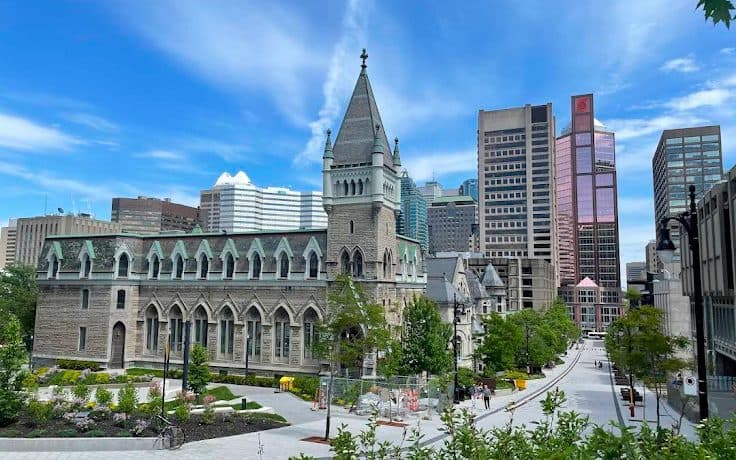
Studying at McGill means one thing that Ontario and BC universities do not ask of you: alongside your Canadian study permit, you need a second approval from the Quebec government, the CAQ. That one extra step is what most applicants don't see coming — and knowing it now puts you ahead. Get the order right (offer, CAQ, then study permit) and McGill becomes one of the most rewarding places in North America to study, in a bilingual city with real character and university fees that are competitive with Canada's other top universities.
Founded in Montreal and home to Canada's first faculty of medicine (1829), McGill has 40,531 students (fall 2025), around 29.5% of them international, and more than 325,000 alumni in over 185 countries. For Indian students planning to study in Canada, it offers top-30 global standing, an English-language education in a French-speaking city, and a degree that qualifies for a Post-Graduation Work Permit. Here are the verified 2026-27 numbers and the steps to follow.
McGill University Ranking and Key Facts
What Can You Study at McGill?
- Science and Life Sciences
- McGill's reputation in medicine and health research runs through its BSc, which is a common starting point for students heading towards biomedical research or graduate health programmes.
- Engineering
- BEng programmes and a Bachelor of Software Engineering, in a faculty with strong research links. BEng tuition for 2026 international entrants is $65,167.50 a year.
- Desautels Faculty of Management
- The BCom is McGill's highest-priced standard undergraduate degree for international students, at $71,687.40 in 2026-27. At graduate level, Desautels runs the MBA and specialised Masters of Management in Analytics, Finance and Retail.
- Arts
- The BA is McGill's lowest-priced large faculty for international students — $54,000 for 2026 entrants — with strengths across economics, political science, psychology and the humanities.
Tuition Fees for 2026-27
McGill publishes its full annual fee tables by degree and year of entry. These are the 2026-2027 figures for international students admitted in fall 2026, based on 30 credits (Canadian dollars).
| Degree | Tuition | Approx. total with compulsory fees |
|---|---|---|
| Bachelor of Arts (BA) | $54,000.00 | About $57,600 |
| Bachelor of Science (BSc) | $64,785.90 | About $68,400 |
| Bachelor of Engineering (BEng) | $65,167.50 | About $68,500 to $69,300 |
| Bachelor of Commerce (BCom) | $71,687.40 | About $75,400 |
- Compulsory fees included above: student services and athletics, registration and administration, IT, society fees, student dental cover, and international health insurance at $1,212 a year (2026-27). McGill publishes these as estimates, so check its fee tables for the confirmed figures.
- Confirmation deposit: international undergraduates pay a non-refundable $1,000 to accept their offer, which is credited to tuition.
- Graduate tuition, 2026-27 (international, full-time, per term): thesis master's $10,674.30; non-thesis master's (fall 2026 entrants) $16,416.30; PhD $9,581.40. Fall and winter terms make up a typical year.
- Master of Management in Analytics (summer 2026 intake): tuition across its four terms totals $77,599.80.
- Living costs: Quebec's figure for a single student's basic needs is $24,617 a year (from 1 January 2026), on top of tuition and a return flight.
McGill's tuition guarantee makes budgeting simpler. International students admitted to a bachelor's programme in 2026-27 pay the same tuition rate per credit for the whole degree, as long as there is no break in enrolment and no change of degree programme. Only the other fees rise, by about 3% a year. Because the rate is set by your year of entry, always read the fee table for your own entering cohort — then build that figure into a four-year plan.
Admissions for Indian Students
Undergraduate
- What McGill looks at: your Class X results, school transcripts for Grade 11 and mid-year Grade 12, or your final Class XII certificate if you already have it.
- Predicted grades and positional grades are not used, so your Grade 11 marks and mid-year Class XII marks do the heavy lifting.
- Deadlines for fall 2027: apply by 15 January, supporting documents by 1 March, and the Entrance Scholarship application by 21 January. Music and Religious Studies have earlier document deadlines.
- Programme choice matters: McGill admits to specific programmes, and prerequisites differ between Arts, Science, Engineering and Management. Check yours before you pick your Class XI subjects.
English Language Requirements
- Undergraduate: IELTS Academic 6.5 with at least 6.0 in each part; TOEFL 90 to 100 depending on programme (or 4.5 to 5.0 on the new six-point scale); Duolingo 125 (130 for BCom and B.Ed. TESL); CAEL 70.
- India is not on McGill's undergraduate exemption list, so most applicants from Indian schools should plan to sit a test. Results must be sent to McGill directly by the testing organisation.
- Graduate: IELTS Academic 6.5, or TOEFL 86 (4.5 on the new scale). Duolingo and PTE are not accepted at graduate level. You are exempt if your degree is from a recognised institution where English is the language of instruction — which covers many Indian universities, subject to your department's approval.
Graduate Admission from India
- Degree: a four-year bachelor's is standard; three-year bachelor's degrees are reviewed case by case.
- Minimum standing: 55/100 overall, or Second Division Upper, which McGill treats as equivalent to its 3.0 minimum. Most programmes are more competitive.
- PAL: since 1 January 2026, master's and doctoral students at a public institution such as McGill do not need a PAL, but they still need a CAQ.
Scholarships and Funding
- One-year entrance scholarships — $3,000
- Awarded automatically on the basis of the grades in your admission application. No separate form.
- Major entrance scholarships — $3,000 to $10,000 a year
- Renewable for up to three or four years if you meet the renewal criteria. You apply separately on the admissions portal (it opens on 1 October), and the deadline is 21 January for students on the Indian curriculum. The $12,000 tier is reserved for Canadian citizens and permanent residents.
- Need-based aid
- McGill runs need-based financial aid for undergraduates from Canada, the US and abroad, offering loans and bursaries once you are enrolled, plus work-study and tuition-deferral options.
- McCall MacBain Scholarship (graduate)
- A full scholarship for a master's or professional degree at McGill, for 30 scholars a year. For the 2027 cohort, applications opened on 1 June 2026 and the deadline for applicants outside Canada and the US was 19 August 2026. If you are aiming for 2028, start preparing now.
Apply for the major entrance scholarship even if you are unsure you will qualify. It is a separate application with its own deadline, a week after the main application closes, and the one-year award is decided from your grades anyway. Five minutes on the portal in January is all it takes to be in the running for a renewable award.
CAQ, PAL and Your Study Permit
The McGill order of operations
- 1
Accept your offer and, as an undergraduate, pay the $1,000 confirmation deposit. Your official admission letter is available in the Applicant Portal.
- 2
Apply for your CAQ from Quebec's immigration ministry. The fee is $135 (2026). For undergraduates, the CAQ also acts as your PAL, provided it carries the attestation wording. Quebec's 2026 allocation is 93,069 study permit applications.
- 3
Prepare financial proof: Quebec's basic-needs amount of $24,617, plus first-year tuition and a return flight. Applicants living in India present this proof with their study permit application to the Canadian visa office.
- 4
Apply for your study permit once your CAQ arrives. The Student Direct Stream closed in November 2024, so all Indian applicants use the regular stream.
- 5
Give biometrics (CAD 85) — Canada's visa application centre in Bangalore (VFS Bengaluru, run by VFS Global) takes biometrics, so there is no need to travel to another city.
Start the CAQ as soon as you accept. Because you need the CAQ before you can file your study permit, McGill applicants have one more step than students heading to Ontario or BC. Students who begin in the first week after accepting their offer arrive for orientation without stress. If you would like help sequencing the CAQ, finances and study permit, talk to us.
Applying from Bangalore and Karnataka
- Karnataka II PUC students: McGill's India page does not name individual boards, so confirm with McGill admissions how Karnataka School Examination and Assessment Board results are assessed for your programme. Because McGill does not use predicted grades, your I PUC (Grade 11) marks and mid-year II PUC marks are central — treat I PUC as seriously as your final year.
- CBSE and ICSE students in Bangalore: send Class X results, the Class XI transcript and mid-year Class XII marks. Ask your school early, because transcripts often take longer than expected.
- Graduates of Karnataka universities: a four-year BE or BTech from a VTU-affiliated or autonomous college meets the standard degree length; three-year degrees from Bangalore University and others are reviewed case by case. McGill does not publish a list of preferred Indian institutions.
- Biometrics: Canada's visa application centre in Bangalore (VFS Bengaluru) takes biometrics, so you can give them without leaving the city.
- Travel: from Kempegowda International Airport, Montreal is usually reached with one stop through a Gulf, European or Indian hub.
- Local help: Falcon Nova's office is in Hebbal, North Bangalore (7th floor, Kirloskar Business Park), with free counselling in person or online.
Life in Montreal
- A bilingual city: McGill teaches in English, but Montreal lives mostly in French. Learning some French opens doors to part-time jobs, internships and friendships beyond campus.
- Winter is real: Montreal winters are long and snowy. Budget for proper winter clothing in your first weeks — students from Bangalore settle in far more easily when they arrive prepared.
- Work while you study: up to 24 hours a week off campus during academic sessions and unlimited hours during scheduled breaks.
- Required internships: where an internship is a required part of your programme, you have not needed a separate co-op work permit since 1 April 2026, provided McGill confirms it in a letter, your study permit allows on-campus work, and the placement makes up 50% or less of the programme. There is no weekly hour limit on these placements.
Careers and the PGWP
- No field-of-study rule for degrees: IRCC states that bachelor's, master's and doctoral graduates face no field-of-study requirements for the PGWP. Quebec degrees are included.
- Language: university graduates need CLB 7 (or NCLC 7 in French) in all four skills.
- Length: up to three years for programmes of two years or more, and for master's degrees of at least eight months. For Quebec programmes, the minimum length is measured as 900 hours.
- Passport validity caps the permit length, so renew your passport before you graduate if needed.
Is McGill Right for You?
McGill is an outstanding choice if you want a top-30 university with a deep research tradition in medicine and the sciences, an English-language degree in one of North America's most distinctive cities, and a clear path to a PGWP. Its fees are competitive with Toronto's — $54,000 for a BA and $64,785.90 for a BSc in 2026-27, guaranteed for your degree — and its admissions are refreshingly transparent about which marks count. The one extra step is the CAQ, and once you plan for it, it is simply part of the timeline. Compare McGill with Toronto if you want a similar global name in Ontario, and with UBC if the Pacific coast appeals.
Make McGill Your Plan, Step by Step
McGill applications succeed on sequencing and detail: using your Grade 11 and mid-year Class XII marks to your advantage when predicted grades are not used, filing the major entrance scholarship form by 21 January, and moving from offer to CAQ to study permit without losing weeks. Falcon Nova Consultants has helped hundreds of Indian students plan applications to leading universities abroad. Book a free counselling session at our Hebbal office in North Bangalore or online, and leave with a McGill timeline that covers every Quebec step.
Book Your Free Counselling Session