Most Indian families searching for the University of Toronto start with the same picture: one grand stone university in the middle of a big city. Knowing the real structure first puts you ahead of most applicants: U of T is three campuses — St. George in downtown Toronto, Mississauga to the west and Scarborough to the east — and you apply to a specific campus and programme, each with its own fees, prerequisites and competition. Get that choice right and the rest of your application falls into place.
Founded in 1827, U of T is Canada's largest university by a distance: 103,140 students in fall 2025, of whom 27,897 are international, from 176 countries and territories — including 1,841 students from India. For Indian students planning to study in Canada, it offers a combination that is hard to match: a place among the world's leading universities in every major ranking, a city with a large, well-established Indian community, and a work-permit pathway that stays open after you graduate. This guide sets out the real 2026-27 numbers — fees, admissions, scholarships and the Canadian immigration rules now in force — so you can plan with confidence.
University of Toronto Ranking and Key Facts
Three Campuses, One Degree — Choosing Where to Apply
- St. George (downtown Toronto)
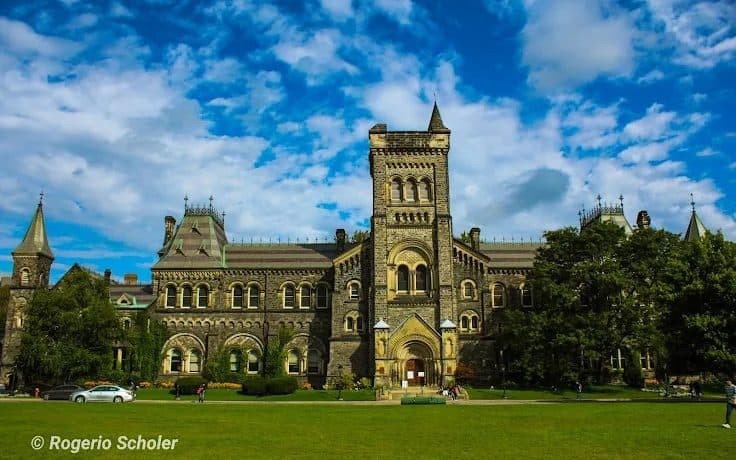
- The historic core, home to the Faculty of Arts & Science, Applied Science & Engineering, the Rotman School of Management and the professional faculties. Arts & Science here is organised through colleges such as University College (pictured above), which shape your residence and community life.
- U of T Mississauga (UTM)
- West of the city. UTM runs its own admissions, including Management and Commerce programmes, and its own international scholar award. International tuition for Arts & Science programmes is the same as St. George: $66,110 for students entering in 2026.
- U of T Scarborough (UTSC)
- East of the city, known for its co-op programmes and a strong management school. It also has its own International Scholar Award, and it is a natural fit if you want structured work terms alongside your degree.
A detail that saves money and heartache. Every campus awards a University of Toronto degree, but each campus sets its own admission standards and some programmes exist on one campus only. Apply to more than one campus through the same application if the same subject is offered at each — it widens your options without weakening your application.
Fees for Indian Students in 2026-27
These are the international tuition fees approved in U of T's 2026-27 Tuition Fee Schedule (Canadian dollars, per year, for students entering in fall 2026). The weighted average international undergraduate fee increase for 2026-27 is 4.1%.
| Programme (entering 2026) | 2026-27 tuition | 2027-28 planned |
|---|---|---|
| Arts & Science (St. George, UTM, UTSC) | $66,110 | $68,750 |
| Applied Science & Engineering | $72,860 | $75,770 |
| Computer Science / Data Science / Bioinformatics | $66,110 (year 1) | $72,480 (year 2) |
| Rotman Commerce / Business Administration | $66,110 (year 1) | $78,160 (year 2) |
| Architectural Studies | $66,110 | $68,750 |
| Kinesiology and Physical Education | $51,460 | $54,030 |
| Music | $50,490 | $53,010 |
- Health insurance: all international students are enrolled in UHIP, which costs $948 for a September 2026 start (1 September 2026 to 31 August 2027).
- Incidental and ancillary fees for student services, societies and athletics are charged on top of tuition and vary by campus and programme — U of T's Tuition Explorer shows the exact figure for your programme.
- Living costs: for your study permit, IRCC requires proof of $23,448 for one year of living expenses (for applications from 1 September 2026), on top of your first year's tuition and travel. Toronto rents are high, so treat that as the legal minimum rather than a comfortable budget.
- Graduate tuition, 2026-27: Master of Engineering $72,850; MSc in Applied Computing $50,070; two-year Rotman MBA $71,670 a year; Master of Management Analytics (15 months, entering 2026) $56,667 plus $28,333; Master of Finance (15 months) $49,860 plus $31,110; Master of Public Health $53,060; Master of Information $46,080. International tuition for most PhD programmes is aligned with the domestic rate.
Read the Computer Science and Commerce rows carefully. Students in these programmes pay the general Arts & Science fee in year one and move to the higher programme fee once they enter the programme in year two. For the 2026 cohort, that is a jump from $66,110 to $72,480 for Computer Science and to $78,160 for Commerce. Plan your four-year budget on the higher figures, and the year-two bill becomes a planned step rather than a surprise.
Admissions for Indian Students
Undergraduate: Boards, Maths and Deadlines
- Accepted qualifications: the All India Senior School Certificate (CBSE) and the Indian School Certificate (CISCE). Year 12 state board results with excellent marks, including Karnataka's II PUC, are considered on an individual basis.
- Maths matters: CBSE students applying to programmes that need Calculus — business, engineering and science — must present Class XII Standard Mathematics. U of T states that Class XII Applied Mathematics will not meet the Calculus requirement. Choose your Class XI subjects with this in mind.
- Everyone needs a Grade 12 English course, and all other prerequisites must be at Class XII level.
- Deadlines for September 2027: apply by the recommended date of 7 November 2026 and complete your documents by 1 December to be considered in the first admission round. The standard deadline is 15 January 2027 for most programmes. Most supplementary applications are due 1 February, except Engineering and Music, which are due 15 January.
- Offers are released in rounds from late January to the end of May.
Graduate: The Three-Year Degree Question
- The School of Graduate Studies accepts a four-year Indian bachelor's degree (BTech, BE, BArch, BPharm, MBBS, BDS and similar), or a three-year bachelor's plus a completed master's.
- Minimum standing: 7/10 or First Class/Division, and 7.5/10 for IIT graduates. Departments often set higher bars.
- MTech, MEng and MPhil are treated as the equivalent of a Canadian master's for PhD entry.
- Research-stream master's and PhD funding is arranged by the department. International PhD tuition for most programmes is aligned with domestic fees, so a funded PhD is far more affordable than a professional master's.
English Language Requirements
- IELTS Academic 6.5 overall, with no band below 6.0.
- Duolingo English Test 120 overall with 120 in Production.
- TOEFL iBT: for tests from 21 January 2026, 4.5 overall with 4.5 in Writing and 4.0 in Speaking; for earlier tests, 89 overall with 22 in Speaking and Writing. Super-scored MyBest results are not used.
- Exemptions apply after four years of full-time study in Canada or in an English-language school in a country where English is the dominant language. India is not on U of T's automatic list, so plan on a test.
Scholarships for International Students
- Lester B. Pearson International Scholarship
- U of T's flagship award: tuition, books, incidental fees and full residence support for four years, for about 37 scholars a year. Your school must nominate you (one student per school). For 2027 entry: school nomination by 9 October 2026, U of T application by 16 October 2026, scholarship application by 6 November 2026.
- President's Scholars of Excellence Program
- Awarded automatically to approximately 150 of the most highly qualified incoming students. No separate application.
- Arts & Science Global Scholarship
- Automatic consideration for international Arts & Science applicants. U of T describes it as covering full international tuition for four years. It is highly selective, and it costs nothing to be considered.
- Campus and faculty International Scholar Awards
- UTM and UTSC each run an International Scholar Award, and Rotman Commerce lists its version at up to $100,000 over four years. All are merit-based and considered automatically at admission, and they can be combined with other awards.
- In-course awards
- Once you are enrolled, U of T offers more than 5,900 in-course scholarships a year, searchable through its Award Explorer.
The Pearson timeline is the one that catches families out — and it is easy to get right early. Because the school nomination closes in early October, the conversation with your principal needs to happen in the summer before Class XII, not after your pre-boards. If Pearson is in your plans, talk to us early and we can map your nomination, application and scholarship dates together.
Study Permit, PAL and the 2026 Cap
Canada is still admitting international students, but in a managed way. For 2026, IRCC expects to issue up to 408,000 study permits, including 155,000 to newly arriving students. Knowing the rules lets you move quickly and calmly once your offer arrives.
From offer to study permit
- 1
Accept your offer and follow U of T's instructions to request a Provincial Attestation Letter (PAL) from Ontario. Undergraduates need one. Ontario's allocation for 2026 is 104,780 study permit applications.
- 2
If you are starting a master's or PhD, you no longer need a PAL: since 1 January 2026, master's and doctoral students at a public institution are exempt.
- 3
Gather proof of funds: your first year's tuition, travel, and $23,448 for one year's living expenses (single applicant outside Quebec, applications from 1 September 2026). Six months of bank statements, a Canadian GIC or funds already in a Canadian account can all serve as proof. The Student Direct Stream closed in November 2024, so every Indian applicant now applies through the regular stream — clear, well-organised financial documents carry real weight.
- 4
Apply online and give biometrics (CAD 85). Canada's visa application centre in Bangalore (VFS Bengaluru, run by VFS Global) takes biometrics, so Bangalore applicants do not need to travel to another city.
- 5
Arrange UHIP and housing, and apply for residence by U of T's deadline (see below).
Applying from Bangalore and Karnataka
A large share of Indian applicants to U of T come from Bangalore's CBSE and ICSE schools, and more are applying straight from II PUC at Karnataka colleges. Here is what applies to you specifically.
- Karnataka PUC marks: U of T does not list the Karnataka School Examination and Assessment Board by name, but it states that Year 12 state board exams with excellent results are considered individually. Aim high, and make sure your PUC combination (for example PCMB or PCMC) includes the Calculus and English the programme requires.
- CBSE students in Bangalore: choose Standard Mathematics, not Applied Mathematics, in Class XII if there is any chance you will apply for engineering, commerce, computer science or life sciences.
- Degrees from Karnataka universities: for graduate study, U of T applies the same India rules to every recognised university — a four-year BE or BTech from a VTU-affiliated college, or a three-year Bangalore University degree plus a master's. The only institution group the equivalency table names separately is the IITs, which need 7.5/10.
- Biometrics: Canada's visa application centre in Bangalore (VFS Bengaluru) takes biometrics, so you can give them without leaving the city.
- Getting there: from Kempegowda International Airport, most students fly to Toronto Pearson with one stop through a Gulf, European or Indian hub. Book early for late-August arrival, when fares climb.
- Local help: Falcon Nova's office is in Hebbal, North Bangalore (7th floor, Kirloskar Business Park). You can book a free counselling session in person or online.
Life in Toronto
- Residence: first-year students are guaranteed residence if they complete the U of T Residence Portal application by the deadline and accept their offer in time. For 2026 entry, those dates were 31 March and 2 June — watch for the 2027 dates, and apply for residence even before you have an offer.
- Community: with students from 176 countries and territories and a large Indian community across the Greater Toronto Area, you will not struggle to find Indian food, festivals and familiar faces — join your campus's Indian and South Asian student associations in your first week.
- Weather: Toronto winters are properly cold. Budget for a real winter coat and boots in your first weeks. Students from Bangalore adjust faster when they arrive prepared.
- Work while you study: up to 24 hours a week off campus during academic sessions, and unlimited hours during scheduled breaks like summer and winter holidays.
Co-op, Careers and the PGWP
U of T is not a co-op-by-default university like Waterloo, but it has strong structured work options: Engineering's PEY Co-op offers 12 to 16-month work terms, and U of T Scarborough and Arts & Science run co-op programmes. A useful change came in on 1 April 2026: post-secondary students no longer need a separate co-op work permit for a work placement that is a required part of their programme, as long as the university confirms it in a letter, your study permit allows on-campus work, and the placement is no more than 50% of the programme. There is no weekly hour limit on those placements.
- PGWP eligibility: IRCC confirms there are no field-of-study requirements for bachelor's, master's or doctoral degree graduates, so every U of T degree qualifies.
- Language: university graduates need CLB 7 in all four skills (reading, writing, listening, speaking) when they apply for the PGWP. Keep your IELTS skills sharp through your degree.
- Length: programmes of two years or more earn a PGWP of up to three years. A master's of at least eight months also earns up to three years, even a one-year MEng.
- Passport validity caps the permit length, so renew your passport before you graduate if it is due to expire.
Why the three-year PGWP matters for your plan. A one-year professional master's such as the MEng costs $72,850 in tuition, but it opens up to three years of open Canadian work authorisation. Set against a two-year programme, that can be the more efficient route to Canadian work experience. We can help you weigh the options side by side in a free counselling session.
Book Your Free Counselling SessionIs the University of Toronto Right for You?
U of T is the right choice if you want a globally recognised research university in a large, diverse city, with the option to specialise in engineering, computer science, business or life sciences at the highest level. The fees are among the highest in Canada — $66,110 to $72,860 in year one for most undergraduates — but they come with automatic merit scholarships, the Pearson award for exceptional nominees, and a three-year PGWP on a degree from any field. If you want co-op built into every year, compare it with Waterloo. If you want a campus with a smaller-town feel, UBC or McGill may suit you better. Whichever you choose, going in with the real numbers means you can make the decision with confidence.
Plan Your University of Toronto Application
U of T rewards applicants who make the right choices early: which of the three campuses to apply to, whether your CBSE maths or Karnataka PUC subjects meet the Calculus requirement, whether to pursue a Pearson nomination before the October deadline, and how to budget for the year-two jump in Computer Science and Commerce fees. Falcon Nova Consultants has helped hundreds of Indian students plan applications to leading universities abroad. Book a free counselling session at our Hebbal office in North Bangalore or online, and leave with a clear U of T timeline built around your marks, your budget and your 2027 start.
Book Your Free Counselling Session