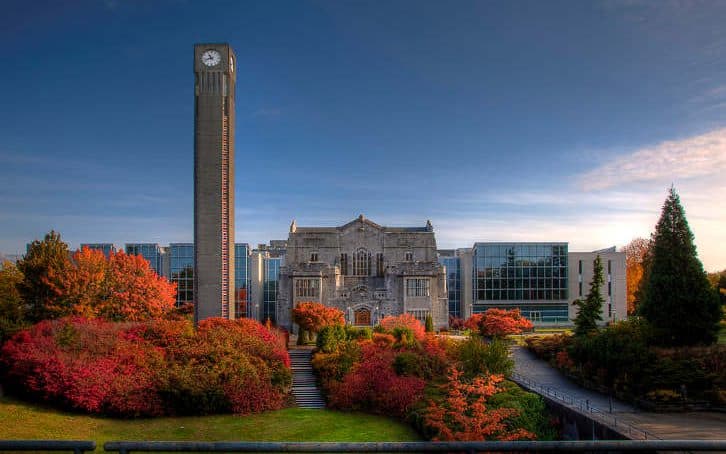
UBC's Vancouver campus sits on a peninsula with forest on three sides and the Pacific Ocean below — and for Indian students, that setting comes with one of the most practical admissions rules in Canada. If you are at a CBSE or ICSE school and score 75% or more in your senior English subject, UBC accepts that as proof of English. No IELTS, no test fee, no retake stress. It is a small detail that puts you ahead from day one, and it is typical of a university that explains its rules clearly.
UBC has 72,100 students across two campuses, Vancouver and Okanagan in Kelowna, and 25.4% of Vancouver students are international. For Indian students planning to study in Canada, UBC offers a world top-50 reputation, a city with a long-established South Asian community, and a work-permit pathway that stays open after graduation. This guide sets out the verified 2026-27 fees, entry rules, scholarships and immigration steps so you can plan your application with confidence.
UBC Ranking and Key Facts
What Can You Study at UBC?
- Applied Science (Engineering)
- A common first year followed by specialisation in disciplines such as civil, electrical, computer, mechanical and engineering physics. International tuition for 2026 starters is $1,789.18 per credit.
- Science, including Computer Science
- Computer Science at UBC sits inside the Faculty of Science, so you apply to Science and specialise later. The international rate for 2026 starters is $1,769.40 per credit — about $53,082 for a 30-credit year.
- Sauder School of Business (Commerce)
- UBC's BCom carries the highest standard undergraduate rate: $2,222.61 per credit for 2026 starters, about $66,678 for 30 credits.
- Arts, Forestry, Land and Food Systems
- Arts is UBC's lowest-priced large faculty for international students at $1,717.68 per credit. Forestry and Land and Food Systems ($1,769.40 per credit) are distinctive UBC strengths with strong links to sustainability careers.
Tuition Fees for 2026-27
These are UBC Vancouver's international per-credit rates for students starting in 2026 (Canadian dollars), with the cost of a typical 30-credit year calculated from them.
| Programme (Vancouver) | Per credit | 30-credit year |
|---|---|---|
| Arts | $1,717.68 | $51,530 |
| Science (incl. Computer Science) | $1,769.40 | $53,082 |
| Applied Science (Engineering) | $1,789.18 | $53,675 |
| International Economics | $2,077.92 | $62,338 |
| Commerce (Sauder) | $2,222.61 | $66,678 |
| Music | $1,434.70 | $43,041 |
UBC's fee promise is worth knowing. For international undergraduates starting in 2026/27, UBC commits that tuition will increase by no more than 3% a year for the following four years or until you graduate, whichever comes first. That makes UBC one of the easiest universities in Canada to budget for over a full degree — build the 3% into your family plan and there are no surprises.
- Engineering credit loads: many engineering years run above 30 credits, and because UBC charges per credit, your bill rises with your load. Check your programme's typical credits per year.
- Graduate tuition (Vancouver, 2026 entry): Master of Data Science $19,922.64 × 3 instalments ($59,768); Master of Engineering (full-time) $9,139.78 per instalment, three instalments a year; Master of Management $20,312.56 × 3 ($60,938); the 16-month MBA $27,105.19 × 4 ($108,421).
- Living costs: IRCC requires proof of $23,448 for one year of living expenses (applications from 1 September 2026), plus tuition and travel. Vancouver is one of Canada's most expensive cities for rent, so treat that figure as the minimum.
- Health cover: British Columbia requires international students to enrol in the provincial Medical Services Plan. Check UBC's current guidance on premiums and interim coverage when you accept your offer.
Admissions for Indian Students
Undergraduate Deadlines for September 2027
- 1
Early October 2026: the UBC online application opens.
- 2
15 November 2026: apply to UBC and submit your award application if you want to be considered for the International Scholars Program.
- 3
15 January 2027: the main application deadline for the Winter Session starting September 2027.
- 4
15 February 2027: deadline for English language documents.
- 5
15 March 2027: final transcripts due for out-of-country secondary school applicants.
- 6
1 May or 1 June 2027: accept your offer and pay your deposit, depending on your offer.
UBC reviews more than marks. Its application includes personal profile questions about your activities, responsibilities and achievements. Give them the same care as your board exams: a clear, specific profile is where a well-prepared applicant stands out.
English Language Requirements
- CBSE or ICSE-affiliated schools: a minimum of 75% (Indian grading scale) in your senior English subject meets UBC's English requirement.
- IELTS Academic: 6.5 overall, with no part below 6.0.
- TOEFL iBT: 90 overall, with reading 22, listening 22, writing 21 and speaking 21.
- Duolingo English Test: 125 overall, with section minimums. PTE Academic: 65 overall, with all sections at 60 or above.
- Other routes include four or more consecutive years of English-medium education in Canada or an English-speaking country, and qualifying IB or AP English grades.
Graduate Admission from India
- Master's: a four-year bachelor's degree or a master's degree, with First Class/Division 1 (65%) or 8/10.
- Three-year degrees: may be considered with first-class standing from an institution with an NAAC rating of A.
- Doctoral: an MPhil or master's degree (including engineering), with the same minimum standing.
- PAL: since 1 January 2026, master's and PhD students at public institutions such as UBC do not need a Provincial Attestation Letter.
Scholarships for International Students
- International Major Entrance Scholarship (IMES)
- Merit-based, $10,000 to $25,000 a year for 2026/2027, renewable for up to three additional years. Automatic consideration for students entering directly from secondary school who apply by the admission deadline.
- Outstanding International Student (OIS) Award
- Merit-based, one-time entrance award of $10,000 to $25,000 (2025/2026 values). Automatic consideration for secondary and post-secondary applicants who apply by the deadline.
- International Scholars Program
- UBC's need-and-merit programme for students with high academic achievement, significant financial need and strong extracurricular or community involvement. It includes dedicated advising. Apply to UBC and submit the award application by 15 November 2026.
Scholarship decisions are made between mid-February and the end of April. Because IMES and OIS need no separate application, the strongest thing you can do is apply to UBC well before the January deadline, with a polished personal profile. If you are considering the International Scholars Program, the November date comes first — talk to us early and we can plan both tracks together.
Study Permit, PAL and the 2026 Cap
Your path from offer to arrival
- 1
Undergraduates request a Provincial Attestation Letter (PAL) from British Columbia through UBC after accepting their offer. BC's 2026 allocation is 32,596 study permit applications, within a national total of 309,670 for students who need a PAL.
- 2
Master's and PhD students skip this step: master's and doctoral students at a public institution have been exempt from the PAL since 1 January 2026.
- 3
Prepare proof of funds: first-year tuition, travel and $23,448 for one year's living costs (single applicant outside Quebec, applications from 1 September 2026). Six months of bank statements, a Canadian GIC or funds already in a Canadian account can all serve as proof. The Student Direct Stream ended in November 2024, so every Indian applicant uses the regular stream, and clear financial documents matter more than ever.
- 4
Apply online and give biometrics (CAD 85). Canada's visa application centre in Bangalore (VFS Bengaluru, run by VFS Global) takes biometrics, so there is no need to travel to another city.
- 5
Arrive in time for orientation, with your offer letter, PAL, proof of funds and port-of-entry letter in your hand luggage.
Applying from Bangalore and Karnataka
- CBSE and ICSE students in Bangalore: the 75% senior English rule can save you an IELTS sitting. Check your Class XII English mark against it as soon as results arrive.
- Karnataka II PUC students: UBC's English waiver names CBSE and ICSE only, so plan to take an English test unless UBC confirms otherwise. Select India in UBC's requirements tool to confirm how state board results are assessed for your degree.
- Graduates of Karnataka universities: a four-year BE or BTech from a VTU-affiliated college or an autonomous engineering college meets the degree-length requirement. For a three-year degree, from Bangalore University for example, UBC looks for first-class standing and an institution with an NAAC A rating — check your college's current NAAC grade before you apply.
- Biometrics: Canada's visa application centre in Bangalore (VFS Bengaluru) takes biometrics, so you can give them without leaving the city.
- Travel: from Kempegowda International Airport, Vancouver is usually reached with one stop through an East Asian, Gulf, European or Indian hub.
- Local help: Falcon Nova's office is in Hebbal, North Bangalore (7th floor, Kirloskar Business Park), with free counselling in person or online.
Life at UBC and in Vancouver
- The campus is on the Point Grey peninsula at the western edge of Vancouver, with beaches and Pacific Spirit Regional Park on its doorstep.
- The climate is among the mildest of Canada's major cities, with wet winters rather than deep freezes — a gentler adjustment for students from Bangalore than central Canada.
- Community: Vancouver and nearby Surrey have large, long-established South Asian communities, so Indian food, festivals and places of worship are close at hand.
- Work: up to 24 hours a week off campus during academic sessions and unlimited hours during scheduled breaks.
Co-op, Careers and the PGWP
UBC runs co-op programmes across Engineering, Science, Arts, Sauder and several graduate programmes. From 1 April 2026, post-secondary students no longer need a separate co-op work permit for placements that are a required part of their programme, provided UBC confirms this in a letter, your study permit allows on-campus work, and the placement makes up 50% or less of the programme. There is no weekly hour limit on these placements.
- No field-of-study rule for degrees: IRCC states there are no field-of-study requirements for bachelor's, master's or doctoral graduates.
- Language: university graduates need CLB 7 in all four skills when they apply for the PGWP.
- Length: up to three years for programmes of two years or more, and for master's degrees of at least eight months — so UBC's 10-month Master of Data Science can lead to a three-year PGWP.
Is UBC Right for You?
UBC is an excellent fit if you want a globally ranked research university with a spectacular campus, a mild climate and a fee structure you can plan around, with increases capped at 3% a year. Its CBSE/ICSE English rule and automatic entrance scholarships reward well-prepared Indian applicants, and its degrees lead to a three-year PGWP in any field. If you would rather be in the heart of a large city, compare it with Toronto; if co-op is your top priority, compare it with Waterloo. With the real figures in front of you, you can choose the one that fits you best.
Build Your UBC Application with Confidence
The details decide UBC applications: whether your Class XII English mark lets you skip IELTS, whether to go for the International Scholars Program before the 15 November deadline, how to write a personal profile that stands out, and how to budget per-credit engineering fees across four years. Falcon Nova Consultants has helped hundreds of Indian students plan applications to leading universities abroad. Book a free counselling session at our Hebbal office in North Bangalore or online, and leave with a clear UBC plan for September 2027.
Book Your Free Counselling Session