Monash University gives Indian students something most universities cannot: a choice of campuses, each built around its specialisms. Engineering and IT are at Clayton, business at Caulfield, and pharmacy has its own campus at Parkville. Many first-time applicants don't realise this, and knowing it helps you choose the right course and the right part of Melbourne.
Founded in 1958 and named after the engineer and general Sir John Monash, the university has grown into one of the best-known names in Australian higher education. It also has a long connection with India through the IITB-Monash Research Academy in Mumbai, a joint PhD programme with IIT Bombay. For students planning to study in Australia, this guide covers what it takes to study at Monash University as an international student: courses, entry marks, English scores, the visa money rules and the post-study work rights that apply to Indian graduates.
Monash University at a Glance
The ranking is useful, but the campus structure is what you will notice every day. Your course decides your campus, and your campus decides your commute, your housing options and your classmates. Pick the course first, then plan your life in Melbourne around the campus where it is taught.
Monash University Courses for Indian Students
1. Information Technology, Data Science and AI (Clayton)
Monash describes itself as the only Group of Eight university with a dedicated IT faculty. The Master of Information Technology (C6001) runs for 1.5 or 2 years at Clayton, depending on your background, with February and July intakes. It welcomes students from IT and non-IT backgrounds and is accredited by the Australian Computer Society (ACS). The Master of Data Science (C6004) and Master of Artificial Intelligence (C6007) follow the same two-level structure: 2 years if your degree is in another field, 1.5 years if you already have the right computing subjects.
2. Engineering (Clayton)
The four-year Bachelor of Engineering (Honours) (E3001) starts with a common first year, and then you choose a branch: aerospace, biomedical, chemical, civil, environmental, electrical and computer systems, materials, mechanical, robotics and mechatronics, or software engineering. For graduates, the Master of Professional Engineering (E6011) offers chemical, civil, electrical, materials and mechanical specialisations and is accredited by Engineers Australia. It takes 3 years, or 2 years if you hold a four-year Bachelor of Engineering in a related discipline with at least a 65% average, which is exactly the profile of many Indian BE and BTech graduates.
3. Pharmacy (Parkville)
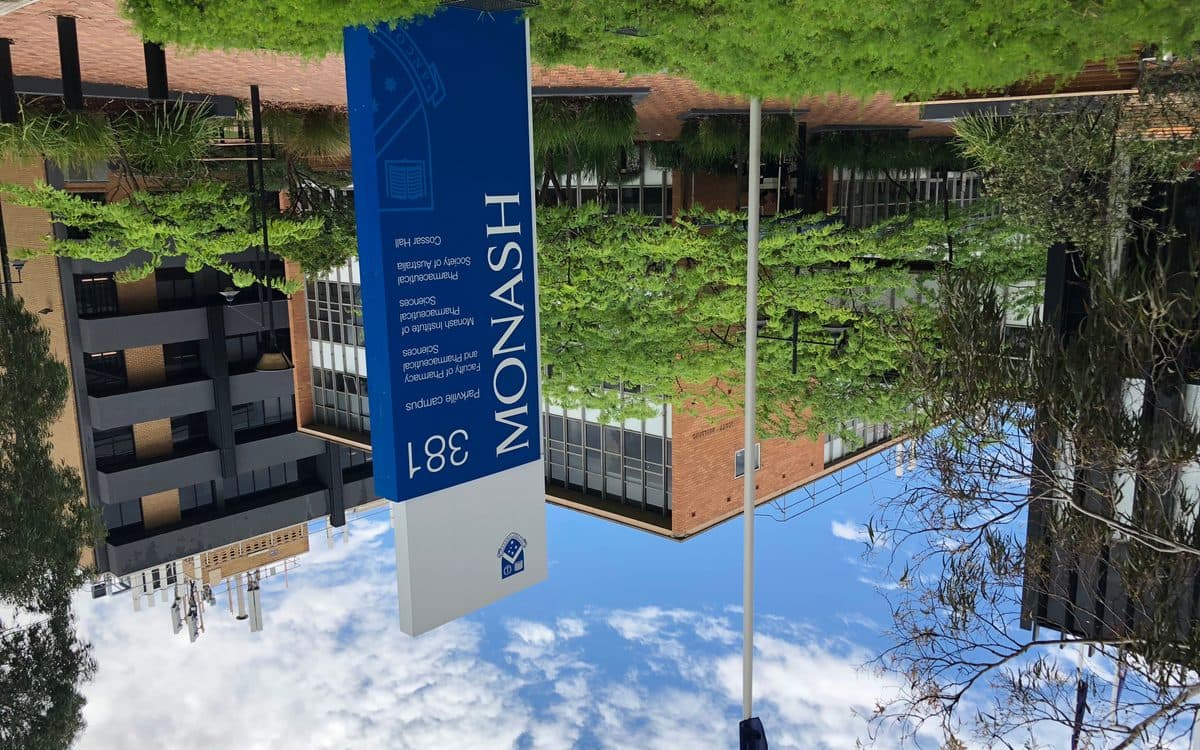
The four-year Bachelor of Pharmacy (Honours) (P3001) is taught at Parkville, home of the Faculty of Pharmacy and Pharmaceutical Sciences. Monash describes it as a fully integrated course with plenty of hands-on practice, including work placements in hospitals and community pharmacies. There is also a Bachelor of Pharmaceutical Science Advanced (Honours) (P3002) for students interested in drug discovery and research rather than practice.
4. Business (Caulfield)
The Master of Business (B6005) at Caulfield is designed mainly for graduates without prior business study. It lasts 2 years, 1.5 years with a related degree, or 1 year with a related degree plus two years of relevant professional experience, and you can specialise in areas such as business economics. The Master of Banking and Finance (B6004) is a focused alternative if you are aiming for finance roles.
Popular with Indian applicants: Master of Information Technology, Master of Data Science, Master of Artificial Intelligence, Master of Professional Engineering, Master of Business, Master of Banking and Finance, and the Bachelor of Engineering (Honours) and Bachelor of Pharmacy (Honours).
Entry Requirements for Indian Students
Postgraduate (Master's)
- The 60% line: the 2027 Handbook entries for the Master of IT, Data Science, AI and Business all ask for a bachelor degree (or equivalent) with at least a credit (60%) average. Monash converts Indian marks to its own scale, so check your conversion early.
- The shorter route: if your degree already covers the right subjects, you can enter at Level 2 and finish in 1.5 years. For the Master of IT, that means completed studies in Java and Python programming, algorithms, computer architecture, operating systems, networks and databases. A strong BE, BTech or BCA transcript often fits, and it saves you a full semester of fees and living costs.
- Engineering: the Master of Professional Engineering asks for a high credit (65%) average and prior maths (including linear algebra and calculus), plus physics and/or chemistry depending on the specialisation. A four-year BE in a related branch at 65% or above qualifies you for the shorter 2-year version.
- Statement and documents: transcripts, your degree certificate and English test results are the core of your application. Make sure your course choice makes sense for your career. That matters again when you write your Genuine Student answers for the visa.
Undergraduate
- Class XII results: Monash lists minimum Indian results on each course page. For 2027 entry, the Bachelor of Engineering (Honours) lists 80% in CBSE (AISSCE) or 75% in ISC, and the Bachelor of Information Technology lists 70% (CBSE) or 65% (ISC), along with prerequisite subjects such as English and mathematics.
- Your board matters: state boards such as Karnataka's II PUC are not listed separately on these course pages, so confirm the figure for your exact board and course with Monash before you apply.
English Language Requirements
- Monash Level A (most courses): IELTS Academic 6.5 overall with no band below 6.0; PTE Academic 58 with no band below 50; or TOEFL iBT 79 with Writing 21, Listening 12, Reading 13 and Speaking 18.
- Higher levels for some health courses: for example, the Bachelor of Occupational Therapy (Honours) uses Monash Level B, with higher band minimums.
- Plan to sit your test with time to retake if needed. Hitting the band minimums is what matters, not just the overall score.
Monash University Fees and Scholarships
Monash sets an international fee for each course and shows it on the course page when you switch to the international view. Fees are revised every year, so always confirm the number on Monash's own page for your course and intake year. When you compare offers, compare the total cost of the course, not just the annual fee. A 1.5-year master's can cost much less in total than a 2-year one, which is why entering at the right level matters so much.
| Course (campus) | Duration | International fee per year (2027) |
|---|---|---|
| Master of Information Technology (Clayton) | 1.5 or 2 years | A$57,540 |
| Master of Data Science (Clayton) | 1.5 or 2 years | A$57,540 |
| Master of Artificial Intelligence (Clayton) | 1.5 or 2 years | A$60,040 |
| Master of Professional Engineering (Clayton) | 2 or 3 years | A$59,740 |
| Master of Business (Caulfield) | 1, 1.5 or 2 years | A$62,140 |
| Bachelor of Engineering (Honours) (Clayton) | 4 years | A$63,040 |
These are Monash's published 2027 international fees for a standard full-time year of 48 credit points. The Master of Banking and Finance is also A$62,140 and the Bachelor of Information Technology A$58,940. For pharmacy and any course not listed here, switch the course page to the international view to see its fee. Multiply by your course length to get the total: a 1.5-year Master of IT at A$57,540 a year comes to roughly A$86,000 in tuition, against about A$115,000 for the 2-year version.
- Monash International Study Grants
- Monash's course pages advertise International Study Grants valued at up to $10,000 for eligible international students. Check the current conditions and eligible intakes when you apply.
- Monash merit scholarships
- Monash also runs competitive scholarships for high-achieving international students. Names, values and deadlines change from year to year, so use Monash's scholarship search for your intake rather than lists copied onto other websites.
- Research degrees and the IITB-Monash Research Academy
- If you are aiming for a PhD, the IITB-Monash Research Academy in Mumbai offers a joint PhD with IIT Bombay and Monash, which is worth exploring alongside Monash's own research scholarships.
Plan your budget around the visa numbers. For a Student visa (subclass 500), Home Affairs asks you to show A$29,710 for 12 months of living costs, your first 12 months of tuition, and A$2,000 for travel if you apply from outside Australia. Alternatively, you can show that a parent or partner earned at least A$87,856 in the 12 months before you apply (A$102,500 if family members are coming with you). Getting this plan in place early makes the visa stage far less stressful, and it's a big part of our free counselling. Talk to us and we'll help you map your Monash budget.
Your Student Visa and Post-Study Work Rights
From Monash offer to visa grant
- 1
Accept your offer and pay the deposit to receive your Confirmation of Enrolment (CoE).
- 2
Arrange Overseas Student Health Cover (OSHC) from an approved provider, starting from the date you arrive in Australia.
- 3
Prepare your Genuine Student answers. The online application asks you questions in English, each with a 150-word limit, about your current circumstances, why you chose this course at Monash, and how it fits your future.
- 4
Gather financial evidence that meets the financial capacity rules above.
- 5
Lodge the Student visa (subclass 500) online through ImmiAccount. The visa application charge is from A$2,500 for the main applicant (Home Affairs pricing from 1 July 2026).
- 6
Provide biometrics or health checks if Home Affairs asks you to.
- Working while you study: Student visa holders can work up to 48 hours a fortnight while their course is in session, with no limit during scheduled breaks. Master's by research and doctoral students have no work limit.
- Temporary Graduate visa (subclass 485): under the Australia–India agreement (AI-ECTA), Indian nationals can stay 2 years after a bachelor degree, 3 years after a bachelor with first-class honours in STEM (including ICT), 3 years after a master's degree and 4 years after a PhD. You must be 35 or under when you apply, with exceptions for research graduates.
- 485 costs and English: the Temporary Graduate visa charge rose to A$5,750 from 1 July 2026. For tests taken from 7 August 2025, the English requirement is IELTS 6.5 overall with at least 5.5 in each band.
- Melbourne is a major city for regional purposes, so a Monash degree from the Melbourne campuses does not lead to the extra regional second 485 visa. Most students find the standard post-study period more than enough to build a career.
Applying from Bangalore and Karnataka
Bangalore students often have exactly what Monash's IT, data science and engineering courses look for: strong maths, solid programming and, for graduates, industry experience in the city's tech sector. Here is how to turn that into a strong Monash application.
- II PUC students: if you are finishing Class XII with the Karnataka School Examination and Assessment Board, confirm Monash's minimum for your board and course before you apply. State-board and CBSE requirements are not always the same.
- Karnataka graduates: whether your degree is from a VTU-affiliated engineering college, Bangalore University or an autonomous institution, Monash assesses the degree and your average against its credit (60%) or high credit (65%) threshold. Send transcripts that show every semester's marks clearly.
- Use your work experience: if you have worked in Bangalore's IT sector, use your application and Genuine Student answers to explain why a Monash master's is the right next step for your career.
- Visa logistics: you lodge the Student visa online in ImmiAccount from Bangalore. India is not on Home Affairs' current list of Australian Biometrics Collection Centre locations, so if you are asked for biometrics, follow the instructions in the request letter (an approved centre or, if eligible, the Australian Immi app) and act within the 14 days you are given.
- Meet us in person: Falcon Nova's office is on the 7th floor of Kirloskar Business Park in Hebbal, North Bangalore, and you can book free counselling in person or online.
Life at Monash
Clayton, in Melbourne's south-east suburbs, is home to engineering and IT, with on-campus housing, sport and food. Caulfield is closer to the city and has a business-district feel, while Parkville sits in Melbourne's medical and research precinct. Melbourne itself has a large, well-established Indian community, so familiar food and festival celebrations are never far away.
One practical point: because your campus is fixed by your course, choose accommodation along the transport lines that serve it. Students who plan housing around their campus save time every day and settle in faster.
Is Monash Right for You?
Monash suits students who know what they want to study and want a large, well-resourced university with a campus built around it: IT and engineering at Clayton, business at Caulfield or pharmacy at Parkville. If you are comparing Australian options, it is worth reading our guides to the University of Queensland and the University of Western Australia too, since each has a different city and a different post-study picture.
Get Your Monash Application Right the First Time
Monash rewards applicants who choose the right course, the right entry level and the right campus. Entering the Master of IT or Data Science at the 1.5-year level alone can save a semester of fees. Falcon Nova Consultants has helped hundreds of Indian students apply to universities abroad. Book a free counselling session at our Hebbal office or online, and we will check your marks against Monash's thresholds, shortlist courses and campuses, and plan your visa finances with you.
Book Your Free Counselling Session