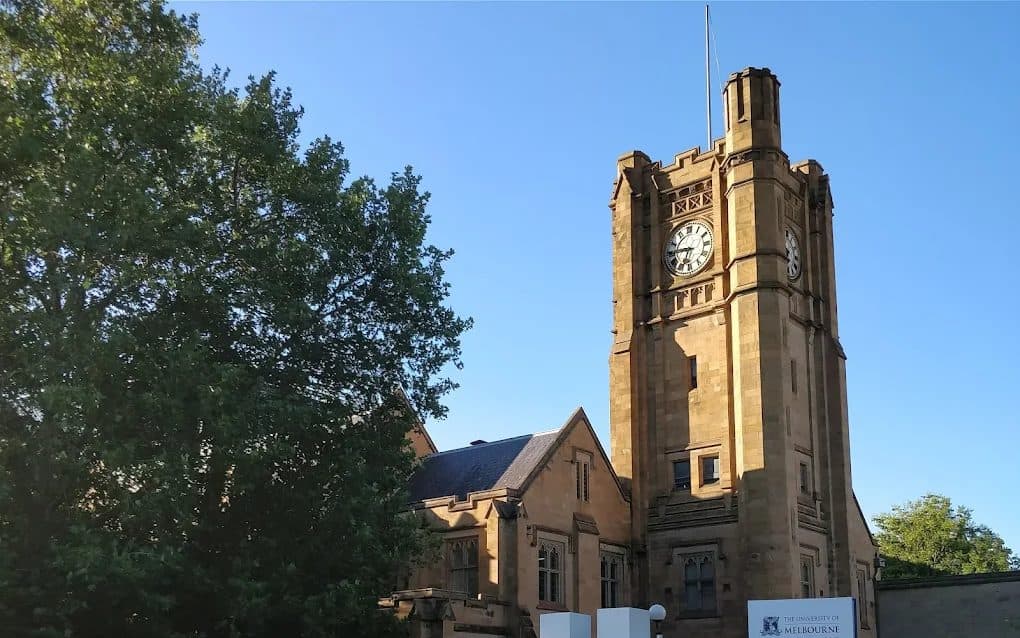
The University of Melbourne has a distinctive structure. Instead of offering dozens of narrow undergraduate degrees, it teaches a small number of broad three-year bachelor's degrees and keeps most professional training for graduate level. It calls this the Melbourne curriculum, and it explains why so many Indian students come to Melbourne for a master's: the graduate school is the centre of the university. Founded in 1853 as Victoria's first university, Melbourne is =22nd in the world in the QS World University Rankings 2027 and =34th in the THE World University Rankings 2027.
If you are an Indian student planning to study in Australia, Melbourne is likely on your shortlist. This guide covers what matters for your application: University of Melbourne fees for Indian students for 2027, the entry scores for CBSE, ISC and Karnataka PUC, the English rule most Indian graduates don't know about, scholarships, deadlines, and the visa and post-study work rules that apply to Indian citizens.
The University of Melbourne at a Glance
The main campus is at Parkville, just north of Melbourne's city centre, and it hosts all the courses covered in this guide. The university's own figures show that just over half of its study load is at graduate level. Melbourne also claims No. 1 in Australia for graduate employability in the THE 2026 rankings.
The Melbourne Curriculum: Why It Matters for Your Choice
- Broad bachelor's, specialised master's: you take a three-year bachelor's degree (such as Commerce, Science, Arts, Biomedicine or Design) with a major and some breadth subjects, then go on to professional graduate study or straight into work.
- Engineering is a graduate degree: Melbourne no longer runs a single "Master of Engineering". It offers separate three-year degrees, such as the Master of Software, Mechanical, Civil, Electrical or Chemical Engineering. As a school leaver, you would usually take a Bachelor of Science first.
- Graduate Degree Packages and ATAR guarantees apply to Australian Year 12 and IB students, not to Indian Class XII. Plan your Indian application around the published entry scores below.
What Can You Study at Melbourne?
1. Information Technology and Computer Science
The Master of Information Technology is open to graduates from any discipline with WAM 65% and one programming subject, so it is a good option for BCom, BSc or mechanical engineering graduates moving into tech. The Master of Computer Science is for computing graduates, requires a WAM of 75%, and runs from a March intake only. The Master of Data Science accepts any degree with WAM 65%, as long as you bring programming plus Calculus 2 and Linear Algebra equivalents.
2. Engineering
The three-year engineering master's degrees (Software, Mechanical, Civil, Electrical, Chemical and others) ask for a WAM of 65% plus 25 points each of university-level maths and science. The one-year Master of Engineering Management is an option for engineers who want to move into management.
3. Business and Management
The Master of Management and its specialist streams accept graduates from any discipline, with a guaranteed pathway through the online Graduate Certificate in Business (WAM 70%). The MBA is a full-time two-year program run by Melbourne Business School, with a 2026 indicative total fee of A$120,384. MBS sets its own fees, so check its site for 2027.
4. Science and Biomedicine
The Bachelor of Science and Bachelor of Biomedicine are the main undergraduate routes into Melbourne's research-intensive sciences, and many graduates go on to its graduate health and engineering programs.
Popular Melbourne choices for Indian students: Master of Information Technology, Master of Computer Science, Master of Data Science, Master of Software Engineering and the other engineering master's degrees, Master of Management, Master of Engineering Management, Bachelor of Commerce and Bachelor of Science.
Entry Requirements for Indian Students
Undergraduate: Published Entry Scores for Indian Boards
| Course | CBSE / ISC (2027 entry) | Indian state boards | Prerequisites |
|---|---|---|---|
| Commerce | 90 | 93 | English and Mathematics |
| Science | 85 | 85 | English, Mathematics and one of Biology, Chemistry or Physics |
| Biomedicine | 89 | 90 | English, Chemistry and Mathematics |
| Design | 80 | 85 | English |
| Arts | 74 | 75 | English |
- How the score is worked out: the average of your best four final-year subjects, for CBSE, ISC and the accepted state boards alike.
- The 2027 change: CBSE and ISC scores are higher for 2027 entry than for 2026 (Commerce went from 81 to 90, and Science from 75 to 85). Many websites still quote the old figures, so use the 2027 ones when you plan.
- Which state boards count: only three are accepted for direct entry: the Tamil Nadu HSC, the Maharashtra HSC and the Karnataka Pre-University Certificate.
- Online schooling: Melbourne does not accept overseas school qualifications completed entirely online through offshore study centres.
- English for school leavers: passing English in the CBSE or ISC Class XII meets Melbourne's undergraduate English requirement.
Postgraduate (Master's)
- Degree level: Melbourne asks for a bachelor degree (AQF7), the level of a standard three-year Australian bachelor's, plus a minimum WAM that varies by course. The university converts your Indian marks with its Grade Conversion Eligibility Calculator. Try it with your own percentage before you apply.
- Master of IT: any discipline, WAM 65%, plus one programming subject. A CS/IT bachelor's can earn up to 50 points of credit, and a four-year CS/IT bachelor's up to 100 points (with advanced study or two years' relevant work experience). For BE and BTech computer science graduates, that can shorten the course significantly.
- Master of Computer Science: a computer science bachelor's with WAM 75% and at least 25 points of university maths or statistics.
- Master of Data Science: any degree with WAM 65%, a programming subject, and Calculus 2 and Linear Algebra equivalents.
- Engineering master's degrees: WAM 65% (H3) with 25 points each of maths and science.
English Language Requirements
| Melbourne level | IELTS Academic | TOEFL iBT | PTE Academic |
|---|---|---|---|
| Level 1 (standard: MIT, MCS, Management) | 6.5, no band below 6.0 | 81 (W19, S19, R16, L16) | 64, 60 in all sections |
| Level 2 | 7.0, bands 6.5 | 91 | 72 |
| Level 3 | 7.5, bands 7.0 | 100 | 78 |
Plan for an English test from the start. Many Indian graduates assume their English-medium degree exempts them from IELTS. At Melbourne it does not: the graduate English page states that its prior-study exemption does not apply to institutions in India. Book IELTS, PTE or TOEFL early, at a test centre and in a single sitting, and aim to have your score before you apply rather than as an offer condition. That keeps your application moving and gives you time to plan your visa. If you would like help fitting your test date around the 30 November deadline, talk to us.
Tuition Fees for 2027
| Course | 2027 first-year fee | 2027 total course fee |
|---|---|---|
| Master of Information Technology (2 yrs) | A$68,480 | A$143,808 |
| Master of Computer Science (2 yrs) | A$68,480 | A$143,808 |
| Master of Data Science (2 yrs) | A$61,440 | A$129,024 |
| Master of Management (2 yrs) | A$65,248 | A$137,021 |
| Master of Software / Mechanical / Civil / Electrical Engineering (3 yrs) | A$66,752 | A$220,950 |
| Master of Engineering Management (1 yr) | A$66,752 | A$66,752 |
| Bachelor of Commerce (3 yrs) | A$56,451 - A$62,464 | A$180,714 - A$200,139 |
| Bachelor of Science (3 yrs) | A$55,556 - A$65,344 | A$181,310 - A$211,405 |
These are from Melbourne's 2027 International Fee Tables. Course pages may still show 2026 figures (for example, A$64,000 for the Master of IT), and older aggregator sites often quote the 2025 fee of about A$58,976, so use the 2027 table. You pay a minimum A$17,000 tuition deposit to accept your offer. International students do not pay the Student Services and Amenities Fee.
How to estimate your visa funds. For a Student visa, Home Affairs expects evidence of 12 months of course fees, A$29,710 for 12 months of living costs, and about A$2,000 for travel from outside Australia. For the Master of IT in 2027 that is roughly A$100,000 for the first year, less any deposit already paid. Alternatively, a parent's personal income of at least A$87,856 in the previous 12 months can meet the requirement (both parents' incomes can be combined). Melbourne doesn't publish an annual living-cost total, but its cost-of-living page quotes Victorian Government median weekly rents of A$475 for a one-bedroom flat and A$575 for a two-bedroom flat. Sharing a flat is how many students keep costs down.
Scholarships for Indian Students
- 1. Melbourne International Undergraduate Scholarship: 20% from 2027 (India eligible)
- Open to citizens of countries with a GDP per capita of US$10,000 or less, and India is on the university's eligible-country list. Awards made from 2027 give a 20% fee remission for the whole course (earlier awards were 25%, so ignore sites that still quote that figure). There is no separate application: you are assessed automatically on your final (not predicted) school results. It cannot be combined with another fee scholarship.
- 2. Graduate Research Scholarships
- For PhD and research master's students: a 100% fee offset (up to four years for a PhD, two for a research master's), a living allowance of A$41,100 a year at the 2027 full-time rate, a A$3,000 relocation grant for students moving from overseas, and Overseas Student Health Cover. About 600 are awarded. This is the most affordable way to study at Melbourne.
- 3. External funding for master's students
- Because we could not verify a current India-specific coursework master's scholarship on Melbourne's official site, most Indian master's students fund their studies through a mix of family savings, education loans and external awards such as the JN Tata Endowment or the KC Mahindra Scholarships for Postgraduate Studies Abroad. Check each funder's current terms directly.
Check scholarship names against the official site. Aggregator sites often promote a "Melbourne India Postgraduate Program" or a "Melbourne Graduate Scholarship" for Indian master's students. As of September 2026 we could not find either on the University of Melbourne's official scholarships site, and the old award pages no longer load. Build your plan on awards you can confirm on scholarships.unimelb.edu.au, and treat anything else as unconfirmed until the university lists it.
Key Dates for 2027
| Intake | Undergraduate deadline | Graduate deadline (e.g. MIT, Management) |
|---|---|---|
| Semester 1, 2027 (February/March) | 30 November 2026 | 30 November 2026 |
| Semester 2, 2027 (July) | 31 May 2027 | 31 May 2027 (MCS and MDS: March intake only) |
Your Student Visa: What Applies to You
- Visa: the Student visa (subclass 500), which allows up to six years of study in line with your enrolment. The application charge for most primary applicants is A$2,500 from 1 July 2026 (up from A$2,000). Check the current figure in the Home Affairs Visa Pricing Estimator.
- Genuine Student requirement: since 23 March 2024 every applicant must show that study is the main reason for the visa. You answer the application form's questions, with a 150-word limit per response, about your circumstances, why you chose this course at Melbourne, and how it benefits you. Home Affairs says that wanting permanent residence later does not count against you.
- Money: 12 months of fees plus A$29,710 living costs and travel, or a qualifying parental or partner income of A$87,856.
- Work: up to 48 hours a fortnight while your course is in session, and unlimited hours during scheduled course breaks. Research master's and PhD students have no limit.
- Health cover: Overseas Student Health Cover is compulsory throughout your stay.
Post-Study Work for Indian Graduates
| Your Melbourne qualification | Standard 485 stay | Indian nationals (AI-ECTA) |
|---|---|---|
| Bachelor's (including honours) | 2 years | 2 years |
| Bachelor's with first-class honours in STEM or ICT | 2 years | 3 years |
| Master's by coursework (e.g. MIT, engineering master's) | 2 years | 3 years |
| Master's by research | 3 years | 3 years |
| PhD | 3 years | 4 years |
Under the Australia-India Economic Cooperation and Trade Agreement, Home Affairs gives Indian nationals three years on the Temporary Graduate visa (subclass 485) after any master's degree, compared with two years as standard. A two-year Master of IT can therefore lead to three years of full work rights. You must be 35 or under when you apply (under 50 for research degrees), and meet the 485's English level of IELTS 6.5 overall with 5.5 in each band for tests taken on or after 7 August 2025. Melbourne is not a designated regional area, so the extra second-485 year for regional graduates does not apply.
Applying from Bangalore and Karnataka
- Karnataka II PUC students: Melbourne is one of the few universities that names your board directly. The Karnataka Pre-University Certificate is one of only three Indian state board qualifications accepted for direct entry, assessed on your best four final-year subjects. Aim for at least 93 for Commerce or 85 for Science and take the prerequisite subjects (Mathematics, and Physics, Chemistry or Biology for Science). Melbourne's English exemption for school leavers names CBSE and ISC English but not PUC, so book an English test.
- CBSE and ICSE/ISC schools in Bangalore: use the 2027 CBSE/ISC entry scores above (90 for Commerce, 85 for Science). Passing English in Class XII meets the undergraduate English requirement.
- Graduates of VTU, Bangalore University, IISc, NITK Surathkal, RV, PES, BMS or Manipal: Melbourne does not publish a list of Indian institutions. Every degree goes through the same grade conversion to a WAM, so run your marks through the Grade Conversion Eligibility Calculator. A four-year BE or BTech in CS or IT from any of these institutions may earn up to 100 points of credit in the Master of IT, which is worth checking before you apply.
- Your visa from Bangalore: you lodge the Student visa online through ImmiAccount. India is not on the Home Affairs list of Australian Biometrics Collection Centre locations (correct as of March 2026). If Home Affairs needs your biometrics, it tells you after you lodge how to provide them, at a collection centre or, if you are eligible, through the Australian Immi app, and gives you 14 days to do it. Follow the ImmiAccount instructions, including any health examination with a Home Affairs-approved panel physician.
- Flights: from Kempegowda International Airport (BLR), students usually reach Melbourne on a one-stop connection through a major Asian hub. Check current routes when you book.
- Local help: Falcon Nova's office is on the 7th floor of Kirloskar Business Park in Hebbal, North Bangalore, and you can book free counselling there or online.
Is the University of Melbourne Right for You?
Melbourne suits students who want a leading research university with a strong graduate school, in one of Australia's biggest student cities. It is especially good for IT and computer science master's degrees, engineering and management. Its published entry scores, its recognition of the Karnataka PUC and its automatic 20% undergraduate scholarship make planning straightforward, and an Indian master's graduate can expect three years of post-study work. Two things to plan for are the English test and the 2027 fee levels. If you are comparing options, look at UNSW Sydney and the University of Sydney side by side before you decide.
Plan Your Melbourne Application Before 30 November
Melbourne rewards careful preparation: your WAM run through its grade conversion, the right master's for your background (the Master of IT for career changers, the Master of Computer Science at WAM 75% for computing graduates), an English score in hand before the 30 November deadline, and a Genuine Student response that explains why Melbourne's graduate model suits you. Falcon Nova Consultants has helped hundreds of Indian students plan their study abroad applications. Book a free, no-obligation counselling session at our Hebbal office in North Bangalore or online, and we will build your Melbourne application around the details that matter for your course.
Book Your Free Counselling Session