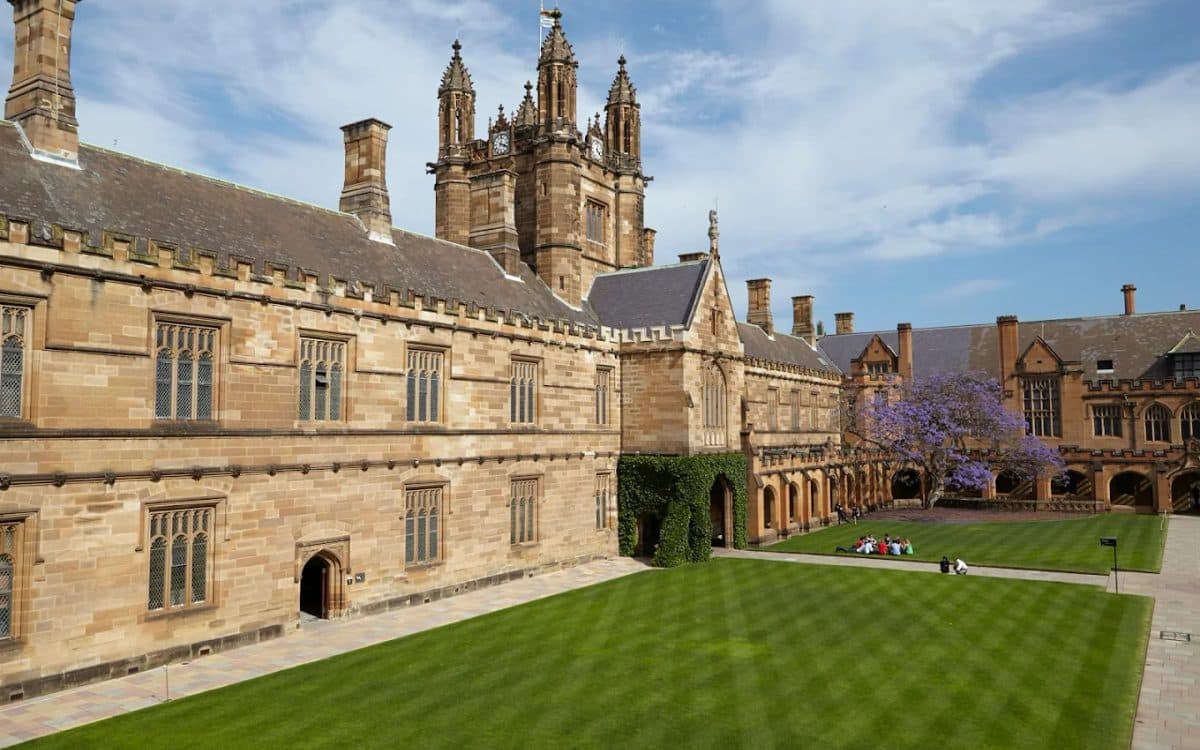
The University of Sydney was incorporated by the New South Wales Parliament on 1 October 1850, making it the first university established in Australia. Its sandstone Quadrangle has been in use since the 1850s and is still the centre of the Camperdown campus. Today Sydney is a large, international university: 28th in the world in the QS World University Rankings 2027 and 51st in the THE World University Rankings 2027, which puts it second in Australia on THE. Nearly half of its students come from overseas.
For Indian students planning to study in Australia, Sydney offers something useful: it publishes entry scores for CBSE, ISC and named Indian state boards, including Karnataka. It also offers scholarships specifically for Indian students, and Commerce and Engineering are among its strongest subjects. This guide explains how to study at the University of Sydney as an international student from India, covering 2027 fees, entry scores, English tests, scholarships, deadlines and the visa and post-study work rules that apply to you.
The University of Sydney at a Glance
Sydney's own 2025 Annual Report shows 15,648 international undergraduates and 20,192 international postgraduates, including 18,110 in coursework master's degrees. As an Indian master's student, you would join a large international postgraduate community. Most teaching takes place on the Camperdown/Darlington campus, a short distance from Sydney's city centre, and the full-time MBA is taught at the Sydney CBD campus.
What Can You Study at Sydney?
1. Computer Science and Data Science
The Master of Computer Science is a two-year degree open to graduates of any discipline with a credit average (65%), so it works for career changers. An advanced-entry version is shorter for computing graduates. The Master of Data Science takes 1.5 years and suits graduates of a cognate three-year degree with a programming or statistics background. Note that Sydney's old Master of Information Technology web address now redirects to the Master of Computer Science, so if you are searching for "Sydney MIT", this is the degree to look at.
2. Engineering
The Master of Professional Engineering runs for three years in streams such as Software, Civil, Electrical and Mechanical. It accepts engineering graduates, and non-engineering graduates with about a year of relevant maths, science or computing. The accelerated two-year version is designed for graduates with a Bachelor of Engineering in a related field. At undergraduate level, the Bachelor of Engineering Honours is a four-year degree.
3. Business and Commerce
The Master of Commerce (1.5 years, or 2 years for the Extension version) is one of Sydney's most popular degrees with Indian business graduates, and the Bachelor of Commerce has one of the university's highest entry scores. If you are interested in an MBA, the full-time MBA (Leadership and Enterprise) is the one open to student-visa holders (see the note below).
4. Science, Medicine and Health
Sydney is a comprehensive research university with major faculties of science, medicine and health. The Bachelor of Science is the broad entry route, with published Indian board scores lower than those for Commerce and Engineering.
Popular Sydney choices for Indian students: Master of Computer Science, Master of Data Science, Master of Professional Engineering (Software, Civil, Electrical, Mechanical), Master of Commerce, Bachelor of Engineering Honours, Bachelor of Commerce and Bachelor of Advanced Computing.
Choosing the right MBA. Sydney offers more than one MBA, and they are not all open to student-visa holders. The standard MBA is part-time only and marked "not available to student visa holders", and the MBA (Technology and Digital Strategy) is online. The full-time option for Indian applicants is the MBA (Leadership and Enterprise): 18 months, taught at the Sydney CBD campus, and requiring at least three years of work experience. The 20% Sydney International Student Award does not apply to MBAs, so plan your budget around the full fee.
Entry Requirements for Indian Students
Undergraduate: Board-by-Board Scores for 2027
| Course (2027 entry) | CBSE (grade points) | ISC | State boards (HSSC) |
|---|---|---|---|
| Bachelor of Commerce | 19 | 94 | 95 |
| Bachelor of Engineering Honours | 15.5 | 87 | 85 |
| Bachelor of Advanced Computing | 17 | 90 | 95 |
| Bachelor of Science | 14 | 84 | 85 |
- CBSE is scored in grade points, not percentages: English or Hindi plus your best four other externally examined subjects, with A1 = 4, A2 = 3.5, B1 = 3, B2 = 2.5, C1 = 2 and so on. Five A1 grades with an average mark of 96 or more counts as 21. This conversion is worth knowing, because many students assume the scores are percentages.
- ISC: the average of your best four subjects, including English.
- State boards: the average of your best five academic subjects. The published scores apply to Andhra Pradesh, Gujarat, Karnataka, Maharashtra, Tamil Nadu and West Bengal, and Sydney says the requirement is higher for other states.
- Same scores as last year: the 2027 figures match the 2026 guide, so you can plan with confidence.
Postgraduate (Master's)
- Master of Computer Science: a bachelor's in any discipline with a credit average (65%) or an equivalent qualification. The advanced-entry version requires a computing degree at 65%.
- Master of Data Science: a three-year Australian bachelor's in a cognate discipline, or equivalent, with a programming or statistics background at 65%. Because Sydney's own benchmark is a three-year degree, a three-year Indian bachelor's is assessed on its merits rather than excluded for its length.
- Master of Professional Engineering: a Bachelor of Engineering at 65%, or a non-engineering bachelor's at 65% with about a year of relevant maths, science or computing.
- Master of Commerce: a commerce or business bachelor's at 65%. Alternatively, any bachelor's at 50% with a GMAT (class average 630, or 585 on GMAT Focus), or any discipline at 65% with a year of work experience.
- How your marks convert: Sydney does not publish a fixed Indian percentage that equals its 65% credit average, and it assesses each transcript individually. Ask Sydney, or ask us, for a reading of your transcript before you pay the application fee.
English Language Requirements
| Level | IELTS Academic | TOEFL iBT | PTE Academic | Used for |
|---|---|---|---|---|
| Standard | 6.5, no band below 6.0 | 85 (R/L/S 17, W 19) | 64, 60 in each | Computer Science, Data Science, Engineering |
| Higher | 7.0, no band below 6.0 | 96 | 72, 60 in each | Commerce (UG and PG), MBA |
IELTS Online and TOEFL Home Edition are not accepted, TOEFL must be the "TOEFL for Australia" version, and tests must be no more than two years old when your course starts. In-person LanguageCert Academic and Cambridge C1/C2 are also accepted. For postgraduate entry, Sydney can also consider a three-year undergraduate degree taught in English case by case, so a test score is the safest way to keep your application moving.
Tuition Fees for 2027
| Course | Duration | 2026 annual fee | 2027 annual fee |
|---|---|---|---|
| Master of Computer Science | 2 years | A$57,900 | A$60,800 |
| Master of Data Science | 1.5 years | A$57,900 | A$60,800 |
| Master of Professional Engineering | 3 years (2 accelerated) | A$57,900 | A$60,800 |
| Master of Commerce | 1.5 years | A$61,700 | A$64,800 |
| MBA (Leadership and Enterprise) | 18 months | A$60,100 | A$63,100 |
| Bachelor of Engineering Honours | 4 years | A$60,600 | A$63,600 |
| Bachelor of Commerce | 3 years | A$56,300 | A$59,100 |
These are Sydney's indicative fees per year of full-time study (48 credit points). The university says they increase each year. Across the university, 2027 undergraduate fees range from about A$55,100 (Arts, Design) to A$63,600 (Engineering, Science, Advanced Computing). Older websites quoting A$45,000 to A$50,000 for a master's are several years out of date.
Use the current visa living-cost figure. Sydney's living-costs page still quotes a Student visa financial-capacity figure of A$24,505 a year, but Home Affairs now requires A$29,710 for 12 months of living costs. Add your first year's tuition and about A$2,000 for travel from outside Australia. For a Master of Computer Science in 2027 that is roughly A$92,500. A parent's personal income of at least A$87,856 in the previous 12 months is an alternative way to meet the requirement. For day-to-day budgeting, Sydney's own guide gives monthly ranges of A$980 to A$3,500 for accommodation, A$1,000 to A$2,500 for food and A$130 to A$800 for transport.
Scholarships for Indian Students
- 1. Sydney International Student Award: 20% for your whole course
- India is an eligible country. The award gives 20% off tuition for the full length of an undergraduate or postgraduate coursework degree to full-time students starting in 2027. You apply by submitting a personal statement with your application: three answers of up to 200 words each. It does not cover MBAs, the EMBA, distance courses or study abroad. Write your three answers carefully, because they decide the award.
- 2. Vice-Chancellor's International Scholarships Scheme: up to A$60,000
- Awards come in five tiers: A$60,000 and A$40,000 paid over one year, and A$20,000, A$10,000 and A$5,000 paid for one semester. There is no application: you are considered automatically once you hold an unconditional offer, subject to available funds. If you also hold the Sydney International Student Award, the Vice-Chancellor's award is capped at A$40,000. For Semester 1, 2027, rounds close on 17 August, 5 October and 16 November 2026, so securing an unconditional offer early gives you more chances. Sydney's India scholarships page still says "up to A$40,000", but the scheme's own page gives the current A$60,000 figure.
- 3. Sydney Scholars India Scholarship Program
- An India-only program worth A$500,000 in total, with 28 awards a year: two 100% undergraduate tuition scholarships, ten A$20,000 awards and sixteen A$10,000 awards, the last two paid for the first year. It is for Indian citizens living in India. The most recent round opened on 1 April and closed on 24 May 2026, so watch the scholarship page for the next round and have your application ready.
- 4. Sydney International Undergraduate Academic Excellence Scholarship
- 100% tuition plus the student services fee for up to four years, with about 20 awarded worldwide each year. It is very competitive and aimed at exceptional school leavers.
Know which awards need an application. Many aggregator sites describe the 20% Sydney International Student Award as automatic. It is not: it depends on your personal statement. The Vice-Chancellor's scheme is the one that needs no application. You may also see the Sydney Scholars India Equity Scholarship listed as a general award, but it is only for residents of specific Delhi communities nominated by the ASHA society. Knowing which award needs what helps you apply for the right ones.
Key Dates for 2027
| Intake | Undergraduate (international) | Postgraduate (international) |
|---|---|---|
| Semester 1, 2027 (February) | 1 December 2026 | 18 December 2026 |
| Semester 2, 2027 (August) | 29 May 2027 | 29 May 2027 |
Sydney warns that courses may close early once full, and it recommends applying six to eight weeks before the start date as a minimum. Most courses in this guide take both February and August intakes. The Bachelor of Engineering Honours (Flexible First Year) takes February only. Sydney had not yet published exact 2027 start dates when we checked.
Your Student Visa: What Applies to You
- Visa: the Student visa (subclass 500), which allows up to six years of study in line with your enrolment. The application charge for most primary applicants is A$2,500 from 1 July 2026 (up from A$2,000). Check the Home Affairs Visa Pricing Estimator before you pay.
- Genuine Student requirement: since 23 March 2024 you must show that study is the main purpose of your visa. You answer the application form's questions, with a 150-word limit per response, about your circumstances, why this Sydney course, and how it will benefit you. Home Affairs states that wanting permanent residence in the future does not count against you.
- Funds: first-year fees plus A$29,710 living costs and travel, or a parent's or partner's income of A$87,856.
- Work: up to 48 hours a fortnight while your course is in session, and unlimited hours during scheduled course breaks. Research master's and PhD students have no limit.
- Health cover: Overseas Student Health Cover is compulsory throughout your stay.
Post-Study Work for Indian Graduates
| Your Sydney qualification | Standard 485 stay | Indian nationals (AI-ECTA) |
|---|---|---|
| Bachelor's (including honours) | 2 years | 2 years |
| Bachelor's with first-class honours in STEM or ICT | 2 years | 3 years |
| Master's by coursework | 2 years | 3 years |
| Master's by research | 3 years | 3 years |
| PhD | 3 years | 4 years |
Under the Australia-India Economic Cooperation and Trade Agreement, Home Affairs gives Indian nationals three years on the Temporary Graduate visa (subclass 485) after a master's degree. This applies even to Sydney's 1.5-year Master of Data Science or Master of Commerce, which means up to twice as long working in Australia as you spent studying. A first-class honours in Engineering Honours or Advanced Computing also brings three years instead of two. You must be 35 or under when you apply (under 50 for research degrees), and the 485 requires IELTS 6.5 overall with 5.5 in each band for tests from 7 August 2025. Sydney is not a designated regional area, so the extra second-485 year does not apply.
Applying from Bangalore and Karnataka
- Karnataka II PUC students: Karnataka is one of the six states whose Higher Secondary results Sydney assesses at its published state-board scores. The II PUC exam is issued by the Karnataka School Examination and Assessment Board (KSEAB), and Sydney averages your best five academic subjects. The 2027 targets are 85 for Engineering Honours and Science, and 95 for Commerce and Advanced Computing.
- CBSE and ICSE/ISC schools in Bangalore: CBSE students should work out their score in grade points (for example, 15.5 for Engineering Honours) rather than percentages. ISC students use the average of their best four subjects including English.
- Graduates of VTU, Bangalore University, IISc, NITK Surathkal, RV, PES, BMS or Manipal: Sydney does not publish an Indian institution list or percentage cut-offs. Each transcript is assessed against its 65% credit average, so prepare full semester-wise mark sheets and your degree certificate early.
- Your visa from Bangalore: you lodge the Student visa online through ImmiAccount. India is not on the Home Affairs list of Australian Biometrics Collection Centre locations (correct as of March 2026). If Home Affairs needs your biometrics, it tells you after you lodge how to provide them, at a collection centre or, if you are eligible, through the Australian Immi app, and gives you 14 days to do it. Follow the ImmiAccount instructions, including any health examination with a Home Affairs-approved panel physician.
- Flights: from Kempegowda International Airport (BLR), students usually reach Sydney on a one-stop connection through a major Asian hub. Check current routes when you book.
- Local help: Falcon Nova's office is on the 7th floor of Kirloskar Business Park in Hebbal, North Bangalore, and you can book free counselling there or online.
Is the University of Sydney Right for You?
Sydney suits students who want a large, established university in Australia's biggest city, with strong computer science, engineering and commerce and a large international postgraduate community. For Indian applicants it offers clear board-by-board entry scores (including Karnataka), a 20% award you can plan for, an India-only scholarship program and short master's degrees that still bring three years of post-study work. If you want to compare it with another Sydney option, read our UNSW Sydney guide. The two campuses are in the same city but differ in teaching calendar and scholarships.
Put Together Your Sydney Application
At Sydney the details that make the biggest difference are converting your CBSE marks to grade points correctly, choosing between the Master of Computer Science and its advanced-entry version, writing the three 200-word answers that decide the 20% award, and securing an unconditional offer in time for the Vice-Chancellor's scholarship rounds. Falcon Nova Consultants has helped hundreds of Indian students plan their study abroad applications. Book a free, no-obligation counselling session at our Hebbal office in North Bangalore or online, and we will help you build a Sydney application that makes the most of every opportunity.
Book Your Free Counselling Session