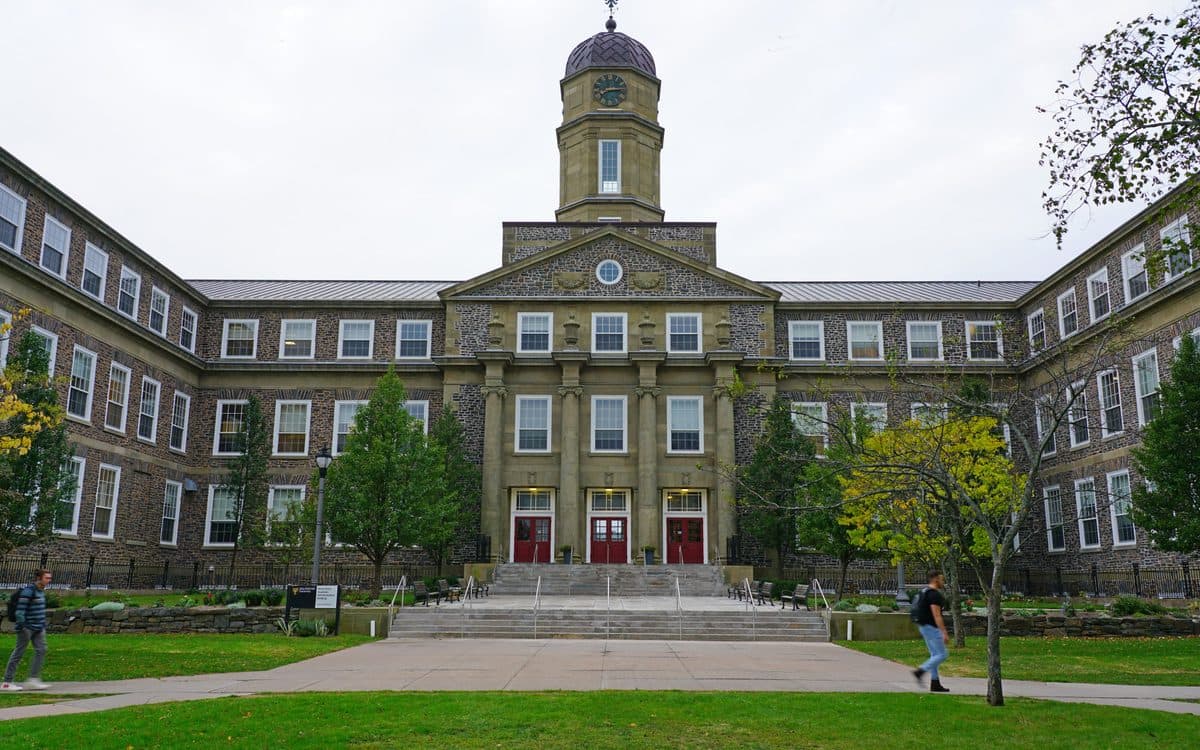
The detail that makes Dalhousie University easy to plan for is one most families only discover after they apply: Dal fixes an international undergraduate's tuition for the full length of the degree plus one year. The number in your offer is the number you pay every year — for engineering in 2026-27, that is $48,594, and for arts or science $37,992. Add more than 2,000 entrance awards open to international students, a coastal city that Dal says keeps you within 30 minutes of a beach, and one of Canada's top 15 research-intensive universities, and you have a strong, predictable option for Indian students planning to study in Canada.
Dalhousie was established in 1818 in Halifax, Nova Scotia, and today teaches about 20,000 students across 13 faculties, with three campuses in Halifax — Studley, Carleton and Sexton — and an Agricultural Campus in Truro. It is Nova Scotia's leading research university and reports more than $270 million in research funding a year. This guide covers what it takes to study at Dalhousie as an international student, with every number checked against Dal's own 2026-27 pages or the Government of Canada.
Dalhousie University at a Glance
What Can You Study at Dalhousie?
As a coastal research university, Dal is known for marine and ocean sciences, medicine and health, and it has full faculties of Engineering, Computer Science and Management. Four routes matter most to Indian applicants.
1. Engineering
Engineering is taught on the Sexton campus in downtown Halifax. Its guaranteed international tuition for 2026-27 is $48,594 a year. Co-op students in Engineering pay a co-op fee in the term before each placement — $562.38 in the 2026-27 master's fee schedule — and Dal notes that co-op graduates leave with a full year of work experience on their résumé.
2. Computer Science
The Faculty of Computer Science's guaranteed undergraduate tuition is $41,688 for 2026-27. At graduate level, programmes include the Master of Computer Science, the Master of Applied Computer Science and a master's in Digital Innovation.
3. Management
The Faculty of Management's guaranteed tuition is $42,042. Its Commerce programme has mandatory work terms, and Management Career Services oversees co-op and work-integrated learning for its students. The MBA (Corporate Residency) is a graduate option with a built-in work component.
4. Science, Health and Agriculture
Science and Arts and Social Sciences share the same guaranteed rate of $37,992, and the Faculty of Agriculture in Truro is Dal's lowest at $30,906. Health programmes such as Nursing, Health Sciences and Medical Sciences have their own earlier deadlines — 15 February 2027 for September 2027 entry.
Popular routes for Indian students: undergraduate Engineering, Computer Science and Commerce; Science degrees in marine and ocean-related fields; and at graduate level the Master of Applied Computer Science, the Master of Computer Science, engineering master's degrees and the MBA (Corporate Residency).
Admissions for Indian Students
Undergraduate
- Qualifications accepted from India: the All India Senior School Certificate (CBSE), the Indian School Certificate (CISCE) or another Senior Secondary School Certificate awarded after Standard XII. Admission depends on your subjects and grades as well as the certificate.
- Programme deadlines for September 2027: 15 February 2027 for Nursing, Health Sciences, Medical Sciences and Social Work; 1 March 2027 for Architecture. Most other programmes consider applications while space remains — but Dal encourages high school applicants to apply early to meet the 15 February entrance award deadline.
- Accepting your offer: pay your admission deposit by 1 May 2027, the same day proof of English is due. The guaranteed residence application deadline is 15 May 2027.
English language requirements
- Three years at an English-based secondary school is generally enough to meet Dal's undergraduate requirement — a useful point for students from English-medium schools in India.
- If you need a test: IELTS 6.5 overall, bands 6.0; TOEFL 90 with bands of 20 (or 4.5 overall on the new 1-6 scale); Duolingo 120; PTE Academic 61; CAEL 70; Cambridge C1/C2 180.
- Pathways: if your scores fall short, Dal can offer conditional admission through its English for Academic Purposes programme or partner institutions in Halifax.
Graduate
- English for graduate study: IELTS Academic 7.0, TOEFL iBT 92 (tests before 21 January 2026) or 4.5 on the new scale, PTE 65, CAEL 70. Some programmes ask for more.
- Waiver route: you can request a waiver during your application if you completed your degree at a recognised university where English was the language of instruction, in a country where English is an official language.
- Deadlines: international applicants must meet the earlier deadlines set for non-Canadian citizens on the Faculty of Graduate Studies' How to Apply page.
- No PAL for master's and PhD students at public institutions such as Dal from 1 January 2026.
The Real Cost of Dalhousie in 2026-27
| Faculty (international undergraduate) | Guaranteed tuition per year, 2026-27 |
|---|---|
| Faculty of Agriculture | $30,906 |
| Faculty of Arts and Social Sciences | $37,992 |
| Faculty of Science | $37,992 |
| Faculty of Computer Science | $41,688 |
| Faculty of Management | $42,042 |
| Faculty of Engineering | $48,594 |
- Including fees: Dal estimates fall and winter tuition and fees for international undergraduates at $33,091 to $51,503 for 2026-27.
- Residence: about $12,877 to $16,792 for lodging and a meal plan.
- Health and dental: full-time students are enrolled in the DSU Health and Dental Plans, listed at $491.89 in the 2026-27 graduate fee schedule; international students also receive a basic health insurance plan.
- What the guarantee covers: tuition for your programme's standard length plus one year. Incidental fees, extra credits beyond your programme and co-op fees are charged separately.
- Graduate example: for 2026-27, the Master of Computer Science and the Master of Applied Computer Science carry a programme fee of $11,303 a year, plus an international tuition fee of $24,685 a year for non-thesis programmes or $8,079 for thesis programmes. PhD students are not charged international tuition fees.
- Living costs: IRCC asks you to show $23,448 a year for living expenses outside Quebec for study permit applications from 1 September 2026.
Why the guarantee is worth more than it looks. Many universities quote a first-year fee and raise it each year you study. At Dal, eligible international undergraduates lock in their cohort's rate for the standard programme length plus one year, so a four-year engineering degree starting in 2026 is budgeted at $48,594 every year — and you know from day one what your family needs to plan for. Just remember to add incidental fees, which can change annually, when you build your budget.
Scholarships and Entrance Awards
- The General Entrance Award application — one form, hundreds of awards
- Applying directly from high school, you complete the General Entrance Award application after submitting your admission application. It considers you for scholarships (mainly academic achievement), bursaries (financial need) and hybrid awards (merit, leadership and need). Awards may be one-time or renewable for up to four years.
- Open to international students
- Dal states plainly that all students — domestic and international — are eligible to apply. More than 2,000 entrance awards are offered each year, with values ranging from about $1,000 to $80,000 (yearly and over four years).
- Eligibility and timing
- You typically need an 80% average, calculated on the five courses required for your programme, and you must be starting in the fall term. For 2027-28 entry the application opens on 1 October 2026 and closes on 15 February 2027, with offers sent in March 2027. Decisions use your Grade 12 first-semester final grades, and later marks are not used for reassessment — so your first-term Class 12 results matter.
Because the award decision rests on your first-semester Class 12 grades and your wider profile, the students who do best apply to Dal early and give the awards form real attention. If you would like help putting that application together, talk to us.
Co-op and Work-Integrated Learning
- 90% of Dal students take part in experiential and work-integrated learning each year, most of them in their second or third year.
- Co-op programmes run through Dal's Work-Integrated Learning and Co-operative Education team, with Management students supported by Management Career Services.
- Visa point: since 1 April 2026, post-secondary students no longer need a separate co-op work permit for a work placement that is a required part of their programme, as long as it makes up 50% or less of the programme and the school confirms the requirement in a letter.
- Tuition during co-op: under the guarantee, you are charged programme tuition in both fall and winter terms whether or not you are in classes, and co-op fees are charged separately.
Canadian Study Permit Essentials for 2026
- PAL for undergraduates: Nova Scotia's allocation under the 2026 international student cap is 8,480 study permit applications for students who need an attestation letter. Ask Dal about the PAL steps as soon as you accept your offer.
- Master's and PhD students at public institutions do not need a PAL from 1 January 2026, and eligible doctoral applicants outside Canada have a 14-day processing standard.
- Proof of funds: first-year tuition plus $23,448 for living costs and your travel.
- Work hours: up to 24 hours a week off campus in term time, unlimited in scheduled breaks.
Applying from Bangalore and Karnataka
- Karnataka II PUC: Dal's India entry includes "another Senior Secondary School Certificate awarded after Standard XII" alongside CBSE and CISCE — the category that covers state-board certificates such as the Karnataka School Examination and Assessment Board's II PUC. Confirm with Dal's international admissions team how your PUC subjects and marks will be read for your programme.
- Award timing for Karnataka students: Dal's entrance awards use Grade 12 first-semester final grades, so ask your PUC college early how and when it can issue those marks in a form Dal accepts before 15 February.
- Karnataka degrees for a master's: Dal assesses each graduate applicant against programme requirements rather than publishing a list of Indian institutions, so check your programme's page and contact it before applying with a degree from VTU, Bangalore University or another Karnataka university.
- Biometrics: IRCC lists a Bengaluru visa application centre (run by VFS Global) among its Indian collection points. Appointments are free to book, so book your slot as soon as IRCC asks for biometrics.
- Travel: from Kempegowda International Airport, expect at least one connection to reach Halifax.
- In person: Falcon Nova's office is on the 7th floor of Kirloskar Business Park in Hebbal, North Bangalore — book free counselling there or online.
Staying On After Graduation
- PGWP without a field-of-study restriction for bachelor's, master's and doctoral graduates.
- Three years for master's graduates whose programme lasted at least eight months, even if under two years.
- CLB 7 in English or NCLC 7 in French, in all four skills, is required when you apply for the PGWP.
- Work-integrated learning during your degree gives you Canadian references and experience to take into your job search.
Is Dalhousie Right for You?
Dalhousie is a strong choice if you want a research-intensive Canadian university with a fixed, published tuition, a real chance at entrance awards and a friendly coastal city. It suits students drawn to ocean sciences, health, engineering, computer science or business, and families who value knowing their costs for the whole degree up front.
Plan around three dates and Dal becomes very straightforward: the 15 February award deadline, the 1 May deposit and English deadline, and the 15 May residence deadline. Apply in the autumn before your intake, send strong first-semester Class 12 marks, and you give yourself the best chance at both a place and an award.
Ready to Plan Your Dalhousie Application?
Dalhousie rewards early, organised applicants: an admission application in the autumn, a General Entrance Award form in before 15 February, a clear answer on how your II PUC or degree is assessed, and your deposit, PAL and study permit lined up for September. Falcon Nova Consultants has helped hundreds of Indian students plan their study-abroad journey. Book your free, no-obligation counselling session — at our Hebbal office or online — and let us build your Dalhousie plan together.
Book Your Free Counselling Session