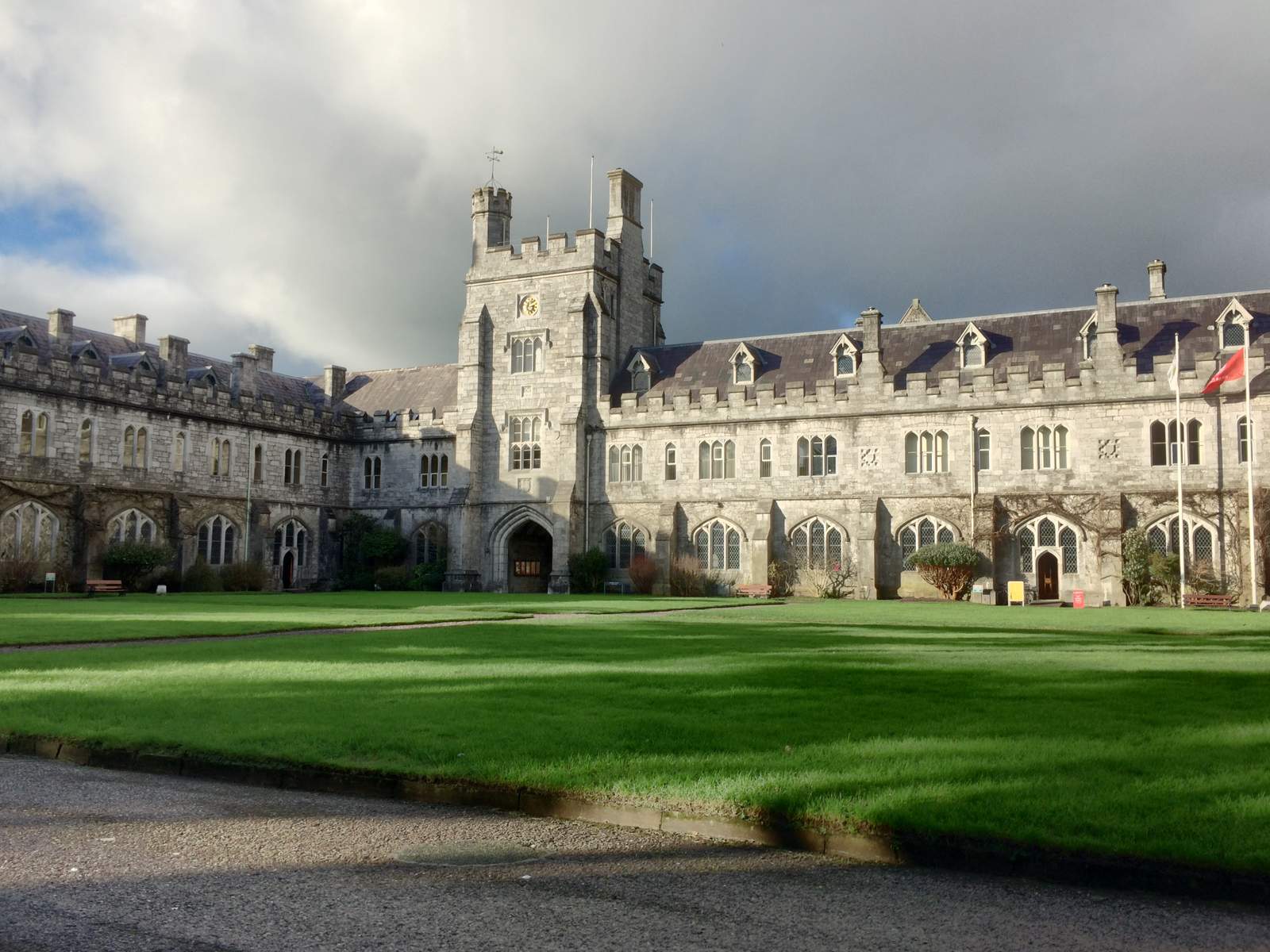
Maynooth University is one of the fastest-rising universities in Ireland. In the QS World University Rankings 2027, it moved into the 721–730 band from 771–780 the year before, the biggest jump of any Irish university that year. For Indian students it offers something even more useful than momentum: some of the clearest published entry rules in Ireland for Indian degrees, including a stated route for three-year bachelor's graduates.
Maynooth's roots go back to 1795, when St Patrick's College was founded. The modern university was established in 1997 and now teaches over 16,000 students across two connected campuses in Maynooth, County Kildare, about 25km west of Dublin. The South Campus has 19th-century buildings around St Joseph's Square, while the North Campus is modern. For Indian students who want to study in Ireland, it combines a proper university town with fees below many Dublin city-centre alternatives.
This guide covers how to study at Maynooth University as an international student: 2026-27 fees, the India entry tables, English requirements, international scholarships, and the Irish visa and work rules.
Maynooth University at a Glance
What Can You Study at Maynooth?
1. Computer Science and Data Science
Maynooth offers an MSc in Computer Science (Software Engineering), an MSc Computer Science (Applied) and an MSc in Data Science and Analytics. At undergraduate level, options include BSc Computer Science and Software Engineering, Computer Science with Artificial Intelligence, BSc Data Science, and BSc Robotics and Intelligent Devices. The university is also home to the Hamilton Institute, an interdisciplinary research institute, and the Innovation Value Institute, founded with Intel.
2. Business, Finance and Economics
The School of Business runs one-year master's in Business Analytics (with a January start option), Finance, Digital Marketing, Business Management, Supply Chain Management and International Accounting with Management, plus a full-time MBA. Economics has an MSc Economics, which comes with dedicated Edgeworth scholarships that are initially reserved for non-EU students.
3. Psychology, Social Sciences and Humanities
Maynooth has a long tradition in the humanities and social sciences. Psychology is among its most competitive undergraduate areas, and MA programmes in fields such as anthropology and Chinese studies are among its most affordable for non-EU students, at €16,000 for 2026-27. The ICARUS climate research centre also sits here, for students interested in geography and climate.
Most Popular Courses for Indian Students: MSc Data Science and Analytics, MSc Computer Science (Software Engineering), MSc Business Analytics, MSc Finance, MSc Digital Marketing, the MBA, and undergraduate Computer Science, Business and Psychology.
Entry Requirements for Indian Students
Postgraduate: Maynooth's Published India Table
| Irish grade | 4-year Indian degree | Delhi, Mumbai, Pune, Calcutta |
|---|---|---|
| 2H2 (lower second) | 60% overall | 55% may be considered |
| 2H1 (upper second) | 65% overall | 60% may be considered |
| 1H (first class) | 75% overall | 70% may be considered |
Good news for three-year graduates. Maynooth applies the same percentages to a three-year Indian bachelor's degree where the final year includes a research project, capstone project, thesis, dissertation or internship, as long as your transcript or programme descriptor shows it. If your final year had none of these, Maynooth may still consider 75% overall for certain business programmes. Gather the documents that show your final-year project before you apply, and your application becomes much stronger. If you're not sure whether your degree qualifies, ask us and we'll review it with you.
Undergraduate
- Qualifications: Standard XII from CBSE, CISCE or a recognised state board, plus your Standard X results.
- How your average is calculated: From your best five recognised subjects.
- Grade equivalences: H2 = 90% in XII, H4 = 85%, H5 = 80%, H7 = 75% in XII (or 80% in X).
- Programme bands: Maynooth sorts non-EU undergraduate programmes into four competitiveness bands, which it reviews each year. Psychology and Theoretical Physics are in band 1, Data Science, Engineering and Quantitative Finance in band 2, and many business, law and computer science programmes in band 3.
- Subjects: You need Mathematics and a language other than English up to Grade X.
English Language Requirements (2026/27 intake)
| Test | Maynooth minimum (UG and PG) |
|---|---|
| IELTS Academic | 6.5, no band below 6.0 |
| PTE Academic | 63, with 59 in each communicative skill |
| TOEFL iBT | 90, with 21 in writing and 19 in other sections |
| Duolingo English Test | 120, with 110 in each subscore |
Your certificate must be issued within two years of your programme start date, and single-module IELTS retakes are not accepted. Maynooth reviews these requirements every year, so check them against your intake.
Tuition Fees 2026-27
| Programme | Non-EU fee per year (2026-27) |
|---|---|
| BA (Arts, Psychology, Social Science) | €16,500 |
| Business and Law degrees | €17,000 |
| BSc Science, Engineering, Computer Science, Data Science | €18,000 |
| MA programmes (e.g. Anthropology, Classical Studies) | €16,000 |
| MSc Data Science and Analytics / MSc Psychology | €17,000 |
| MSc Business Analytics / Finance / Computer Science (Software Eng.) | €18,000 |
| Full-time MBA | €25,000 |
Non-EU students pay their fees in full before completing registration, using Maynooth's TransferMate payment system. Indian students paying by bank transfer are asked to upload supporting documents. Deposits are non-refundable, and Maynooth's refund policy on a visa refusal requires official proof of the refusal. Read the policy before you pay so every step goes smoothly.
Scholarships for International Students
Maynooth's International Office runs a set of non-EU scholarships each year. For the 2026 entry cycle, the awards were:
- Vice President International Scholar Award
- €7,500 off tuition for two outstanding taught postgraduate applicants who hold a first-class-equivalent degree from a university ranked in the QS or Times Higher Education top 500. Applications ran from 1 February to 31 March.
- International Excellence Scholarship
- €5,000 off tuition for one year, awarded to one taught postgraduate student from each of six regions, including South Asia. You'll need at least 80% in your primary degree. Applications ran from 1 February to 31 March.
- International Merit Award
- €1,500 off tuition for 25 students on full-time undergraduate or taught postgraduate programmes. Postgraduate applicants need at least 80% in their primary degree. Applications ran from 1 April to 30 June.
- Faculty and programme awards
- Including a €2,000 Arts and Humanities international postgraduate scholarship (65%-equivalent degree), a €5,000 MBA Excellence Scholarship, and €3,500 Edgeworth scholarships for MSc Economics, which are initially reserved for non-EU students.
Most of these awards need you to have accepted your offer and paid your deposit by the scholarship deadline, and several close as early as 31 March. The students who benefit are the ones who apply when applications open in October and hold an offer by early spring.
Ireland Visa and Work Rights
Your route from offer to Maynooth
- 1
Pay your tuition. Irish immigration requires at least €6,000 of your fees (or the full fee, if lower) to be paid before you apply for your visa.
- 2
Show your living funds. Show immediate access to at least €10,000 for a year of study, supported by six months of bank statements. For each later year of your course you also need access to another €10,000, on top of your fees.
- 3
Apply for your study visa on AVATS Online, with your Maynooth offer, fee receipt, financial evidence, English results and private medical insurance, then give biometrics and lodge your documents at VFS Global. The Embassy of Ireland in New Delhi lists usual study-visa decisions at 4–8 weeks from the day it receives your application, and applications made less than three weeks before your course starts cannot be guaranteed a decision.
- 4
Register within 90 days of arriving. Book an appointment with Immigration Service Delivery (ISD), whose Registration Office is on Burgh Quay in Dublin; the fee is usually €300. You'll receive Stamp 2 permission and an Irish Residence Permit (IRP) card, and Maynooth's international office can tell you how registration works for its students.
Applying to Maynooth from Bangalore and Karnataka
If you're applying from Bangalore or elsewhere in Karnataka, here's how Maynooth's published rules apply to you.
- Karnataka II PUC marks: Maynooth accepts Standard XII from a recognised state board, and Karnataka's II PUC is conducted by the Karnataka School Examination and Assessment Board (KSEAB). Your best five subjects set your average. Keep your SSLC marksheet ready, because Maynooth asks for Standard X results too. It doesn't name individual boards, so confirm with its admissions team how your II PUC marksheet will be assessed.
- Degrees from Karnataka universities: The lower master's thresholds in Maynooth's India table apply only to the Universities of Delhi, Mumbai, Pune and Calcutta. If you studied at VTU, Bangalore University or another Karnataka university, plan on the standard 60% (2H2), 65% (2H1) or 75% (1H). If you have a three-year degree, gather proof of your final-year project.
- Your visa application in Bangalore: VFS Global runs an Ireland Visa Application Centre in Bengaluru, open Monday to Friday, 08:00 to 16:00, so you can apply without travelling to another city.
- Getting to Maynooth: Plan for a one-stop journey from Kempegowda International Airport to Dublin, usually connecting through a Middle Eastern or European hub, then continue to Maynooth, about 25km west of the city.
- Talk to us in Hebbal: Falcon Nova's office is on the 7th floor of Kirloskar Business Park in Hebbal, North Bangalore, and you can book free counselling in person or online. If the October application opening is coming up, book a session and we'll help you get ready.
Life at Maynooth
Maynooth is a real university town: the campus, the high street and student life are all close together, and Dublin is a short commuter-train ride away when you want the capital. Many international students like this mix. They get a friendly, walkable place to live and study, with the capital's jobs, events and airport within easy reach.
Career Outcomes
- Dublin's job market within reach: Commuter rail connects Maynooth with the capital, so part-time work and graduate roles in Dublin are accessible.
- In-demand master's: Data science, software engineering, business analytics and finance match the areas where Irish employers recruit.
- Industry-linked research: The Innovation Value Institute, founded with Intel, reflects Maynooth's links with industry.
- Up to two years on Stamp 1G: Master's graduates can build Irish work experience before moving into an employment-permit role.
Is Maynooth Right for You?
Maynooth suits students who want a rising Irish university, transparent entry rules for Indian degrees (including three-year degrees), fees from €16,000, and a university-town lifestyle close to Dublin. If you're aiming for data science, computing, business or psychology, and you can plan ahead for the early-spring scholarship deadlines, Maynooth is a smart, well-priced choice.
Get Your Maynooth Application In Early
Maynooth opens 2027/28 applications on 14 October, and its biggest international scholarships have closed on 31 March, so the students who plan early benefit most. With published India entry rules that include three-year degrees and a place on Dublin's commuter rail line, Maynooth rewards a well-timed application. Falcon Nova Consultants has helped hundreds of Indian students plan their study abroad applications. Book your free, no-obligation counselling session and we'll check your eligibility, shortlist the right programme, and build your application around the scholarship deadlines.
Book Your Free Counselling Session