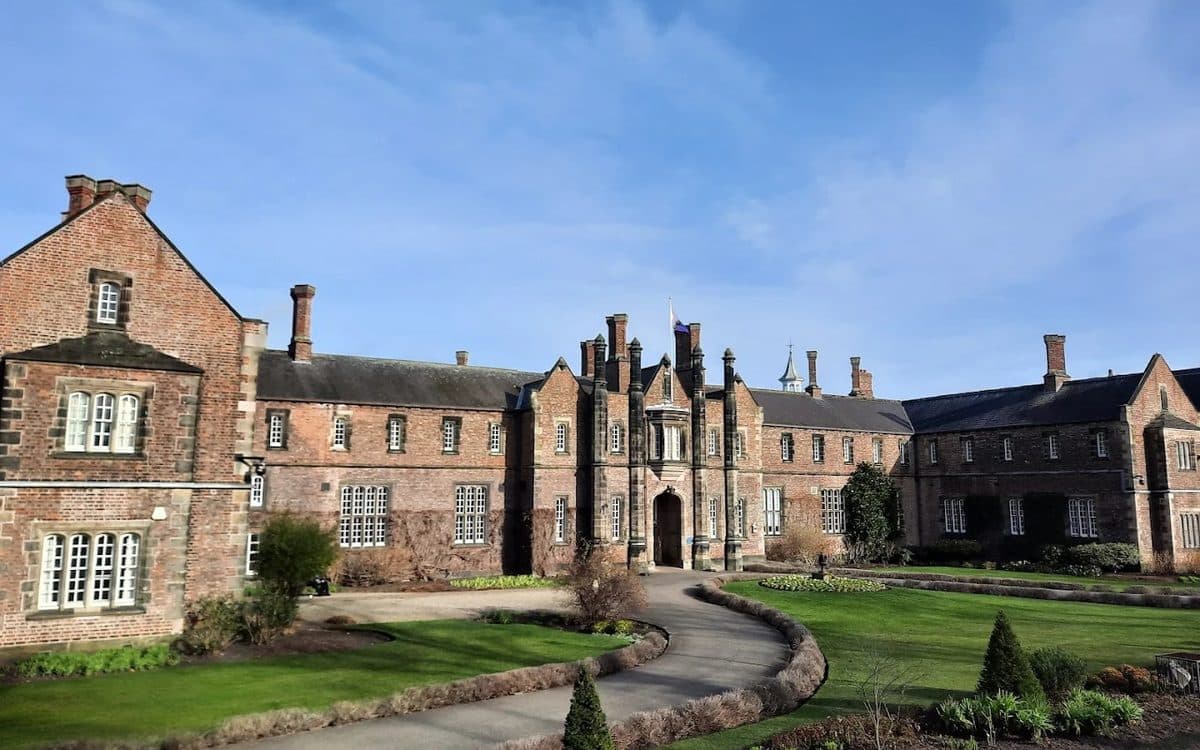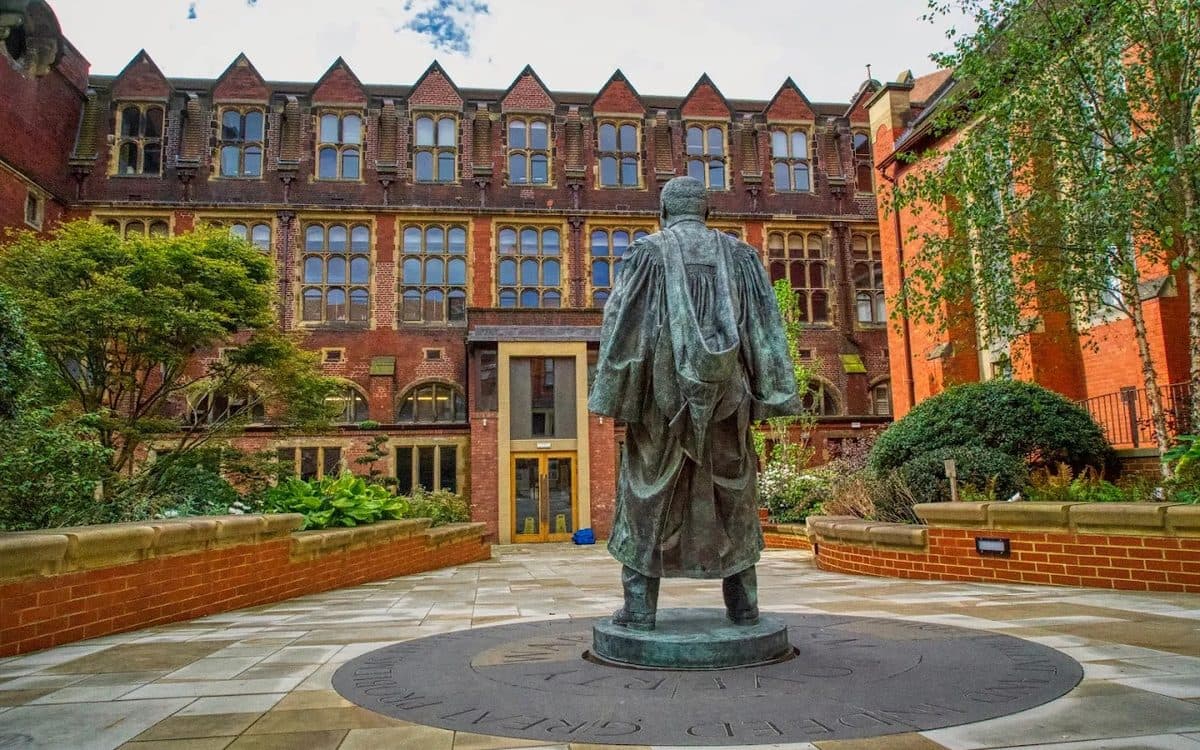
At the heart of Newcastle's campus, in a courtyard called King's Quad, stands a bronze figure in academic robes. It is Dr Martin Luther King Jr, and he is there because Newcastle gave him an honorary degree in 1967 — months before he was assassinated in April 1968. The university still lists that ceremony, on its own social justice page, alongside its living-wage and community-organising commitments. Most universities lead with a ranking. Newcastle leads with that.
The university's own story starts earlier, and starts with medicine. A School of Medicine and Surgery was founded in 1834 in the Barber Surgeons' Company Hall, followed by a College of Physical Science in 1871 to supply engineers and chemists to Tyneside's shipyards, mines and steelworks. The two merged in 1937 to form King's College — a division of the federal University of Durham. When that federation was dissolved, King's College became a university in its own right on 1 August 1963. Newcastle and Durham are, quite literally, the same institution split in two.
For Indian students planning to study in the UK, Newcastle answers a very specific brief: a Russell Group name, a medical and dental school, world-class marine engineering, and one of the cheapest student cities in Britain. This guide covers exactly how to study at Newcastle University as an international student — the real fees, the published Class XII conversion, the India scholarship that actually exists, and a clear-eyed view of where Newcastle fits best, so you can decide with confidence rather than guesswork.
Newcastle University at a Glance
Read Newcastle's rankings honestly. It is a genuine global top-150 university — QS placed it 149th in the world in the 2027 edition published on 18 June 2026, out of more than 1,500 institutions, its sixth consecutive year inside the top 150 — and 34th in the Times and Sunday Times 2026. But it sits 81st in the Guardian University Guide 2025, a table that weights teaching satisfaction and value added far more heavily. Newcastle publishes all three figures side by side on its own rankings pages, which is to its credit, but the spread is not a rounding error. If domestic league-table position is your family's primary filter, Newcastle will look weaker than its research and its city deserve. And treat any site calling Newcastle a global top 100 university as wrong, not just dated. Newcastle publishes its own fifteen-year QS series on that page: its best position in the whole run is 110th, in 2023. It has never been inside the QS top 100. Knowing the accurate numbers is what lets you make the case for Newcastle on the strengths that are genuine — a six-year run inside the world top 150, 15th in the UK for research power, and eight subjects in the national top ten.
Newcastle and Durham — The Same University Until 1963
This comparison comes up in almost every counselling session, so it is worth settling. Durham and Newcastle shared one royal charter for over a century, and the two campuses are twelve minutes apart on the East Coast Main Line. What separates them now is not distance but shape.
- Durham ranks far higher domestically — 3rd in the Times and Sunday Times Good University Guide 2026 against Newcastle's 34th. On global tables the gap narrows considerably.
- Newcastle has the professional schools. Medicine, Dentistry, Architecture, Agriculture, Marine Engineering and a triple-accredited business school — Durham has none of the first five.
- Newcastle is a city of 300,000; Durham's city parish is about 23,000. That drives everything downstream: jobs, food, community, flights, nightlife.
- The South Asian community is not comparable. 11.4% of Newcastle residents are Asian or Asian British and around 4,600 were born in India (Census 2021). Across County Durham the Asian share is roughly 1.5%.
- Cost cuts Newcastle's way. Newcastle sits in the UK top 5 of the QS Best Student Cities 2027, and the university's own figures put rents and living costs up to 65% cheaper than London.
If you want the collegiate, historic, highly selective experience, read our Durham guide alongside this one. Plenty of students apply to both — and the twelve-minute train means whichever you pick, you get the other one on your doorstep.
What Can You Study at Newcastle?
1. Medicine and Dentistry — Where the University Began
Newcastle's medical school is the institution's founding faculty — it predates the university itself by 129 years. It runs two routes: the five-year A100 MB BS and the four-year accelerated A101 for graduates, which asks a UK first or 2:1 Honours degree or its international equivalent. Newcastle's admissions policy states both are available to Home and International students, and there is a Dental Surgery BDS alongside them. Entry is AAA at A-level or 36 IB points, and every applicant sits the UCAT.
The single most important thing an Indian medicine applicant needs to know about Newcastle. International applicants are ranked in a completely separate pool from home applicants, and Newcastle's published *2027 Entry Admissions Policy* states that for all international applicants — and all A101 applicants — UCAT score will form the sole basis for ranking and selection for interview. Read that precisely: you must first clear an academic screen against the minimum entry requirements, and failing it means rejection at that point. But once you are through the screen, the GCSE and A-level points system applied to home applicants is not used on you at all. Your UCAT alone decides whether you are interviewed. Newcastle also grants no UCAT exemptions — if your country has no test centre you are expected to travel to the nearest one — will not consider anyone in Situational Judgement Band 4, and does not accept foundation courses from other universities. If you are called, expect a different format from the home cohort: international applicants are normally interviewed by a panel of two, on campus or remotely, rather than through the Multiple Mini Interview circuit, with interviews running December to February. The UCAS deadline for 2027 entry is 15 October 2026 at 18:00 UK time, not January, and late applications are not normally considered. For a well-prepared applicant this clarity is actually an advantage: you know months in advance exactly which score decides your interview, so every hour of preparation goes where it counts. Sequencing a UCAT sitting against a 15 October deadline is precisely the kind of plan our counsellors can build with you — talk to us well before the autumn.
2. Newcastle University Business School
NUBS holds the full triple crown — AACSB, AMBA and EQUIS — which places it in the top 1% of business schools worldwide. Its AMBA accreditation has run for more than thirty-five years. The school sits in a £50 million building at Newcastle Helix, the university's 24-acre innovation district built with Newcastle City Council and Legal & General. Professional recognition is unusually broad: ACCA, ICAEW, CIMA, CFA Institute, CISI, CIM, CIPD, CIPS, CILT and CMI all accredit or affiliate with programmes here, and the school is a Bloomberg Experiential Learning Partner.
3. Marine Technology and Naval Architecture
This is Newcastle's most distinctive engineering strength and a direct inheritance from Tyneside's shipbuilding century. The facilities are not brochure language — they are working national assets, and there are very few universities anywhere that can offer this combination to an undergraduate.
- A towing tank running since 1951 — 37 metres long, 3.7 metres wide, 1.25 metres deep, with a carriage speed up to 3 m/s and a wavemaker.
- The Emerson Cavitation Tunnel, described by Newcastle as the largest commercial propeller test tunnel in the UK — a 3.10 × 1.22 × 0.81m test section reaching 20 knots, taking propellers from 150 to 400mm.
- A combined wind, wave and current tank — 11 × 1.8 × 1m with wind to 20 m/s — which Newcastle calls one of only a handful of such facilities in the world. It lets you model a full offshore environment in one place.
- A high-speed research vessel, The Princess Royal, and a marine station on the Northumberland coast — so the sea trials are real sea trials.
- Where graduates go, in Newcastle's own words: classification societies, ship operation, marine design and consultancy, offshore renewables, subsea and pipeline, and shipbuilding and repair.
4. Computing, Data and AI
The School of Computing is over sixty years old — Newcastle built one of Britain's first university computing laboratories — and now occupies the £58 million Urban Sciences Building at Helix. Newcastle's own accolades list puts it top 15 in the UK for Computer Science and Informatics at REF 2021 (UoA 11) and top 15 in the UK on the QS subject table, though a banner on the same page says top 20, so read it as comfortably inside the top twenty. It leads the £30 million National Innovation Centre for Data and the National Edge AI Hub funded by UK Research and Innovation, is a partner of the Alan Turing Institute, and its Cyber Security MSc is accredited by the National Cyber Security Centre. For an Indian applicant that NCSC accreditation is the useful signal: it is a government certification, not a marketing line.
5. The Subjects You Would Not Guess
Newcastle places eight subjects in the UK top ten in the Complete University Guide 2027, and the full list is idiosyncratic in a good way: Agriculture and Forestry, Creative Writing, Art and Design, Speech and Language Therapy, Asian Studies, Archaeology, English and Food Science. Newcastle owns working farms, a fine art school with a long reputation, and one of the country's strongest speech and language science departments. If your field is one of these eight, Newcastle outranks its own overall position of 35th by a very wide margin — and that, not the headline number, is the ranking you should actually be reading.
Most Popular Courses for Indian Students: MSc Computer Science and Advanced Computer Science, MSc Data Science and Advanced Artificial Intelligence, MSc International Business and MSc Business Analytics at NUBS, MSc Banking and Finance, MSc Electrical Power, MSc Civil and Mechanical Engineering, MSc Naval Architecture, Marine and Ocean Engineering, and MPH Public Health.
Entry Requirements for International Students
For Undergraduate Study — Class XII Is Accepted Directly
- A-Level range: ABB to AAA. ABB for Naval Architecture, Aerospace and Mechanical Engineering; AAB for Computer Science and Business Management; AAA for Medicine, Dentistry and — a surprise to most applicants — Architecture.
- Class XII conversion, published by Newcastle: AAA = 85% · AAB = 80% · ABB = 75%, taken as your Standard XII average.
- The board list is unusually generous. Newcastle names CBSE, CISCE, the National Institute of Open Schooling (NIOS), various state boards and autonomous schools as acceptable awarding bodies. State-board students are not treated as a special case here, which is a real advantage over several peer universities.
- Newcastle publishes no conversion above AAA, because AAA is the top of its typical offer range. There is no A*A*A tier to chase.
- Subject marks still count. Engineering, computing and science programmes look at your Maths and Physics or Chemistry marks specifically, not just the aggregate.
- Pathway routes: the Newcastle University International Study Centre runs an International Foundation, an International Year One and a Pre-Master's on campus, with guaranteed progression on meeting the success requirements. Newcastle is also an NCUK partner, so the NCUK International Foundation Year is a recognised route.
For Postgraduate Study — Understand the Three Sections
Newcastle bands Indian institutions into three sections and applies a different percentage to each. Graduates of the most highly regarded institutions face the lowest threshold. Newcastle does not publish which universities sit in which section, so confirm yours with admissions before you build a plan around a number. Newcastle also attaches an explicit caveat to this whole table — *admissions criteria may vary depending on the course you are applying for* — so treat the figures below as the baseline, not the final word on your specific programme. Pinning down your section band and course criteria before you shortlist is exactly the kind of groundwork our counsellors can help you with — talk to us and build your list on confirmed numbers.
- UK 2:1 equivalent — the usual master's requirement: 60% or CGPA 6.0 (Section 1) · 62% or 6.2 (Section 2) · 65% or 6.5 (Section 3).
- UK 2:2 equivalent: 58% or 5.8 · 60% or 6.0 · 63% or 6.3 across the same three sections.
- UK First Class equivalent: 65% or 6.5 · 68% or 6.8 · 70% or 7.0.
- A three-year Indian bachelor's is explicitly accepted. Newcastle's list of recognised qualifications includes the Bachelor Pass or General degree in Arts, Science or Commerce, alongside honours degrees and professional degrees.
- Here is the part most guides miss: most Newcastle taught master's ask a 2:2, not a 2:1. MSc Computer Science, Advanced Computer Science, Data Science, Business Analytics, Digital Marketing, Digital Business, International Business, HRM, Operations Logistics and Supply Chain Management, Civil, Mechanical, Electrical Power and Naval Architecture, Banking and Finance, and the MPH all state a 2:2 minimum — which for a Section 1 institution means 58%. The clear exceptions asking a 2:1 are the MBA, MSc Advanced Artificial Intelligence and MSc Advanced Data Science.
English Language Requirements
- Standard: IELTS 6.5 overall with at least 5.5 in each sub-skill. That 5.5 floor is genuinely lower than most of the Russell Group — and lower than the 6.0 several study-abroad sites incorrectly quote for Newcastle.
- Course requirements run from IELTS 6.0 to 7.5. Newcastle's own conversion tables carry equivalents at 6.0, 6.5, 7.0 and 7.5, so 6.5 is the typical case, not the ceiling. Read the course page rather than assuming.
- PTE Academic: 65 for IELTS 6.0, 70 for IELTS 6.5, 76 for IELTS 7.0.
- TOEFL iBT: 4.5 on the scale introduced on 21 January 2026 (reading 3.5, writing 3, listening 3, speaking 3). Tests sat before that date use the old scale: 90, with 18/17/17/20.
- Duolingo: 125 overall with no sub-skill below 100. IELTS One Skill Retake is accepted from 2025 entry onwards, and all tests must have been taken within three years of your course start date.
You may not need IELTS at all — and almost nobody tells Indian students this. Newcastle's English language page accepts the Indian 12th Standard Examination with a score of 75% in English in place of a test, for the CBSE and CISCE boards, adding that additional interviewing conditions may apply. It waives the interview if either you sat that exam no more than three years before your course starts, or your undergraduate degree was taught and assessed in English and you completed it no more than three years before your course starts. Read the three-year window carefully: a 2019 Class XII pass followed by a gap does not qualify on its own, and it is the *course start date* that the clock runs to. Two more limits. The clause names CBSE and CISCE only — state-board applicants should confirm with admissions rather than assume. And it works for degree-level study: UKVI lets a university assess English itself only at degree level and above, so for a foundation year or any course below degree level you would still need an approved secure English language test. For a CBSE or ISC student going straight onto a Newcastle master's, though, this removes a test fee, several weeks of preparation and a booking queue from your timeline. Get the waiver confirmed in writing before you cancel an IELTS booking.
Tuition Fees and Living Costs
Newcastle publishes fees course by course rather than in bands, so the figures below are the actual 2026-entry international rates for representative programmes. What stands out is how low the humanities and social science end sits for a Russell Group university.
- Undergraduate, £24,500: History, English Language and Literature, Politics. £25,100 for Law. £25,750 for Business Management and Economics. £25,800 for Geography and Fine Art. £26,400 for Mathematics.
- Undergraduate, £29,850–£31,500: Architecture £29,850 · Naval Architecture, Aerospace and Mechanical Engineering £30,700 · Biomedical Sciences and Psychology £30,900 · Computer Science, Biology and Agriculture £31,500.
- Medicine and Dentistry are in a different universe: £47,000 for MB BS and £47,400 for BDS, each year. Over five years that is a quarter of a million pounds in tuition alone.
- Postgraduate taught: History MA £25,900 · Media and Journalism MA £27,100 · Civil, Mechanical, Electrical Power and Naval Architecture MSc £30,050 · most NUBS master's and the MPH £30,800 · Advanced Computer Science, Data Science and Advanced AI £31,700 · Banking and Finance and Accounting, Finance and Financial Analysis £31,950 · Computer Science MSc £32,300 · the MBA £33,250.
- One outlier to know about: the specialist clinical dentistry master's — MClinDent in Endodontics, Periodontics and Prosthodontics — are £57,700 a year, the highest taught fee Newcastle charges. If someone quotes you a Newcastle postgraduate range topping out at the MBA, they have not looked at the clinical programmes.
- For scale, the home undergraduate fee is £9,790 in 2026/27, rising to £10,050 in 2027/28 — so an international science student pays a little over three times what a British classmate pays.
Three money details worth knowing before you commit. First, the fee you are quoted covers year one only — Newcastle states on every course page that you should expect the fee to rise each subsequent year in line with inflation, so a four-year MEng will cost meaningfully more than four times the headline. Second, you pay in two instalments — half in September and half the following January — which is gentler on a family's cash flow than a single up-front demand, and there is a 2% discount for international students who pay the year in full on or before 25 September 2026. On a £31,500 Computer Science fee that is £630 back for paying early. Third, if your degree includes a placement or study-abroad year, international students pay the same reduced rate as home students for that year — £1,955 or £1,465 in 2026/27 (£2,010 and £1,505 in 2027/28), not the full international fee. That last one is a genuinely large saving on a four-year sandwich degree and it is almost never mentioned.
- University accommodation runs from £79.80 to £242.55 a week for 2026-27 — but read the bottom of that range before you budget on it. £79.80 is Jesmond Road, and it is a 16-week first-semester contract only. For a full year the cheapest are Bowsden Court in South Gosforth from £117.60 (postgraduates, couples and families, two miles from campus) and Windsor Terrace from £142.80. Washbasin rooms at Marris House are £158.20; most en suite rooms sit between £175 and £205.
- Contract lengths of 16, 22, 40, 46, 49 and 50 weeks are offered, so you are not forced into a 50-week let if you do not need one.
- Accommodation is guaranteed for new first-year undergraduates and taught postgraduates — but only on deadlines. Postgraduates must hold an unconditional firm offer and have applied by 30 June 2026; undergraduates must have made Newcastle their firm choice and applied for a full year by noon on 24 July 2026, holding an unconditional firm by 17 August 2026. The guarantee is of *a* room, not the one you picked, and it excludes Clearing and insurance applicants.
- Visa maintenance: the UKVI requirement is £1,171 a month outside London against £1,529 inside it, for up to nine months, held for 28 consecutive days.
- Newcastle's own comparison with London, using Numbeo data: monthly travel £65.11 against £200 — 68% cheaper — and a gym membership £26.42 against £47.98. Newcastle states rents and living costs are up to 65% cheaper than London.
There is no Newcastle campus in India, and you should know who does have one. Newcastle states that it operates in three locations only — Newcastle, Singapore and Malaysia, and as at 11 August 2026 it does not appear on the University Grants Commission's register of approved Foreign Higher Educational Institutions in India. Five universities are on that register: Southampton in Gurugram, Liverpool and UNSW in Bengaluru, and Bristol and York in Mumbai. This matters because an Indian campus changes the cost arithmetic entirely — Liverpool's Bengaluru campus charges Indian residents a fraction of its UK fee. Newcastle offers no such route: studying here means paying the full international fee in Newcastle. One related correction: aggregator sites still host live "Newcastle University London" profiles. There is no London campus — Newcastle's own Global Locations page lists three, and London is not one of them.
Scholarships for Indian Students
Correct this before you build a funding plan. Indian aggregator sites are still advertising a full tuition fee waiver at Newcastle — the Newcastle–India Leadership and Innovation Scholarship, usually described as ten awards at 100% of tuition. The scholarship is real: Newcastle's own India page carries it for 2026 entry, for one-year master's applicants, with applications open until 6 June 2026. But note two things. Newcastle does not publish a value or a number of awards for it anywhere on its own site — the "ten awards, full tuition" detail comes from aggregators, not from the university, so do not budget against it. And as at August 2026 that round has closed, while Newcastle's official Global Scholarships page for 2027 entry publishes a different India award entirely: the Newcastle University India Future Leaders Scholarship, worth £10,000. No full-tuition India scheme is published for 2027 entry. Separately, the *Vice-Chancellor's Excellence Scholarships – India* page still live on Newcastle's site is a 2025-entry relic — it says so in its own heading, and its closing dates were 27 February and 3 April 2025 — so skip it and put your energy where it pays. The live 2027 awards below are generous, mostly automatic, and the right foundation for your funding plan.
- 1. Newcastle University India Future Leaders Scholarship — £10,000
- Newcastle's named award for India at postgraduate level, worth £10,000 off tuition for 2027 entry. There is no separate application: eligible candidates are awarded it automatically as part of their programme application. The condition is that you accept your degree offer and pay your tuition fee deposit in full by 2 August 2027. Newcastle does not publish the deposit amount anywhere on its public fees pages, so get the figure in writing when your offer arrives — the scholarship depends on paying it on time. Newcastle runs identical £10,000 Future Leaders awards for Pakistan and Nigeria, which tells you this is a settled country strategy rather than a one-off.
- 2. Vice-Chancellor's International Scholarships — £7,000 a year (UG) or £8,000 (PG)
- The workhorse award, and the one most Indian students actually receive. For 2026 undergraduate entry it is £7,000 per academic year for the full duration of the degree — so £21,000 across a three-year degree — and India is named on the eligible-country list. For postgraduates it is an £8,000 tuition award, live now for 2027 entry, conditional on accepting your offer and paying your deposit in full by 2 August 2027. Both are automatic with no separate application. One timing caveat: the undergraduate terms for 2027 entry had not been published when this guide went up, and Newcastle says they arrive in September 2026, so treat the £7,000 as the 2026 figure until you can check the 2027 page.
- 3. Vice-Chancellor's Excellence Scholarships — up to 50% of tuition
- The big one, and the one that needs work. Thirty awards at undergraduate level and thirty at postgraduate level, each worth up to 50% off tuition for the full duration of the degree. Undergraduates need a minimum of ABB or equivalent — which by Newcastle's own conversion is 75% in Class XII. This requires a separate application through the Apply to Newcastle Portal after you hold an offer, and it has hard deadlines: for 2026 entry, 26 February and 2 April at undergraduate level, and 26 February and 26 May at postgraduate level. Undergraduates also had to make Newcastle their firm UCAS choice by 5 June. Those 2026 dates have passed; Newcastle says the 2027 eligibility rules and timelines will be published in September 2026, and the pattern suggests a late-February first deadline again, so have your materials ready before Christmas.
- 4. International Family Discount — 10%, and the alumni discount at 20%
- Two discounts that most families never think to claim. The International Family Discount is 10% off tuition per year, for close relatives — husband, wife, brother, sister, mother, father, son or daughter — of a Newcastle international student or graduate, at the Newcastle city campus only. Where two family members start in the same year, one of them may apply. Separately, Newcastle's own graduates returning for further study get a 20% Graduate Discount on tuition, applied to every full year of the new course. On a £31,700 master's that is £6,340. Note the family discount page still names 2025-26 in its eligibility wording, so confirm the current year in writing before you rely on it.
- 5. Chevening Scholarships
- The UK Government's fully funded flagship, covering tuition, living costs and return airfare for a one-year taught master's. You apply through Chevening rather than the university, typically need a 2:1 equivalent plus around two years of work experience, and the deadline falls in the autumn before your intake. India is one of Chevening's largest cohorts anywhere.
- 6. Commonwealth Scholarships
- India is eligible, but you cannot apply directly — you must be nominated through India's Ministry of Education, External Scholarships Division. The Commonwealth Master's Scholarship covers full fees, return airfare and a monthly stipend. Country eligibility is set per scheme and varies year to year, so confirm India's status for your specific stream before planning around it.
A note on scale, and one award you should stop looking for. Newcastle states it has over 1,000 scholarships available for international and EU students — a much larger programme than most UK universities of its size run — and there are sports scholarships worth up to £5,000 for students who have competed at regional, national or international level in the last twelve months, worth knowing if you play cricket, badminton or hockey seriously. Undergraduate terms for 2027 entry are due in September 2026. But do not plan around a GREAT Scholarship at Newcastle. Newcastle genuinely ran them for India once — the British Council listed three GREAT awards for Indian students for 2022-23, plus one for justice and law — and that listing was taken down in 2023 and has not returned. Newcastle's own 2027 scholarships page names only the two Vice-Chancellor's schemes and the three Future Leaders awards. If a page is offering you a Newcastle GREAT Scholarship, check its date.
Life in Newcastle — An Honest Picture
Newcastle upon Tyne is a city of roughly 300,100 people whose population grew 7.1% between 2011 and 2021 — nearly four times the North East's rate. The campus is in the city centre, and Newcastle describes it as less than two minutes' walk from the main city-centre shopping area, with most student accommodation within a twenty-minute walk of the centre of campus. The two exceptions are the School of Computing and the Business School, which sit at Newcastle Helix, still only fifteen minutes' walk away. It is one of the most genuinely compact, walkable university cities in Britain, and that is a large part of why it is cheap: you rarely need to pay for transport at all.
The honest headline for an Indian family: this is a city with a real South Asian community, not a token one. At the 2021 Census, 11.4% of Newcastle residents were Asian or Asian British — up from 9.7% a decade earlier, the largest rise of any ethnic category in the city — and around 4,600 residents were born in India, up from about 3,300 in 2011. 9.0% of the city is Muslim, 1.4% Hindu and 0.5% Sikh. For comparison, the England-wide Asian and Asian British share is 9.6%, and the same Census puts County Durham's at 1.5%. Keep the absolute numbers in view alongside the percentages, though: 1.4% Hindu in a city of 300,100 is roughly four thousand people. That is a community, not a metropolis-scale one.
- Societies: Newcastle runs over 200 societies and sports clubs. The Students' Union A–Z currently lists a South Asian Society, a Kalakshetra (Indian Performing Arts) Society, a Tamil and Malayali Society, a Pakistan Society, an Islamic Society and an AhlulBayt Islamic Society, alongside the International Society. Newcastle's India page also advertises a Bollywood Dance society, though it is not in the current A–Z. One check worth doing early: there is no dedicated Hindu or Sikh society on that list. If a mandir or gurdwara within reach matters to your family, a quick look at what the city itself offers before you accept the offer means you arrive knowing exactly where your community is.
- Food and daily life: we are not going to quote you a restaurant count, because nobody publishes an audited one and the numbers that circulate are guesses. What the census does support is the underlying point: a city where 11.4% of residents are Asian or Asian British and 9.0% are Muslim sustains South Asian restaurants, grocers and halal butchers as ordinary neighbourhood businesses rather than as a novelty. In a district where the Asian share is 1.5%, it does not. That is the honest version of the food question.
- Support on arrival: Newcastle lists an airport meet and greet service, visa advice, an International Welcome programme, and guaranteed accommodation for new students for one year, subject to the conditions above.
- Sport is serious here — Newcastle is top 10 in the UK for sport in BUCS, the British Universities and Colleges Sport league.
- On safety, be realistic about the difference between a city and a cathedral town. The campus is in the city centre, and Newcastle's own provision reflects that: cross-campus CCTV, a SafeZone app, 24-hour porters at halls of residence, security staff on duty across campus at all times, and an out-of-hours emergency contact card issued at registration. Newcastle publishes no crime figures of its own, so ignore any site ranking it as a 'safest' or 'most dangerous' student city — those tables are built from whole-city police data that maps poorly onto student areas.
- Getting to India: Newcastle International connects to the city centre on the Tyne and Wear Metro. There are no direct flights from Newcastle to India, so budget for one connection each way and for the extra leg into a London or Gulf hub — a real cost across four years, so build it into the sums from day one and it will never catch you by surprise.
The honest counterweight is distance. Newcastle is roughly three hours from London by train, and the North East's graduate labour market is smaller and less diverse than London's, Manchester's or Birmingham's. That matters most if you are targeting investment banking, management consulting or a Big Four graduate scheme, where the roles are concentrated in the South East. If that is your plan, budget for travel to assessment centres, and start the recruitment cycle early rather than assuming employers will come to you.
Career Outcomes
- 94% of full-time graduates in work or further study 15 months after graduating — though note this is the Graduate Outcomes Survey 2021-22, the most recent figure Newcastle publishes on its own rankings pages. Treat it as directionally right rather than current.
- 5 QS Stars for student employability (2024), and 39th in the UK for graduate prospects in the Complete University Guide 2027, scoring 77.8 out of 100 — solidly upper-middle, and a long way below Newcastle's research standing of 15th in the UK.
- The Careers Service supports you for up to three years after you graduate — which for an international student on the Graduate Route is exactly the window that matters.
- On employers, Newcastle publishes one India-specific list and one broad claim. Its India page names KPMG, Deloitte, Amazon, Accenture, Shell and Reliance Industries as employers of its Indian graduates — but attributes that to LinkedIn data from 2019, so read it as a shape rather than a current roster. The Careers Service itself publishes no graduate-recruiter list, only the claim that Newcastle is consistently targeted by Times Top 100 recruiters. Treat any guide naming firms beyond those six with scepticism.
- Paid placements and internships are built into many degrees, and the reduced placement-year fee makes them financially sensible here in a way they are not at most universities.
On the UK Graduate Route, as the rules stand in August 2026, bachelor's and master's graduates get 18 months to live and work in the UK without sponsorship, and PhD graduates three years. The duration is set by your *application* date rather than your course dates: two years if you apply on or before 31 December 2026, and 18 months from 1 January 2027 onward. In practice, a one-year master's starting in September 2026 finishes in late 2027, so you should plan on 18 months. The visa cannot be extended — to stay longer you would switch to a route such as the Skilled Worker visa.
Is Newcastle Right for You?
Newcastle is a strong choice if you want a Russell Group degree in a professional or applied field without paying London prices for it. The marine and offshore facilities are national assets. The business school is triple-accredited. The medical school is the university's founding faculty. What makes it unusually navigable for an Indian applicant is that Newcastle publishes the things most universities make you email for: the Class XII conversion, the named acceptable boards including state boards, the three-section postgraduate percentage table, and a list of accepted Indian degrees that includes the three-year pass degree. Add a 2:2 minimum on most master's, a CBSE or ISC English mark of 75% that can replace IELTS, a genuine £10,000 India scholarship awarded automatically, and a city in the UK top five of the QS Best Student Cities 2027 — and the value case makes itself.
Go in with clear eyes on the trade-offs — knowing them early is what turns a hopeful application into a confident one. Newcastle is 34th and 35th in the two main domestic tables and 81st in the Guardian University Guide 2025 — if league-table position is your family's yardstick, have that conversation early, with the subject tables in hand: eight top-ten subjects tell a stronger story than the headline number. It is roughly three hours from London in a smaller regional job market, so plan your recruitment cycle early rather than late. Medicine and Dentistry cost £47,000 and £47,400 a year and, for international applicants, come down almost entirely to a single UCAT sitting — which also means you know precisely what to prepare for. Newcastle publishes no median graduate salary and no current recruiter list, so the most recent employment figure is from a 2021-22 survey — worth asking about directly at open days. And there is no India campus and no domestic-fee route. If world-ranking prestige and a larger Indian student community matter more to you than cost, look at Manchester; if marine and offshore engineering is the whole reason Newcastle is on your list, put Southampton beside it and compare the facilities properly before you choose. Whichever way that comparison lands, you will be choosing from strength rather than settling.
Ready to Build Your Newcastle Application?
Newcastle rewards applicants who move early — the Excellence Scholarship deadlines fell in late February for 2026 entry and the 2027 rules land in September 2026, the accommodation guarantee closes in June and July, and the Vice-Chancellor's awards are allocated through the year rather than at the end of it. Get the timing right and the pieces fall into place: your section band confirmed, your board acceptance settled, the automatic scholarships locked in before the deadlines pass. Falcon Nova Consultants has helped hundreds of Indian students secure places at top UK universities, and Newcastle's openly published rules make it one of the most plannable applications in the Russell Group — with the right guidance. Your counselling session is completely free and no-obligation, and you will leave with a clear, personal timeline for your Newcastle application.
Book Your Free Counselling Session