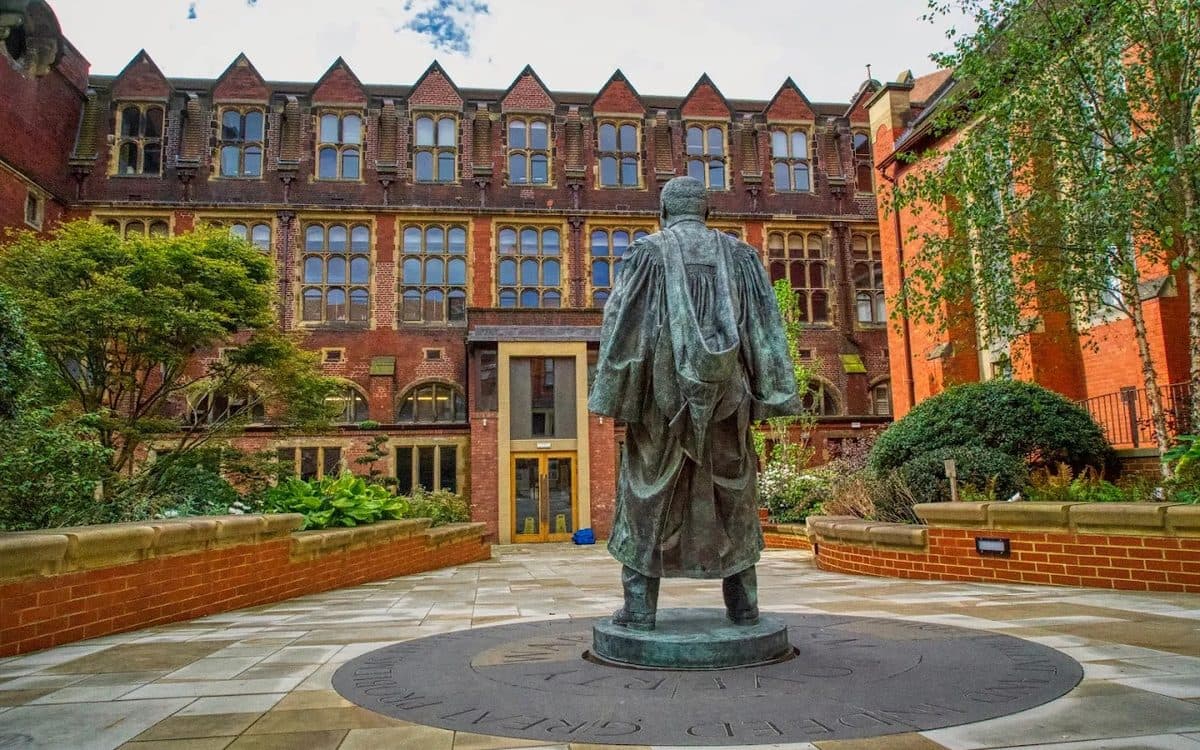
In 2021 the most famous resident of the University of York was a duck. Long Boi — an Indian Runner cross who lived on the fish pond beside Derwent College — went viral after a Reddit post declared him the tallest mallard ever recorded, at over a metre. He was not a mallard, and he was about 70 centimetres. Neither correction slowed anything down: a mention on James Corden's show took his Instagram following to 16,300 in under a day, and in September 2024 the university unveiled a bronze statue of him.
The story tells you two true things at once. First, York is built around water and birds: 500 acres of green space, two lakes, and a resident population of ducks, geese, swans, grebes, moorhens, coots and herons. Second, claims about this university travel a great deal further than the evidence behind them. The campus lake is described across the internet as *the largest plastic-bottomed lake in Europe*. York's own campus page makes no such claim: its exact words are "500 acres of green space with ponds, gardens, parkland and two lakes". Nobody publishes the measurement that would settle it. Expect exactly the same gap between claim and source in the rankings, fees and scholarship figures you read elsewhere — and hold everything below to the standard that superlative fails.
York opened its doors to 230 students in 1963, working out of Heslington Hall and King's Manor. It is one of the 1960s "plate glass" universities, built fast and cheaply in prefabricated concrete alongside Sussex, Warwick, Lancaster, Essex, Kent and East Anglia. Sixty years on it is the outlier of that generation: invited into the Russell Group in 2012, rated Gold in the Teaching Excellence Framework 2023 and joint 10th in the UK for research in REF 2021 — one of only four UK universities to hold both, with Oxford, Cambridge and Imperial.
For Indian students planning to study in the UK, York answers a narrower question than most: *what if I want a collegiate university, a compact green campus and genuine research weight, without Oxbridge odds or Durham's price tag?* Search study at University of York international students and you will mostly get recycled, out-of-date answers. This guide covers what it actually takes — the Class XII percentages, the fee escalator, which scholarships are real, and the Mumbai campus that changes the maths entirely.
The University of York at a Glance
That table contains the most useful lesson in this guide. York is 20th in the Complete University Guide 2027 and 20th in the Times and Sunday Times 2026, but 38th in the Guardian University Guide 2026 — 25th in the 2025 edition and 19th in 2024, a nineteen-place slide in two years on a Guardian score of 59.5 out of 100. The tables are not contradicting each other. The Guardian says it ranks "which universities give their students the best experience, rather than just showing you which are strongest in academic research", and its eight measures contain no research indicator at all. Research is exactly where York is strongest: 9th in the UK for research quality in the Complete University Guide, joint 10th in REF 2021, and a record £107 million of research income in 2024/25. Always read which table a rank comes from, and which edition. A widely-shared Indian guide to York, updated in July 2026, still lists "QS ≈169", "Times Higher Education ≈147" and "Top 12 UK" on the Complete University Guide. The current editions say joint 158th, joint 154th and 20th. The same table claims York is "Top 10 UK" for graduate employability; the Complete University Guide 2027 puts it 45th.
The Collegiate System — And Why It Is Nothing Like Oxbridge
York is a collegiate university, and this is the single most misunderstood thing about it. There are 11 colleges — Alcuin, Anne Lister, Constantine, David Kato, Derwent, Goodricke, Halifax, James, Langwith, Vanbrugh and Wentworth. Ten take undergraduates; Wentworth is the graduate college, describing itself as York's only purely postgraduate college, with over 8,000 members most of whom live off campus. You are allocated a college on arrival, normally through your accommodation, and you keep it whether you move into the city later or not.
The structural difference matters more than the word "college" suggests. York's colleges were designed from the outset not to run admissions, not to appoint academic staff and not to be financially autonomous — and that still holds. Your college does not admit you, does not teach you, does not employ your lecturers, and charges no college fee. Oxford and Cambridge colleges do all of those things. Durham sits between the two: its colleges also stay out of admissions and teaching, but carry gowns, formals and centuries of ceremony. York's are named after an astronomer, a Roman emperor, a Yorkshire diarist and a murdered Ugandan human-rights activist, and the newest two date from 2021 and 2022. This is a modern pastoral system, not a heritage one.
- What your college gives you: accommodation, a bar and cafés, social and study space, a student-run JCR, welfare support, and an events programme. Membership continues whether you live on campus, in the city, or after you graduate.
- Peer mentors: every fresher is assigned STYCs and STYMs — trained returning students attached to your college who run your first week and stay available long after it.
- College sport is the main event: over 20 college sporting leagues, open from beginner level, entirely separate from the university teams.
- The Roses Tournament, contested against Lancaster since 15 May 1965, is often described as the largest inter-university sports tournament in Europe — 50-plus sports over one weekend. Be warned: Lancaster have won every edition since 2022, and took the 2026 tournament 241.5 to 120.5.
What Can You Study at York?
York placed 12 subjects in the UK top 10 in the Complete University Guide 2027. Its global subject profile is narrower but sharper: three subjects in the QS world top 50 and nine in the top 100, with Arts and Humanities as a whole at joint 50th in the world.
1. Archaeology — York's strongest global subject
Archaeology is ranked 5th in the UK and 16th in the world (QS by Subject 2026), having climbed nine places in a single year. The department runs BioArCh, its bioarchaeology laboratory, and works on the Mesolithic site at Star Carr — one of the most significant prehistoric sites in Britain. You are also studying archaeology in a city that is itself a Roman, Viking and medieval excavation. One caution for league-table readers: York's domestic archaeology rank slipped from 6th in the Complete University Guide 2026 to 11th in the 2027 edition, so the two tables currently disagree about the same department.
2. English, History and the Humanities
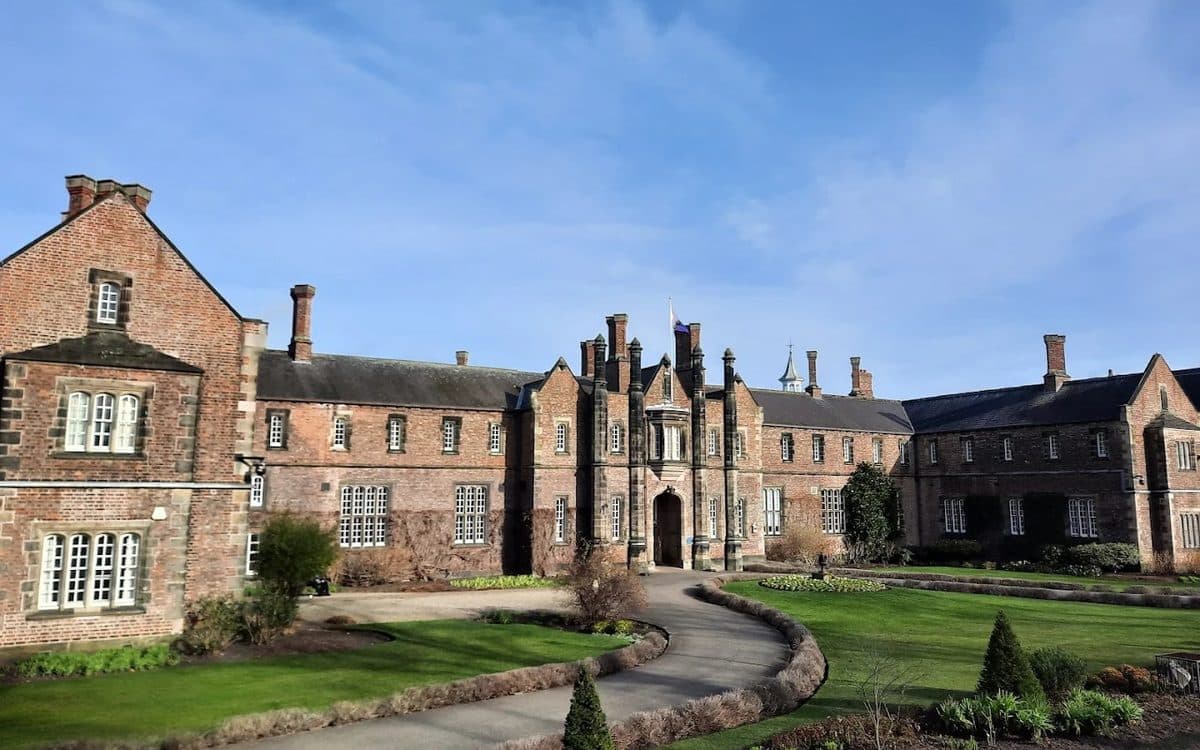
This is York's deepest cluster. English and Related Literature is 6th in the UK (Complete University Guide 2027) and 28th in the world (QS 2026, up four places). History is 8th in the UK. Around them sit Philosophy (9th), History of Art, Architecture and Design (10th), Linguistics (5th), French (6th), Iberian Languages (4th) and Drama, Dance and Cinematics (6th). The Centre for Medieval Studies works out of Heslington Hall, the listed manor house of 1568 pictured above — and York also holds King's Manor, a second site inside the city walls, so a humanities degree here is not confined to 1960s concrete.
3. Economics — and a Nobel laureate
The Department of Economics and Related Studies is one of the largest in the UK, 15th nationally and inside the world top 125 for Business and Economics (THE 2026), joint 14th in the UK for research in REF 2021 and joint top 10 for impact. Its alumni list is remarkable for a university founded in 1963: Daron Acemoğlu took his BA in Economics here in 1989 and won the Nobel Memorial Prize in Economic Sciences in 2024, alongside a former President of Portugal (Aníbal Cavaco Silva) and a former Prime Minister of South Korea (Han Seung-soo).
4. Computer Science and Safe Autonomy
York's Computer Science department is a top-ten UK research department on Times Higher Education's ranking of REF 2021, with courses accredited by BCS, the Chartered Institute for IT. Its distinctive strength is safety-critical and high-integrity systems — the engineering of software you cannot allow to fail. That work is anchored by the £45 million Institute for Safe Autonomy, funded with Research England and the Lloyd's Register Foundation, which brings over 100 academics together with test spaces for autonomous systems in transport, healthcare and hazardous environments. Among the alumni: Gavin Wood, who took his MEng and PhD here, co-founded Ethereum, wrote the language Solidity, founded Polkadot and coined the term "Web 3.0".
5. Psychology, Social Policy and Law
Psychology is 11th in the UK (Complete University Guide 2027) and 98th in the world (QS 2026), and Social Policy and Administration is joint 38th in the world, with Social Work 4th in the UK. York Law School is unusual in building its teaching around problem-based learning rather than lectures, sits in the UK's top 25 law schools for research on Times Higher Education's ranking of REF 2021, and runs the Baroness Hale Legal Clinic, where students work live cases giving free advice to people who cannot pay for it.
Hull York Medical School — know the numbers before you apply
HYMS, a joint venture with the University of Hull, is the most selective route on this page — and the one where knowing the numbers early gives you the biggest advantage. It offers up to 11 places for international students a year across the entire MB BS. Tuition for 2026 entry is £49,750 a year — five years at that rate is £248,750 before any increase, and HYMS applies the same CPI-linked rise capped at 10 per cent, so treat that as a floor rather than a total when you budget. HYMS awards up to four International Excellence Scholarships a year, worth 5 per cent of the overseas fee for each year of successful study on the 2025-entry terms — about £2,490 against the 2026 fee — and the school states plainly that details for 2026 entry are still to be confirmed. Two planning notes: HYMS is excluded from every one of York's main international scholarships, and Duolingo is not accepted as English evidence for it — so build your budget on the full fee and book IELTS, PTE or TOEFL from the outset. Demanding, yes — but every part of that preparation is within your control, and it all gets easier the earlier you start.
Most Popular Courses for Indian Students: MSc Advanced Computer Science, MSc Safety Critical Systems Engineering, MSc Cyber Security, MSc Finance, MSc Management, Electronic Engineering, Economics, and the LLM programmes at York Law School. Note that most of these sit in York's upper fee bands — £31,900 to £34,500 — rather than the £26,900 humanities rate. One clarification that saves applicants real time: there is no campus MBA at York. Aggregator pages advertise "the MBA at the University of York, through the York Management School, £35,000+". There is no York Management School — the faculty is the School for Business and Society — and York's only two MBAs, Business Administration and Public Sector Management, are online, part-time, two-year distance programmes. A distance course cannot get you a Student visa or the Graduate Route. If a full-time MBA in the UK is the goal, York is simply not the right vehicle for it — and finding that out now, rather than after an application cycle, is a genuine head start. Several strong UK universities do offer campus MBAs; talk to us and we will help you shortlist the right ones.
University of York Entry Requirements for Indian Students
For Undergraduate Study — Class XII Is Accepted Directly
- **A-Level range: ABB to AAA/A*AB.** ABB for BA Archaeology; AAB for BSc Economics; AAA for BSc Computer Science (including Maths), BSc Psychology (including a science), BA History (including History or Classical Civilisation) and MEng Electronic Engineering (including Maths); AAA/A*AB including an A in English Literature for BA English.
- Class XII conversion: 75% to 85% overall, depending on how competitive your course is. Treat 75% as the floor for ABB courses and 85% as the working target for the AAA ones.
- The board rule is the detail that matters, and almost nobody reports it correctly. York's published wording is that Standard XII from CBSE and CISCE (ICSE/ISC) needs 75% to 85% "accepted from best four subjects", while all other state boards need 75% to 85% "accepted from best five subjects". Read that carefully: the percentage is identical — there is no higher bar for a state board. What changes is the arithmetic, and a best-five average is harder to lift than a best-four one, so a Karnataka PUC or Tamil Nadu applicant carries one more subject into the calculation than a CBSE one. The compensation is that state boards are accepted as a named category rather than assessed case by case, which is more generous than Durham and several other Russell Group peers.
- Foundation route: the International Pathway College, delivered on campus with Kaplan, runs Foundation and International Year One programmes for students who do not yet meet the direct-entry bar. Note that IPC students are excluded from York's international scholarships.
For Postgraduate Study — Three-Year Degrees Are Accepted
- York sets no minimum degree length, so a standard three-year Indian bachelor's from a recognised institution is not a barrier. The requirement is expressed as a class, not a duration.
- The published equivalents are refreshingly plain: 60% = a UK 2:1, and 50% = a UK 2:2.
- Most taught master's ask for a 2:2 or above, so 50% is genuinely the working floor across a large part of the catalogue. Competitive programmes — the finance cluster in particular — will still want more, and requirements vary by course.
- York adjusts for harsher markers. It states explicitly that from institutions that mark more rigorously, for example the University of Delhi, it usually accepts 55 per cent or higher.
- There is no published IIT or NIT tier list. York bands informally rather than publicly, so email india-team@york.ac.uk with your specific institution and transcript before building expectations around a percentage.
English Language Requirements
- There is no single university-wide score. York's postgraduate equivalency table runs from IELTS 5.0 to a ceiling of 7.5, each level with its own per-component minimum. Always check your course page.
- The most common requirement is IELTS 6.5 with a minimum of 6.0 in each component, covering Computer Science, Psychology, English, History, Archaeology, Economics, MSc Management and MSc Finance.
- Some engineering asks less: MEng Electronic Engineering requires only 6.0 with 5.5 in each component.
- Equivalents at 6.5: PTE Academic 61 (55 each), Duolingo 120 (105 each), Cambridge B2 First 176 (169 each). TOEFL now has two scales and York publishes both — iBT 87 with 21 in each component if you sat it before January 2026, or 4.5 overall with 5 in Listening and 4.5 elsewhere if you sat it after. Check which scale your score is on before you send it. Duolingo is not accepted for Hull York Medical School.
- Indian Class XII English at 75% or above replaces a test outright, accepted from CBSE and ICSE and the Maharashtra, Kerala, Karnataka, West Bengal, Tamil Nadu, Andhra Pradesh, Rajasthan and Madhya Pradesh boards — provided you completed Class XII within the last seven years. A Medium of Instruction letter is not accepted at any level of study.
- Test results must be dated no more than two years before your course starts, and scores from different sittings cannot be combined — the IELTS One Skill Retake is the only exception.
University of York Fees for Indian Students, and Living Costs
- Undergraduate 2026/27: £26,900 for English, History, Archaeology and most arts and humanities · £27,500 for Economics · £32,350 for Computer Science, Psychology, Electronic Engineering and the laboratory sciences.
- Medicine: £49,750 a year at Hull York Medical School — a different order of magnitude, and there are at most 11 international places a year.
- Postgraduate taught 2026/27: £26,900 or £27,250 for most arts, humanities and social science master's — those two bands alone cover 134 of the 240 full-time taught courses York lists · £31,900 for the management cluster of 16 courses, including MSc Management and MSc Human Resource Management · £32,900 for the 50 computing, engineering and science master's, including MSc Advanced Computer Science, Cyber Security, Intelligent Robotics and Safety Critical Systems Engineering · £34,500 for the ten-course finance cluster, including MSc Finance and MSc Accounting and Finance.
- A year away costs less: a study abroad year is charged at 15% of the full-time fee and a year in industry or placement year at 20%.
- Deposit: taught postgraduates needing a Student visa pay a £3,000 tuition deposit, due by 11.59pm BST on 2 September 2026 for 2026/27 entry. Your CAS is not issued until every condition of your offer is met, and paying early does not speed that up. There is no undergraduate deposit.
The fee detail that puts prepared families ahead — and almost no other guide mentions it. The number on your York offer is year one only. Fees then rise annually in line with CPI, capped at a maximum of 10 per cent a year — against the 2 per cent cap York applies to continuing *home* postgraduates. At the full international cap, a £32,350 course would reach roughly £39,100 by year three; that is the worst case the published policy allows, not a charge York has levied, but it is the number to budget against. Ask Admissions in writing what increase they have actually applied over the last three years before you build a three-year plan.
- Accommodation 2026/27: self-catered rooms run £149 to £251 a week, which York publishes as £5,960 to £11,424 for the year; catered rooms run £165 to £269 a week, or £6,600 to £10,640 a year.
- Read the contract length, not just the weekly rate. Contracts run 38, 40, 44 or 51 weeks depending on the college and site. A cheap weekly rate on a 51-week contract costs more than an expensive one on 38 — which is why the annual figure above is the only one worth comparing.
- Catered means breakfast and an evening meal, Monday to Friday in term, in your college dining hall. First-year undergraduates on Campus East get one weekly college meal included as standard.
- Visa maintenance: the UKVI requirement is £1,171 a month outside London against £1,529 inside it — roughly 31% higher in London on the government's own measure, and the clearest official statement of what studying in York saves you.
Scholarships for Indian Students at York
Four corrections before you build a funding plan, all checked against York's own pages in August 2026. First, the "Vice-Chancellor's International Scholarship" at York worth up to £10,000 does not exist — nor does a "York Global Scholarships" award of £2,500–£5,000. Both appear in a scholarship table on an Indian student-accommodation site's York guide, and neither has a scheme page, an application route or any place in York's published funding lists. The real award with a similar name is the York Global Clearing Scholarship, £5,000, and only through Clearing. Second, York does run a GREAT Scholarship — four awards of £10,000 for 2026/27 — but you must be a permanent resident and passport holder of China, Indonesia, Malaysia or Kenya. India is not eligible. Third, the "78% acceptance rate" is invented: York publishes no acceptance rate, its own India page says only that "the acceptance rate may vary by course", and one site quoting 78.5% contradicts itself in the same article with "30% to 35%" for undergraduates. Fourth, and most expensive: one of these pages lists BSc Computer Science tuition as "£24,000–£29,000". York's own course page says £32,350 — an understatement of up to £8,350 a year, or £25,000 across a three-year degree. Budget from the university, never from a blog.
- 1. Global Impact Undergraduate Scholarship — £5,000 per year
- The most valuable award for Indian undergraduates, because it is paid for each year of study rather than year one only — £15,000 across a three-year course. Open to India, China, Malaysia, Nigeria, Thailand, Türkiye and the USA. You need an offer and a completed fee assessment by the June deadline (11.59pm BST on 30 June for 2026/27 entry). Hull York Medical School, International Pathway College, part-time, distance, partnership and Kaplan International College London students are excluded, and you lose the award if you defer your place.
- 2. Dean's Global Excellence Scholarship — full first-year tuition
- York's largest undergraduate award: a full tuition fee discount in year one, then £10,000 in each of years two and three. Note the number, because York publishes it and almost nobody quotes it — only six are available, selected by the deans of the three faculties across the entire international intake. Consideration is automatic for international offer holders, with outcomes from 15 May, but the deadline is brutally early: you must hold a conditional or unconditional offer by 6 May for 2026/27 entry. You are ineligible if you already hold a 100% tuition scholarship or are fully sponsored.
- 3. International Undergraduate Achievement Scholarship — up to £10,000
- A merit award for international undergraduates with outstanding academic results, worth up to £10,000 against first-year tuition only. There is also a York Global Clearing Scholarship of £5,000 against first-year tuition for international students admitted through Clearing — worth knowing if your Class XII results land differently from what you predicted. And watch one more: to mark the Mumbai campus, York launched an India Undergraduate Global Opportunities Scholarship worth £10,000, open to Indian students only, automatically considered. It ran for 2025/26 entry and York now lists it under previous opportunities with no 2026/27 edition — but the same page says such schemes are often renewed, so it is worth asking the international team directly before you assume it is gone.
- 4. Global Impact Masters Scholarship — £6,000 for India
- York sets this award by country and India sits in the £6,000 band, against £5,000 for the USA and Canada and £8,000 for Pakistan, Bangladesh, Nepal, Sri Lanka, Nigeria, Kenya, Ghana and Egypt. Worth knowing that your neighbours are banded higher. It covers the first year only, is awarded automatically to every eligible offer holder with no application form, and needs your offer and fee assessment complete by 31 August. Medicine, nursing, online, distance, part-time and IPC courses are excluded.
- 5. International Masters Achievement Scholarship — up to £10,000
- Up to £10,000 against first-year tuition, again with automatic consideration and a panel of senior staff choosing the awardees. You must hold your offer and have your fee assessment complete by 28 August for 2026/27; if you are then offered the award you have to accept it formally and, where one applies, pay the £3,000 deposit by the date in your offer email. The exclusion list is long: HYMS, MSc Nursing, IPC, Kaplan International College London, MA Public Policy (Mundus MAPP), the LLM Professional Legal Practice SQE tracks, postgraduate research and PGCert courses.
- 6. Chevening, Commonwealth and the alumni discount
- York is a Chevening partner: full tuition plus a living stipend for a one-year taught master's, applied for through Chevening directly, with a 6 October deadline for the following year's intake. India is among the countries eligible for Commonwealth Scholarships, nominated through India's Ministry of Education rather than the university. York also lists the Charles Wallace India Trust among external funders for Indian postgraduates, and York graduates returning for a master's get the York Graduate Loyalty Discount — 10% off tuition.
Note the calendar, because this is where early movers win. York's two largest undergraduate awards close on 6 May and 30 June, and the equivalent dates fall at the same point in every cycle — both before Class XII results are out in most Indian boards. The students who collect these awards apply early on predicted grades and hold a York offer in the spring, not the summer. Building an application timeline around deadlines like these is exactly what our counsellors do with students — talk to us well before your board exams, and the calendar works for you rather than against you.
The Mumbai Campus — And What It Actually Costs
This is the newest section of the guide and probably the most decision-relevant. York received its UGC licence on 16 June 2025 and its formal Letter of Approval on 22 June 2026, and University of York Mumbai opens to its first undergraduate and postgraduate students in September 2026, at One Boulevard, Hiranandani Gardens, Powai, while a full campus is developed. You can check that for yourself: the UGC's register of Foreign Higher Educational Institutions lists York at that address, alongside just four others — Southampton in Gurugram, Liverpool and UNSW in Bengaluru, and Bristol in Mumbai. Graduates receive a University of York degree, the same award as the UK campus.
- Undergraduate, three years: BSc (Hons) Computer Science, Computer Science with Artificial Intelligence, and Computer Science with Cyber Security; BA (Hons) Business and Management; BA (Hons) Business of the Creative Industries. All are ₹12,50,000 a year for Indian-resident students (₹14,00,000 for international students).
- Postgraduate, one year: MSc Management ₹15,00,000, MSc Finance ₹16,00,000, MSc Artificial Intelligence ₹16,50,000 for Indian residents.
- Set that against the UK campus. BSc Computer Science in York costs £32,350 a year before living costs and before the £1,171-a-month maintenance the visa requires. The Mumbai equivalent is ₹12,50,000, at home.
- The escalator is gentler too: Mumbai fees may rise up to 5 per cent a year, against the UK campus's 10 per cent cap.
- Scholarships are published: the York Academic Excellence Scholarship is worth up to ₹3 lakh a year for undergraduates and ₹4 lakh for postgraduates, merit-based with a personal interview, applied as a tuition reduction each year provided you hold a 70% average. Merit-cum-need awards may also be available. The 2026/27 application deadline was June 2026.
- Other costs to budget: a ₹2,000 application fee, which is non-refundable under any circumstances, plus a ₹50,000 admission fee and a ₹50,000 security deposit — both of which York Mumbai states are refundable if you cancel, the deposit in full at the end of your course. The prospectus also names 31 August 2026 as the last notified date of admission, after which no tuition refund is due at all.
- You can still get to the UK: undergraduates can take a 2+1 pathway or a semester exchange at York in year two, and postgraduates a two-week UK residency.
Two honest caveats. First, York's UK scholarships explicitly exclude partnership and exchange students, so do not assume the £5,000 or £6,000 awards above transfer to Mumbai — the Mumbai scholarship is a separate, Indian-rupee scheme. Second, a brand-new campus has no graduate outcomes, no alumni network on the ground and no track record: you are buying the York degree and the York curriculum, not the York campus experience. If an India-based route appeals and you are in Bengaluru, Liverpool's Bengaluru campus at Kadugodi is the closer comparison — it opens in the same year, and its BSc Computer Science is ₹11,50,000 a year for domestic students, a shade under York Mumbai's ₹12,50,000.
Life in York — An Honest Picture
York is a walled medieval city of about 202,800 people, with a Minster, a Viking archaeology industry and one of the best-preserved historic centres in Europe. The campus sits at Heslington, a short bus or cycle ride out, and York is the 5th safest of university towns and cities in England and Wales on the Complete University Guide's 2025 measure. There are over 200 student-run societies and more than 65 sports clubs. If your ideal is a compact, green, safe, sociable place where you know the city within a month, York delivers that better than almost anywhere in the UK.
The most honest thing we can tell you about York. The university's own India page describes "a vibrant community of over 250 students from India". Against a total student body of 22,345, that is a little over one per cent — a real community, and a small one. The city figures point the same way: the Asian or Asian British population of York is 3.8 per cent at the 2021 census, and the Indian population specifically is 1,853 people, 0.9 per cent of the city — against 9.7 per cent Asian in Leeds, a city of 811,953 people a short train ride away. York names a British Asian Society and a Tamil and Malayali Society among its international societies, and points students to Indian restaurants and Asian grocery shops in the city — but there is nothing here resembling the concentration of temples, gurdwaras and South Asian food streets you would find in Leeds, Bradford or Manchester. For many students that is fine; you are a short journey from all of it. If a dense desi community around you every day is what makes an unfamiliar country liveable, Leeds is the more honest answer, and we would rather say so now than after you have paid a deposit.
- Transport is excellent for a small city. York sits on the East Coast Main Line, served by five operators — LNER, CrossCountry, TransPennine Express, Grand Central and Northern. London King's Cross is 1 hour 47 minutes at the fastest, over 188 miles. Leeds, Manchester, Newcastle and Edinburgh are all direct.
- Flying home, and this changed this month. Manchester Airport is your realistic gateway. IndiGo has been flying Manchester to Delhi and Mumbai direct, but both routes end on 31 August 2026 — so anyone arriving for the September 2026 intake should plan on a one-stop Gulf connection, not a direct flight. Manchester has Emirates to Dubai, Qatar Airways to Doha and Etihad to Abu Dhabi, all connecting onward to Delhi, Mumbai, Bengaluru and Hyderabad. Leeds Bradford, though closer, has no scheduled service to India or the Gulf at all. Position as of August 2026 — check before you book.
- York collects you. The university runs free airport collection from Manchester Airport for new international students — a small thing that matters enormously at the end of a fifteen-hour journey. It also runs a specialised international Welcome Week, in-house immigration advice, an International Student Support team and dedicated facilities for practising your faith on campus.
- Cost of living sits well below London on every measure, with the UKVI maintenance gap — £1,171 against £1,529 a month — the clearest official proxy.
Career Outcomes
- 88% of York students were in work or further study 15 months after graduating (HESA Graduate Outcomes, 2023/24 data). Read York's own small print on that figure: it is the percentage of *UK* undergraduate and postgraduate students. York publishes no international-specific outcome or salary figure at all, so treat 88% as the domestic benchmark, not as a promise about your own cohort.
- Be realistic about where that sits. The Complete University Guide 2027 ranks York 45th of 130 for graduate outcomes (76.4/100) and 54th on its "on track" measure — solidly good, and well below its 9th place for research quality. York is a stronger research university than it is a graduate-recruitment brand — and knowing that from day one lets you plan for it rather than discover it at graduation.
- The one employer metric moving fast: York's global Employer Reputation rank in the QS World University Rankings 2027 rose 80 places in a single year — the biggest single driver of its climb to joint 158th. QS weights that measure at 15% of the total, and it is the closest published proxy York has for how your degree reads to a recruiter.
- Two other metrics deserve your attention. York ranks 106th of 130 for student satisfaction in the same table (3.09 out of 4), and 110th for academic services spend. Neither should decide the question on its own, and neither shows up on a prospectus — which is exactly why it is worth knowing them now, before you commit four figures a month to living here.
- The local job market is the honest constraint. York's economy is small and weighted to heritage, tourism, rail and the public sector. Leeds is the graduate engine of the region — 30-plus national and international banks, plus Channel 4, Asda, KPMG, Aviva and Direct Line — and close enough to commute to for interviews.
- Where York's name travels furthest: safety-critical software and autonomous systems, archaeology and heritage, social policy, economics and academia.
On the UK Graduate Route, bachelor's and master's graduates can stay and work for 18 months and PhD graduates for three years, with no job offer, sponsor or salary threshold required. The duration is set by your *application* date, not your course dates: two years if you apply on or before 31 December 2026, and 18 months from 1 January 2027 onward. Start a one-year master's in September 2026 and you will graduate in late 2027 — so plan on 18 months. The visa cannot be extended; to stay longer you switch to a route such as the Skilled Worker visa. This is the position as of August 2026.
Is York Right for You?
York is a genuinely strong choice if your subject is one of its strong ones. Russell Group, TEF Gold, joint 10th in the UK for research, 12 subjects in the national top 10, undergraduate fees from £26,900, a £6,000 master's award for Indian students and a £5,000 undergraduate award paid *every year* — that is real value. The collegiate system gives you a community of a few hundred people from day one without the fees, gowns or admissions politics of Oxbridge. And with Mumbai opening in 2026, there is now a second route to the same degree at roughly a third of the sticker price. If the collegiate structure draws you but you want the history and ceremony with it, compare York against Durham.
Weigh the other side just as carefully. York is 20th in the UK and 24th on QS's UK ranking, not top ten — if institutional prestige is your primary filter, it will not carry the weight of Edinburgh or Manchester in an Indian employer's eyes. Student satisfaction is its weakest published metric, 106th of 130, and the Guardian's student-experience table has moved it from 19th to 38th in two years. Graduate prospects are mid-table. The city is small, the Indian community is just over 250 people, and the local graduate market is smaller still. None of that is disqualifying — it simply tells you what York is for. Choose it deliberately, for the research, the subject strength, the campus and the cost, and go in with a clear plan for your own career story rather than a name that will do the work for you.
Let's Build Your York Plan Together
York rewards applicants who get the details right — the correct best-four or best-five Class XII calculation for your board, the early May and June scholarship deadlines that decide the largest awards, and a clear-eyed choice between the Heslington campus and Mumbai. Those are exactly the details our counsellors work through with families. Falcon Nova Consultants has helped hundreds of Indian students secure places at top UK universities. Book your free, no-obligation counselling session through our contact form, and we will map your percentage conversion, your scholarship timeline and your best route to a York degree — before a single deadline passes you by.
Book Your Free Counselling Session