The fact that changes the numbers at the University of Ottawa is this: uOttawa will cut an international student's tuition by as much as $18,000 per term if they study in French or join the French Immersion Stream. Most Indian families never hear about it, and those who plan for it early can bring a high international fee down to a far more manageable one. Even if you stay fully in English, uOttawa offers a downtown campus in Canada's capital, a co-op programme spanning more than 90 programmes, and a bilingual degree that Canadian employers recognise.
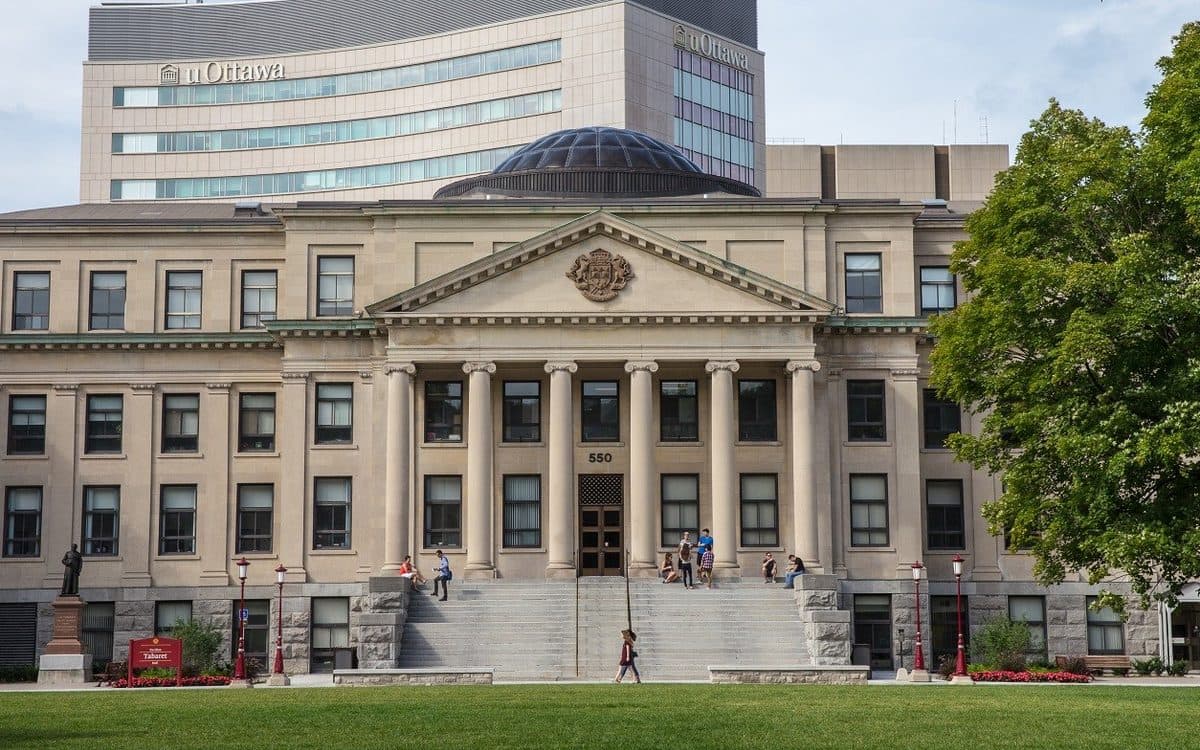
uOttawa has taught in Ottawa since 1848 and today counts 50,000 students and 12,000 professors, researchers and staff. It runs a technology campus in Kanata North, which it describes as the country's largest technology park, and sits minutes from Parliament, federal departments and national research bodies. For Indian students planning to study in Canada, this guide sets out uOttawa's real 2026-27 fees, its India entry averages, and the Canadian visa rules now in force.
The University of Ottawa at a Glance
What Can You Study at uOttawa?
uOttawa's direct-entry faculties are Arts, Engineering, Health Sciences, Science, Social Sciences and the Telfer School of Management, with Law, Education and Medicine as professional faculties. Three strengths stand out for Indian applicants.
1. Engineering and Computing
The Faculty of Engineering houses Computer Science, Data Science, Software Engineering, Computer Engineering and the traditional engineering disciplines, and many programmes can be combined with Computing Technology. These are uOttawa's most competitive programmes for Indian applicants, with minimum averages of 80% to 90%. At graduate level, the MEng in Electrical and Computer Engineering and the MSc in Computer Science are common choices, and the Kanata North campus connects the university to Ottawa's technology sector.
2. Law, Public Policy and Social Sciences
Being in the capital shapes uOttawa's Social Sciences and Law faculties. Political Science, Public Administration, International Development and Globalization, Conflict Studies and Human Rights, and Economics and Public Policy are all offered, and uOttawa describes its public-policy experts as working in close proximity to granting and research bodies.
3. The Telfer School of Management
Telfer's BCom and the combined BCom/JD ask for an 85% minimum, and Telfer's other programmes 78%. Its international tuition sits between Science and Engineering at CA$26,592.19 per term for 2026-27.
Popular routes for Indian students: undergraduate Computer Science, Software Engineering, Data Science and Computer Engineering; Telfer's BCom; Economics and Political Science; and at graduate level the MEng in Electrical and Computer Engineering, the MSc in Computer Science, Engineering Management and Digital Transformation and Innovation.
Admissions for Indian Students
Undergraduate entry averages
uOttawa asks Indian school-leavers for a Higher Secondary School Certificate or the All India Senior School Certificate with a minimum 75% average and the prerequisites for their programme, completed in the senior year. Programme minimums from uOttawa's India page:
| Programme | Minimum admission average |
|---|---|
| Computer Science, Data Science, Software Engineering (competitive) | 90% |
| Computer Engineering (competitive) | 87% |
| Mechanical and Biomedical Mechanical Engineering | 83% |
| Civil, Electrical and Chemical Engineering | 80% |
| Biomedical Science | 83% |
| Most Science programmes | 78% |
| Telfer — BCom and BCom/JD | 85% |
| Arts; most Social Sciences | 70% |
How uOttawa chooses in its competitive programmes. For Computer Science, Data Science, Software Engineering and Computer Engineering, uOttawa states that selected applicants are chosen from those who put uOttawa among their top three choices. If one of these is your target, rank uOttawa accordingly — it is a simple step that keeps you in the pool.
- Fall 2027 dates: applications open on 17 September 2026. uOttawa recommends applying before 15 January 2027 and submitting documents and test results by 15 February 2027 or within 30 days of applying.
- International deadlines are earlier in practice: most programmes close to international applicants in May to leave time for study permits, and programmes can close as soon as they fill. Engineering and Health Sciences are among the programmes that fill quickly.
- Winter entry: the Winter 2027 deadline is 17 October 2026, but no Engineering or Health Sciences programmes admit in winter. International students cannot start in the spring-summer term.
- Deposit and PAL: after you accept your offer, you pay a $2,000 admission deposit, and uOttawa's Admissions Office emails your Provincial Attestation Letter within about three business days of receiving it. Payments from outside Canada can take up to 14 business days to arrive, so pay early.
English and French requirements
- India is not on uOttawa's English-exempt country list, so most Indian applicants either qualify through an exemption or submit a test.
- The India-specific exemption: a final grade of 75% in CBSE or CISCE Class 12 English. If you are still at school, interim or pre-board marks are used.
- Test route: IELTS Academic 6.5 overall with 6.5 in Writing for direct entry. An overall 6.0 lets you start your programme with one or two extra ESL courses, and lower scores can lead to conditional admission through the English Intensive Program.
- A practical tip for South Indian names: uOttawa warns that applicants from cultures that do not use surnames — it names parts of southern India — can have test results fail to link to their file. Use one of your given names as your last name on the application, and make sure it matches your test registration exactly.
- For a French-language programme: you will need French proficiency — for example DELF B2 or TCF B2 — unless you qualify for an exemption. The French Immersion Stream has its own admission requirements, so check them on the programme page.
Graduate — master's and PhD
- Accepted Indian qualifications for a master's: a three-year bachelor's plus a master's; a four-year bachelor's; a postgraduate diploma; or, for some programmes, a three-year bachelor's from an institution with a NAAC rating of A.
- Minimum grades: 61% if your university's pass mark is 35%, 64% if it is 40%, and 70% if it is 50%.
- English: IELTS Academic 6.5 overall, 6.5 in Writing, no band below 6; TOEFL iBT 84 with 24 in Writing (tests before 21 January 2026) or 4.5 on the new scale, with section minimums; CAEL 70. India is not on the graduate exemption list either.
- No PAL for master's and PhD students who apply for their study permit on or after 1 January 2026. Graduate certificate and diploma students still need one.
The Real Cost of uOttawa in 2026-27
uOttawa's international tuition is a flat rate per term for full-time undergraduates. Figures below are from uOttawa's 2026-27 international tuition calculator for students in their first 33 units; a full-time year is two terms.
| Programme (full-time undergraduate) | Tuition per term | Two terms (approx. one year) |
|---|---|---|
| Engineering and Computer Science | CA$31,582.15 | about $63,164 |
| Telfer School of Management (Commerce) | CA$26,592.19 | about $53,184 |
| Science (e.g. Biology); Social Sciences (e.g. Political Science) | CA$21,667.54 | about $43,335 |
- No increase this year: uOttawa states international undergraduate tuition for 2026-27 is unchanged from 2025-26, and master's and doctoral tuition is unchanged too.
- Predictable after that: for international students admitted from Fall 2022, uOttawa limits future tuition increases to 7% a year as long as you stay full-time and progress normally.
- Graduate examples for 2026-27: the MEng in Electrical and Computer Engineering is charged at CA$1,421.91 per unit, and the thesis-based MSc in Computer Science at CA$10,502.45 per term.
- Also budget for ancillary fees, the University Health Insurance Plan (UHIP) for international students, and living costs. IRCC asks you to show $23,448 a year for living expenses outside Quebec for applications from 1 September 2026.
The French Advantage — uOttawa's Biggest Scholarship
uOttawa's Differential Tuition Fee Exemption Scholarship exists to support its commitment to the French-speaking world, and it is aimed at international Francophone and Francophile students — whatever their nationality — who study in French. For undergraduates starting in Winter 2024 or later, the value per eligible term is:
| Faculty | Scholarship per term | Engineering example (2026-27) |
|---|---|---|
| Faculty of Engineering — all programmes | $18,000 | $31,582.15 tuition, about $13,582 after the scholarship |
| Telfer School of Management | $16,000 | — |
| Arts, Education, Social Sciences | $12,500 | — |
| Science — most programmes | $12,500 | — |
| Health Sciences — most programmes | $12,500 | — |
- Who qualifies: international students who accept an offer to a programme taught in French, or to an English programme with the French Immersion Stream and meet its requirements — and who take at least three French-taught courses (9 units) per term while full-time.
- How long: up to 12 per-term payments across an undergraduate programme, renewed at the value in your offer as long as you keep the conditions. It is not paid during co-op work terms.
- Master's students in French-taught or eligible programmes can also receive it — for example $5,500 per term in Arts, Science, Health Sciences and Social Sciences.
- Other uOttawa entrance scholarships are largely aimed at Canadian citizens and permanent residents unless stated otherwise, so for an Indian student this French-stream scholarship is the one to plan around.
Is French realistic for an Indian student? For many, yes — with a plan. The French Immersion Stream lets you keep an English-language programme while taking part of it in French — to hold the scholarship you need at least three French-taught courses each term — and uOttawa accepts results such as DELF B2 or TCF B2 as proof of French for its French-language programmes. Starting French in Class 11 or during a gap year gives you a clear goal to aim for. If you would like help working out whether the timeline fits your intake, book a free session with us.
Co-op at uOttawa
- Scale: co-op is available in 90+ programmes with 4,000+ employers, and the programme is accredited by Co-operative Education and Work-Integrated Learning (CEWIL) Canada.
- Who can join: four-year undergraduate programmes (honours with specialisation, double major, major with minor) and some master's programmes.
- Typical rhythm: studies in years one and two, a first paid work term in the summer after year two, then alternating study and work terms until you finish — usually four work terms in total.
- Visa point: since 1 April 2026, post-secondary students no longer need a separate co-op work permit for a work placement that is a required part of their programme, as long as it makes up 50% or less of the programme and the school confirms the requirement in a letter.
Canadian Study Permit Essentials for 2026
- PAL for undergraduates: Ontario's allocation under the 2026 international student cap is 104,780 study permit applications. At uOttawa, the PAL is issued after you accept your offer and pay your deposit.
- No PAL for master's and PhD at public institutions from 1 January 2026, and a 14-day processing standard for eligible doctoral applicants outside Canada.
- Proof of funds: tuition for your first year plus $23,448 for living costs and your travel, for applications from 1 September 2026.
- Work hours: up to 24 hours a week off campus in term time; unlimited in scheduled breaks.
Applying from Bangalore and Karnataka
- Karnataka II PUC: uOttawa's India page is written around the Higher Secondary School Certificate and the AISSC. Karnataka's II PUC, issued by the Karnataka School Examination and Assessment Board (KSEAB), is the state's higher secondary certificate, but uOttawa does not name it — so email InfoAdmission to confirm how your PUC average and prerequisites will be calculated.
- Plan on IELTS if you are a PUC student: uOttawa's Class 12 English exemption names only CBSE and CISCE, so a KSEAB student should budget for IELTS Academic 6.5 (Writing 6.5) unless uOttawa confirms an exemption in writing.
- Karnataka degrees for a master's: a four-year BE or BTech — for example from a VTU-affiliated engineering college — fits uOttawa's four-year bachelor's route. If you hold a three-year degree, uOttawa's rule is based on the institution's NAAC rating of A for some programmes, so check your college's current NAAC grade and the programme's rules together.
- Biometrics: IRCC lists a Bengaluru visa application centre (run by VFS Global) among its Indian collection points. Appointments are free to book, so book your slot as soon as IRCC asks for biometrics.
- Travel: from Kempegowda International Airport, expect at least one connection to reach Ottawa.
- In person: Falcon Nova's office is on the 7th floor of Kirloskar Business Park in Hebbal, North Bangalore — book free counselling there or online.
Staying On After Graduation
- PGWP without a field-of-study restriction for bachelor's, master's and doctoral graduates.
- Three years for master's graduates whose programme was at least eight months, even if shorter than two years.
- CLB 7 in English or NCLC 7 in French, in all four skills, is required when you apply — and a bilingual uOttawa graduate can use either language.
- Co-op experience gives you Canadian references and a résumé that Ottawa and Toronto employers recognise from day one.
Is uOttawa Right for You?
uOttawa is an outstanding choice if you want a large research university in a capital city, a co-op programme with real reach, and the rare chance to graduate bilingual. For students willing to take French seriously, the Differential Tuition Fee Exemption Scholarship makes it one of the best-value options in Ontario — an engineering student can save $18,000 a term.
Plan for three things and uOttawa becomes very manageable: the high averages in computing, the English test that most PUC students will need, and the per-term fees in English-only programmes. Apply when the portal opens in September, rank uOttawa in your top three if you want its competitive programmes, and decide early whether the French route suits you.
Ready to Build Your uOttawa Application?
uOttawa rewards students who make three decisions early: whether the French Immersion Stream and its tuition scholarship fit your plans, which programme your Class 12 average genuinely suits, and how to clear the English requirement from your board. We can work through each of these with you, along with the deposit, PAL and study permit steps that follow. Falcon Nova Consultants has helped hundreds of Indian students plan their study-abroad journey. Book your free, no-obligation counselling session — at our Hebbal office or online — and let us map out your uOttawa application with you.
Book Your Free Counselling Session