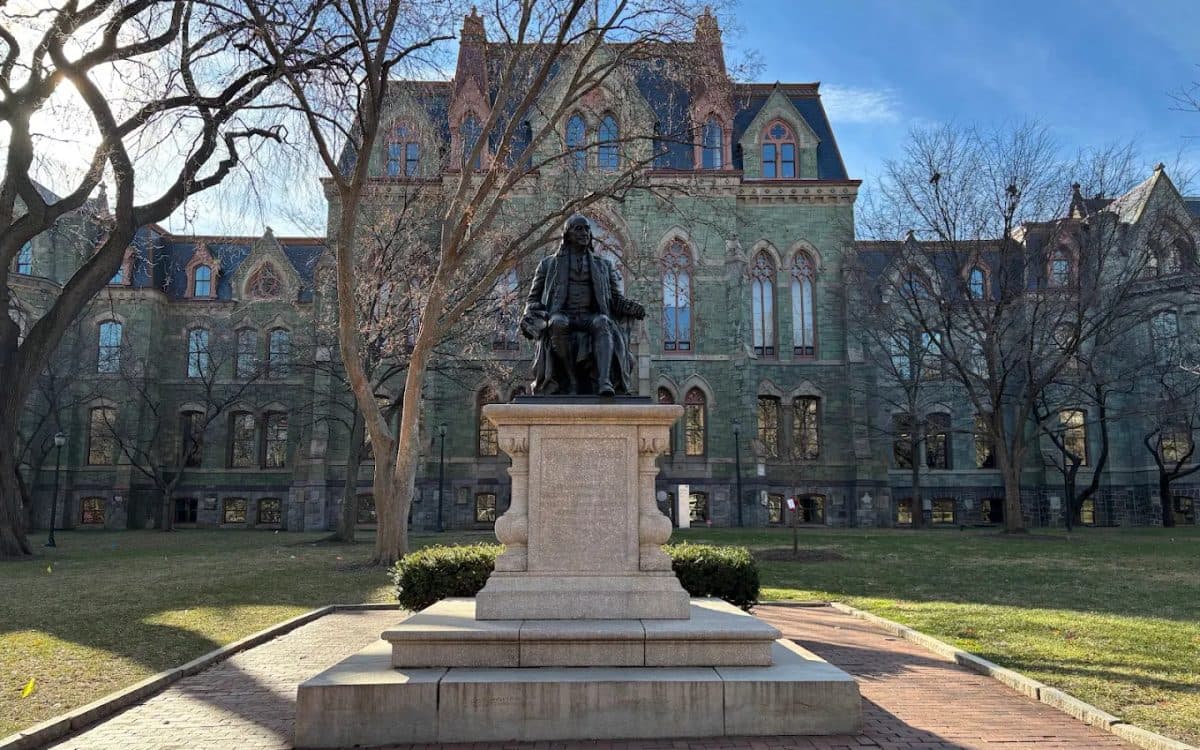
In 1881, thirteen undergraduates sat down to something no university anywhere had ever taught: a business degree. That was the founding class of the Wharton School — the world's first collegiate business school — endowed by the industrialist Joseph Wharton at a university that already had a 141-year head start. It is still the single biggest reason Indian applicants look at Penn, and it is still the thing they most often misunderstand.
The University of Pennsylvania was founded in 1740, traces its charter to Benjamin Franklin, and today runs 12 schools on a 299-acre campus in West Philadelphia with 29,384 students and a $24.81 billion endowment. It ranks 7th among National Universities (US News 2026) — up three places, tied with Duke, Johns Hopkins and Northwestern — and 14th in the world (Times Higher Education World University Rankings 2026).
Before anything else: Penn is not Penn State. This confusion is genuinely common among Indian applicants — and untangling it now, before any fees are paid, is one of the easiest wins in this guide. The University of Pennsylvania is a private Ivy League university founded in 1740 in Philadelphia, with a 5.8% acceptance rate. Penn State is Pennsylvania State University, a public land-grant university chartered in 1855 as the Farmers' High School of Pennsylvania, based at University Park about three hours west, with over 86,000 students and roughly 62% of undergraduates from Pennsylvania. Both are real, respectable universities — Penn State ranks 92nd in the world (QS 2027). They are not related, and "Penn" only ever means the first one.
For Indian families planning to study in the USA, Penn poses a very particular question: is a direct-entry business degree at seventeen, or a Wharton MBA at twenty-eight, worth the price and the odds? This guide covers exactly what it takes to study at University of Pennsylvania as an international student — the fees, the aid rules that most guides get backwards, and the insider details that put a well-prepared applicant ahead.
University of Pennsylvania at a Glance
Two numbers there deserve reading twice, and the headline is neither of them. First, 5.8% is not your rate — and knowing the real one is what lets you build a genuinely strategic list. Penn's own facts page records that 17,882 international students applied for Fall 2025 and 441 were admitted — 2.5%. Second, the early round is where the places go: the Common Data Set 2024-25 shows 1,235 admitted from 8,683 Early Decision applications, 14.2%, against 5.4% overall in that same cycle. Early Decision at Penn is binding, and for an international applicant who also needs financial aid that is a genuinely difficult trade-off. We come back to it below. Note too that 5.8% is a *loosening*: the previous cycle admitted 4.9%, and applications fell from 72,544 to 61,264.
Wharton — Why Most Indian Applicants Are Here
The Undergraduate Programme — A Business Degree at Seventeen
This is Penn's structural advantage and it barely exists elsewhere in the Ivy League: you can be admitted directly into a business degree as a school-leaver. Wharton undergraduates earn a Bachelor of Science in Economics across 37 course units — 23 in business, 9 in the liberal arts and sciences, and 5 unrestricted electives anywhere at Penn — with a concentration required. Wharton is ranked joint 1st for undergraduate business in the US News 2026 rankings, alongside MIT Sloan, and about 22% of its undergraduates are international.
There is no separate Wharton application. Penn's central Office of Undergraduate Admissions decides every case, and Wharton states there are "no fixed criteria and no cut-offs in terms of grades or test scores." You name Wharton as your school on the Common App and answer its school-specific essay prompt. Penn does not publish a school-by-school acceptance rate, so treat any site quoting a "Wharton acceptance rate" as an estimate rather than a fact.
The Wharton MBA — Cost, Class Profile and the STEM Detail That Matters
Wharton publishes a full profile for the MBA Class of 2027: 888 students enrolled from 7,613 applications, 26% international from 68 countries, 44% women, an average GMAT of 735 on the legacy scale (676 on GMAT Focus), an average GRE of 163 quantitative and 162 verbal, an average undergraduate GPA of 3.7, and five years' average work experience. One shift is worth noticing before you build a plan on the international pipeline: that international share fell from 31% in the Class of 2026 to 26% in a single year. Wharton also fell to 2nd in the US News 2026 full-time MBA ranking behind Stanford, but it remains 1st in the US for Finance, Accounting, Management, Marketing, Real Estate and the Executive MBA.
- Cost: $135,441 a year, in each of the two years. That is $93,008 in tuition and fees ($87,970 tuition, $4,268 general fee, $770 clinical fee) plus $42,433 in living expenses including $5,018 of compulsory health insurance. Over two years, roughly $271,000.
- Wharton Fellowships are merit-based and awarded to about one-third of the incoming class, automatically considered at admission — the opposite of Penn's undergraduate rule.
- Nine of Wharton's 21 MBA majors are STEM-certified, including Finance, Business Analytics, Quantitative Finance and Statistics & Data Science. Wharton is explicit: "If you choose one of these majors, you will be eligible for 36 months of post-completion OPT (compared to 12 months for a non-STEM major)." For an Indian student who intends to work in the US, that single choice is worth more than most scholarships.
- Class of 2025 outcomes: median base salary $185,000. Consulting took 28.2% of accepted offers at a $190,000 median; financial services 38.2% at $175,000, with private equity at $200,000; technology 15.3% at $164,250.
The honest caveat on Wharton MBA outcomes — and the part most guides get backwards. Those salaries are overwhelmingly American ones: 94% of the Class of 2025 took jobs in the United States and only 6% went international, with just 3.4% to Asia. Wharton's own career report gives an international median base salary of $135,000 against $185,000 in the US — but that international figure is dragged down by Europe at $119,728, while Asia reports a median of $180,000, close to the US number. So the honest reading is not "you will earn far less in Asia". It is that almost nobody goes — roughly eighteen people out of 529 accepted offers — which makes the Asia median a small-sample figure. If your plan is to return to India after Wharton, model your own offers, not a median built from a couple of dozen graduates.
The Coordinated Dual Degrees — Penn's Real Signature
These are the most distinctive undergraduate programmes at Penn, the most competitive things it admits to, and the worst-covered in Indian study-abroad content. A coordinated dual degree is not a double major — it is two full degrees from two different Penn schools, with a curriculum designed jointly from the start. You must apply as a first-year applicant, with an extra essay, and for some of them you cannot transfer in later at all.
- Huntsman Program in International Studies and Business
- A BA in International Studies from the College and a BS in Economics from Wharton over four years, plus advanced training in one of 11 target languages — Arabic, Mandarin, French, German, Hindi, Italian, Japanese, Korean, Portuguese, Russian or Spanish — and a mandatory semester abroad in a country where that language is spoken. Intermediate proficiency is expected on entry. Penn's catalog is blunt about the route in: students must apply to the programme when they apply to Penn, and cannot transfer into it.
- Jerome Fisher Program in Management & Technology (M&T)
- A BS in Economics from Wharton and either a BS in Engineering or a Bachelor of Applied Science from Penn Engineering. M&T admits 50 to 55 students a year from what the programme describes as thousands of applicants worldwide — an admit rate far below Penn's overall 5.8%. Usefully, M&T states that applying to a coordinated dual degree does not diminish your chances of admission to Penn generally, and you can nominate a single-degree fallback.
- Roy and Diana Vagelos Program in Life Sciences and Management (LSM)
- A BA in a life science from the College and a BS in Economics from Wharton, for students heading into biotech, pharmaceuticals or healthcare investing. It is the smallest of the group, enrolling roughly 25 students a year.
- Nursing and Health Care Management (NHCM)
- A Bachelor of Science in Nursing from the top-ranked Penn Nursing and a BS in Economics from Wharton, over five years. It is a genuinely unusual combination — clinical practice plus health-system management — and it exists at almost no other university.
- Vagelos Integrated Program in Energy Research (VIPER)
- A BA from the College and a BS in Engineering, built entirely around energy research over four years, with an optional fifth year for a master's. The one coordinated dual degree on this list that does not involve Wharton.
What Else Penn Is Known For
- Nursing — the best in the world. Penn Nursing is ranked 1st globally in the QS World University Rankings by Subject 2026, having reclaimed the top spot with a perfect score for academic reputation across more than 1,900 institutions ranked. It is 2nd for undergraduate nursing in the US (US News 2026), tied with Emory.
- Penn Carey Law — 4th in the US (US News 2026), tied with the University of Virginia. Penn Law is unusually integrated with the rest of the university, with joint degrees running into Wharton, Medicine and Annenberg.
- Perelman School of Medicine — the oldest medical school in the United States, founded 1765, and the anchor of Penn Medicine, which is also one of the largest graduate employers of Penn's own students.
- Penn Engineering — home of ENIAC, the first general-purpose electronic computer, and now 21st for undergraduate engineering (US News 2026), up six places. It supplies the highest median starting salary of any Penn school.
- Annenberg School for Communication — a small, research-intensive graduate school whose doctoral programme is among the most influential in communication studies worldwide.
Most Popular Courses for Indian Students at Penn: the Wharton MBA and its STEM-designated Finance and Business Analytics majors; Wharton's undergraduate BS in Economics; MSE Computer and Information Science, Data Science, Robotics and Systems Engineering at Penn Engineering; the M&T and Huntsman coordinated dual degrees; MSc Bioengineering; and the LLM at Penn Carey Law.
Admissions for Indian Students
Undergraduate — Deadlines, Testing and What Actually Counts
- The odds you actually face are not 5.8%. Penn's own facts page reports 441 admissions from 17,882 international applicants for Fall 2025 — 2.5%. The Common Data Set 2024-25 shows the same shape a year earlier: 439 admitted from 15,727 international applicants, 2.8%, against 5.4% overall. Build your list against that number, not the headline one.
- Deadlines: Early Decision 1 November (binding, decisions 15 December) and Regular Decision 5 January (decisions in April). Application fee $75. Penn accepts the Common App, the Coalition Application and QuestBridge equally.
- The SAT or ACT is required — Penn's testing page, checked 10 August 2026. Penn announced the reinstatement on 14 February 2025, beginning with the 2025-26 cycle, and the page now carries its deadlines under the heading "2026-2027 Admissions Cycle" and reads: "Penn applicants are required to submit scores for the SAT or ACT." It applies to all first-year, domestic, international, homeschooled, transfer and QuestBridge applicants. There is no minimum score, no preference between the tests, Penn superscores both, and you may self-report — though admitted students must send official scores before enrolling. Penn's SAT code is 2926 and its ACT code is 3732. The latest permitted dates this cycle are SAT 7 November 2026 for ED and 5 December 2026 for Regular, ACT 17 October and 12 December 2026.
- The hardship waiver is real, and it is automatic. Applicants who have not taken either test and face hardship — Penn names lack of test centre availability, financial hardship, natural disaster or civil unrest — submit a waiver with the application, and "once submitted, the testing requirement is automatically waived." The catch is that you cannot use it tactically: if you *have* taken a test you are required to report it, and any score Penn receives supersedes the waiver.
- Do not assume this rule applies elsewhere. Testing policy across the Ivies genuinely diverged, and a reader applying to four of them can face four different rules. As of August 2026, Penn, Harvard, Cornell, Brown and Dartmouth require scores, while Princeton and Columbia reinstate theirs from the 2027-28 cycle. Check each university's own page for the cycle you are applying in, not a summary of "Ivy League policy".
- Class XII expectations: Penn publishes no percentage conversion, and no Indian board is named. What its Common Data Set 2024-25 does say is which factors carry weight — rigour of your secondary school record, academic GPA, the essay, recommendations and personal character are all rated "very important", while test scores are merely "considered". Treat a strong Class XII record in the hardest subject combination available to you as the baseline, not the differentiator.
- Essays: three Penn-specific prompts — a 150-200 word thank-you note to someone who has helped you, a 150-200 word piece on the Penn community you want to join, and a school-specific essay for the College, Wharton, Engineering or Nursing. Coordinated dual degrees add their own.
- Recommendations: one from your school counsellor and one from a teacher in a core subject (mathematics, science, history, English or a foreign language). One optional additional letter is permitted.
- There is no interview. Penn made alumni conversations non-evaluative from the 2023-24 cycle and ended them entirely from the 2025-26 cycle, citing an application pile that grew from about 31,000 in 2012 to 72,544 in its most recent cycle. Its Common Data Set already listed the interview as "not considered". Ignore any guide selling you Penn interview preparation.
Early Decision and financial aid — the choice to make before November. In the last cycle the Common Data Set covers, ED ran at 14.2% against 5.4% overall, and Penn reports that 51% of the Class of 2029 was admitted early decision — the early round is where most of the places go. But ED is binding, Penn is need-aware for international applicants, and you must submit your CSS Profile by 6 November for ED or 1 February for Regular Decision. If you need substantial aid, ED means committing to Penn before you can compare offers from anywhere else. If you can pay in full, ED is the single strongest lever you have. Decide which of those two you are, honestly, before November — and if you are unsure which side of the trade-off you fall on, talk to us before you commit either way.
Graduate — Department by Department, Not University-Wide
- The three-year Indian bachelor's question has no single Penn answer. Penn admits by department, and departments differ. Penn's Department of English states outright that "the three year Indian B.A. is accepted", and Penn Engineering asks only for "a bachelor's degree from an accredited college or university". Confirm with your specific department in writing before you build a plan around it.
- Credential evaluation: Penn Engineering requires a course-by-course evaluation from a NACES member — it names WES, ECE, Educational Perspectives, IEE and The Evaluation Company — showing course titles, grades, GPA and US degree equivalency. Unofficial transcripts are fine at application stage; official ones are only required if you enrol.
- GRE: optional for all Penn Engineering graduate programmes. Penn Engineering is direct about it: "we don't require a minimum GRE score (or a GRE score at all)". Scores must be five years old or less. Other schools vary — Wharton's MBA accepts GMAT or GRE and sets no minimum.
- Deadlines: Penn Engineering master's applications open 15 September, with an early deadline of 1 November for Computer and Information Science, Data Science, Robotics and MCIT — the four Indian students most often apply to — and a regular deadline of 1 February. Doctoral applications close 15 December. Wharton's MBA runs three rounds; apply in Round 1 or 2 if you need a visa appointment in good time.
- Funding is the sharp divide. PhD programmes are fully funded — Penn states that "most of our PhD programs are fully funded, meaning that for 4-5 years, the program will pay for your tuition and fees", and Biomedical Graduate Studies guarantees a $49,000 stipend for 2026-27 plus tuition, fees and health insurance for the duration of training, adding full vision and 80% dental cover from Fall 2026. Professional and taught master's degrees are not. Penn Engineering offers only "a limited number of RA and TA positions" to master's students.
English Language Requirements
- TOEFL, IELTS or the Duolingo English Test is required, unless English is your native language or has been your language of instruction for three or more years — which exempts most CBSE, ICSE and English-medium state-board students, but confirm rather than assume.
- At undergraduate level Penn publishes guidance, not minimums. Competitive applicants "tend to have" a TOEFL iBT composite of 100 or above or a Duolingo score of 130 or above, with consistency across sections. Penn publishes no undergraduate IELTS figure.
- At graduate level the numbers get specific. Penn Engineering recommends TOEFL iBT 100, IELTS 7.5 or Duolingo 135 — note that the IELTS figure is high, and higher than most Indian applicants assume for a US master's.
- Penn does not accept the IELTS Indicator or TOEFL MyBest scores, and scores are valid for two years from the test date.
- English scores cannot be self-reported. Unlike the SAT and ACT, official results must come directly from the testing agency. Book early enough for the results to arrive.
The Real Cost of Penn
The number that matters is the cost of attendance, not the tuition. It is what Penn certifies on your I-20, what the US consulate weighs at your F-1 interview, and what you actually spend. For 2026-27 the Trustees approved a 3.8% rise across the board. If you would like a full four-year budget built around numbers like these, a free counselling session is the quickest way to get one.
- Undergraduate 2026-27: $94,582 total — $65,670 tuition, $8,308 fees, $13,644 room and a $6,960 meal plan.
- Wharton MBA 2026-27: $135,441 a year, budgeted identically for both years — $93,008 tuition and fees, $42,433 living costs.
- Penn Engineering master's 2026-27: $8,825 per course unit, plus a general fee of $530 per unit (capped at $2,134) and a technology fee of $135 per unit (capped at $405). A ten-unit master's therefore runs to roughly $91,000 in tuition and fees. Penn budgets $28,484 for living costs across Fall 2026 and Spring 2027, rising to $36,305 if you include Summer 2026.
- PhD 2026-27: $51,578 in tuition and fees for most schools ($52,530-$52,670 for Engineering, Nursing, Wharton and Biomedical Sciences), plus the same $28,484 living budget — almost always paid by the university rather than by you.
- Health insurance is compulsory and separately billed at Penn — $5,018 a year in the published graduate budgets. Waivers require comparable US-compliant cover, which Indian travel policies generally are not.
A useful cost anchor — read the period, not just the number. Penn's published graduate budget puts housing at $12,978 for Fall 2026 and Spring 2027 combined. That is the nine-month academic year, not a calendar year, so the honest monthly figure is roughly $1,440 — and you must budget separately for the summer, which Penn prices at a further $7,821 across all living costs. Even so, this is well below what the New York Ivies budget for the same thing, and it is the clearest financial argument for Penn over Manhattan: same league, same recruiters, distinctly lower rent.
Financial Aid for Indian Students — Read This Twice
Two corrections that Indian aggregator sites get wrong constantly. First: Penn awards no merit scholarships to undergraduates. Its own answer is one sentence — *"All Penn financial aid awards are need-based, not merit based."* — and its Common Data Set 2024-25 proves it rather than asserting it: item H2A, the non-need-based scholarship table, is entirely blank, and the row for non-need-based grants in item H2 is a dash. The Benjamin Franklin Scholars and Joseph Wharton Scholars programmes that appear on Indian sites as funded awards are honours programmes, not tuition awards. Joseph Wharton Scholars carries no money at all; Benjamin Franklin Scholars offers only small internal grants once you are already enrolled — summer research funding capped at $2,100, typically $500 to $1,000. Neither reduces your fees. Second: Penn is need-AWARE for international applicants, not need-blind, despite what is widely written. Penn states it explicitly: *"Penn is need-aware for international applicants, who are defined as non-citizens, and non-permanent residents of the United States, Canada, and Mexico."* Both rules are strict, but neither is hidden — and knowing them before you apply, rather than in April, is what lets you plan around them.
What Penn does guarantee is generous, and worth understanding precisely. Once you are admitted, Penn meets 100% of demonstrated financial need with grants and work-study, and no loans at all — for international students on exactly the same terms as Americans. Its 2026-27 aid budget is $347 million. Under the Quaker Commitment, families earning up to $200,000 with typical assets are guaranteed a package covering at minimum full tuition, and families earning under $75,000 have all billed expenses covered — tuition and fees, housing and dining.
- In 2023-24 — the aid year Penn's most recent Common Data Set reports — 416 international undergraduates received institutional aid averaging $75,356 each, $31,498,608 in total. Penn enrolled 1,327 international undergraduates in Fall 2024, so on the closest comparison the data allows, roughly one in three is receiving substantial aid. The same table records that institutional non-need-based aid is not available to international undergraduates at all.
- Every aided student had 100% of need met — Penn reports 4,612 full-time undergraduates determined to have need, and 100% of it met for all of them, at an average need-based grant of $66,973.
- You must apply for aid at the same time as you apply for admission. Penn is unambiguous: international students not admitted with a financial aid package "are not eligible to apply for financial aid at a later point in their studies." The rule is strict but easy to satisfy: file your aid application alongside your admission application, and the question never arises.
- Citizens and permanent residents of Canada and Mexico are treated as domestic for aid purposes — need-blind. Everyone else, including Indian nationals, is need-aware.
Graduate funding works on completely different rules. PhD admission at Penn effectively comes with a job: tuition, fees, health insurance and a stipend — $49,000 for 2026-27 in Biomedical Graduate Studies — guaranteed for the duration of training in good standing. Professional and taught master's programmes are largely self-funded, with only limited teaching and research assistantships. The MBA sits in between: Wharton Fellowships are merit-based and reach roughly a third of the incoming class, which makes Wharton one of the very few places at Penn where academic merit converts into money.
Life at Penn — An Honest Picture
Penn's campus occupies 299 acres of West Philadelphia, a genuine city neighbourhood rather than a college town. That has two consequences, and it is worth being straight about both. The first is that Penn is walkable, dense and full — a real campus with quadrangles and lawns dropped into a working city, twenty minutes by train from the airport and just over an hour from New York. The second is that West Philadelphia is a neighbourhood with real social problems, and Penn's relationship with it is complicated.
Nobody can tell you how many Indians are at Penn, and you should distrust anyone who does. Penn publishes only aggregate international numbers — 6,785 international students at all levels in Fall 2025. Neither Penn's facts page, its ISSS statistics nor its Common Data Set breaks enrolment down by country of citizenship, so there is no published Indian headcount at all, and the specific figures circulating on Indian study-abroad sites trace back to old visa datasets rather than to Penn. On the trend, what *is* published points two ways. Penn's international enrolment rose 2.1%, from 8,956 to 9,143, in the 2025 Open Doors report, against a national 7.2% fall in new international enrolees — but IIE's fall 2025 snapshot then recorded new international enrolments down 17% nationally, with 96% of the institutions reporting a decline citing visa concerns. Penn says nothing India-specific either way. What we can say is that South Asian student life here is large and organised — see below.
On safety, here is what we can actually verify. Penn's Division of Public Safety patrols a zone running 30th to 43rd Street and Market Street to Baltimore Avenue — deliberately wider than the Clery Act requires. It runs its own police department, a 24/7 walking escort service and the Penn Guardian app, and it publishes a daily crime log covering every alleged criminal incident reported in that zone, posted within two business days, supplied weekly to the student newspaper and to Penn's Almanac. DPS told the Daily Pennsylvanian: *"We put more in our crime log than we are required to by law... This is about transparency and trying to best inform the community."* What we will not do is quote a crime statistic we could not retrieve, because Penn's annual security report PDF is not reachable in a form we could verify. Read the daily crime log yourself for a fortnight before you decide — it is public, and it is the most honest picture available.
- South Asian student life is substantial. The South Asia Society runs undergraduate cultural life; Rangoli, founded in 1999 as the Indian Graduate Student Association, does the same for graduate students. Penn Masala — founded in 1996 and billed as the world's first South Asian a cappella group — is genuinely famous, and sits alongside Penn Raas, Penn Masti and several other South Asian performing arts teams.
- Faith and food provision: Penn's Office of the Chaplain, or SPARC, at 118 S 37th Street coordinates chaplaincy across traditions, and Penn Dining runs an all-you-care-to-eat halal cafe at Kings Court English House alongside kosher dining at Penn Hillel — a genuinely useful detail if you keep halal or want reliable vegetarian options. The honest caveat: the Hindu mandirs are suburban, not local — BAPS Shri Swaminarayan Mandir in Levittown, the Bharatiya Temple in Chalfont — so plan on a drive rather than a walk.
- Food off campus: New Delhi Indian Restaurant at 4004 Chestnut Street has been feeding Penn students since 1988 and is a two-minute walk from campus, with Sitar India, Tandoor India and Ekta Indian Cuisine also in University City. This is not a city where you have to hunt for a decent thali.
- Winters are cold but not brutal. Philadelphia sits meaningfully south of Boston and Ithaca; snow arrives, but it is a coat-and-boots winter rather than a survival exercise. Late August through October and April through June are genuinely pleasant.
- Flights home: there are no nonstop flights from Philadelphia to India. Philadelphia International Airport announced in June 2026 that Qatar Airways returned to PHL with a daily Doha service from 1 August 2026, flown by an Airbus A350-900 — that is now the cleanest one-stop routing to Indian cities via Hamad International. Otherwise you connect through New York, Frankfurt or London.
Career Outcomes and Staying On
- Class of 2025 undergraduates: 72.5% in full-time employment and 18.5% in further study, with 5.2% still seeking work, on a 74% knowledge rate. Median starting salary $103,418 — down 1.5% from $105,000, the first decline in recent years, which is worth noticing.
- By school (median): Engineering $122,500 · Wharton $110,000 · College of Arts and Sciences $88,000 · Nursing $85,280. The spread between Engineering and the College is $34,500, and it is the clearest financial argument for which school you apply to.
- Where they go: financial services took 34% of employment outcomes and consulting 17%, with investment banking and brokerage alone above 20%. Top employers: Boston Consulting Group, Goldman Sachs, McKinsey & Company, Morgan Stanley, Penn Medicine and the Children's Hospital of Philadelphia.
- Wharton MBA Class of 2025: median base salary $185,000, with 90.5% of job-seekers reporting offers and 87.0% reporting acceptances.
Now the visa reality, as of August 2026. After graduating you get 12 months of OPT. If your degree sits on the DHS STEM Designated Degree Program list, you can add a 24-month STEM extension — 36 months in total — which requires a Form I-983 training plan and an employer enrolled in E-Verify. Check the CIP code of your specific programme before you enrol, not after; at Wharton, nine of the 21 MBA majors are STEM-certified and twelve are not, and that choice alone is worth two extra years of work authorisation.
The rule that changes what an F-1 visa even is. On 17 July 2026 DHS published a final rule, *Establishing a Fixed Time Period of Admission and an Extension of Stay Procedure for Nonimmigrant Academic Students, Exchange Visitors, and Representatives of Foreign Information Media*, effective 15 September 2026. It replaces "duration of status" with a fixed admission period set to your programme length and capped at four years — so a PhD longer than four years now needs a formal extension of stay. It also cuts the departure period after your course or OPT ends from 60 days to 30. OPT and STEM OPT survive, and there is a transition concession: students who timely file for post-completion OPT or STEM OPT on or before 18 March 2027 do not have to file a separate extension-of-stay application. This is current as of August 2026 and the rule is subject to congressional review, so check the position at the time you apply.
The H-1B lottery has new rules — and knowing them early is your advantage. The annual cap is 65,000 plus 20,000 reserved for holders of a US master's or higher. In FY2026, USCIS selected 120,141 of 343,981 eligible registrations — roughly a 35% chance, and that was the most favourable year in some time. But under a final rule published on 29 December 2025, from FY2027 USCIS runs a weighted selection process that, in its own words, "favors the allocation of H-1B visas to higher skilled and higher paid aliens": registrations at OEWS wage level IV are entered into the pool four times, level III three times, level II twice, and level I once. A fresh master's graduate on an entry-level salary is a level I registration. That is one entry against four for a senior hire. USCIS confirmed the FY2027 caps were reached but had not published FY2027 registration and selection totals as of August 2026. Plan on the lottery being genuinely uncertain, and treat a STEM-designated degree — which buys you three shots at it instead of one — as the real hedge.
The $100,000 H-1B payment — narrower than the headlines. Presidential Proclamation 10973, signed 19 September 2025 and effective 21 September 2025, restricts H-1B entry unless the petition is accompanied by a $100,000 payment. Its operative language limits it to petitions for beneficiaries who are currently outside the United States, and the Secretary of Homeland Security may waive it where the hiring is in the national interest. If you finish at Penn and move from OPT to H-1B without leaving the country, this is not aimed at you — though travelling abroad afterwards is where it gets complicated. It is also time-limited: it expires twelve months after taking effect, on 21 September 2026, unless extended. Position as of August 2026 — take advice on your own facts rather than from a forum.
Is Penn Right for You?
Penn is the correct answer if business is what you actually want to study, and you want to start studying it now rather than after a liberal arts detour. Nowhere else in the Ivy League can a seventeen-year-old enrol directly into the world's first business school, and nothing else offers the coordinated dual degrees — Huntsman, M&T, LSM — that pair Wharton with international studies, engineering or the life sciences. If you are weighing a business-focused undergraduate degree, the sensible comparisons are not the other Ivies but LSE and Warwick, both of which cost a fraction as much for a three-year degree — the question is whether the Wharton network and the US job market are worth the difference.
The other side of the ledger is financial, and it rewards the same clear-eyed planning. Penn costs $94,582 a year with no merit aid whatsoever, runs a need-aware admissions process in which an Indian applicant's aid request is part of the decision, asks you to apply for aid at admission rather than later, and admits international applicants at 2.5%, not the headline 5.8%. None of that rules Penn out — it tells you which version of the application to run. If your family cannot fund Penn outright and you need the strongest possible aid position, keep Harvard, which is need-blind for international applicants, on your list alongside it. And if you want the Ivy name in a city with a larger Indian community and a deeper graduate job market, weigh Columbia — accepting that you will pay New York rents to get it.
Ready to Build Your Penn Application?
Penn rewards decisions made early and deliberately: Early Decision or Regular, Wharton or the College, a coordinated dual degree or a single one, a STEM-designated major or not. Each of those choices shapes your odds, your cost and your years of work authorisation — and none of them is a choice you have to make alone. Falcon Nova Consultants has helped hundreds of Indian students win places at top US universities. Book your free, no-obligation counselling session through our contact form, and together we will map the version of Penn that genuinely fits your budget, your profile and your plans.
Book Your Free Counselling Session