Columbia hosted 20,733 international students in 2024/25 — the third-largest international student population of any university in the United States, behind only NYU and Northeastern (IIE Open Doors 2025). No other Ivy League university appears anywhere in that top ten. If you are an Indian student weighing the Ivies, this is the one where you will not be a curiosity.
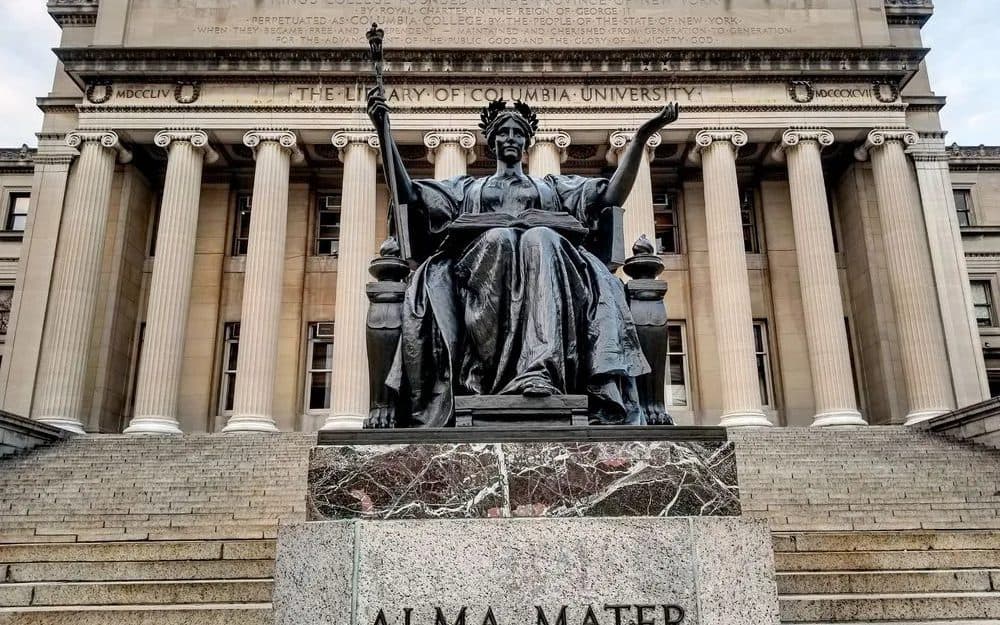
Columbia was founded in 1754 as King's College by royal charter of George II, making it the fifth-oldest institution of higher education in the United States. It became Columbia College after the Revolution in 1784, took its present name in 1896, and moved that same year from midtown to the Morningside Heights campus it still occupies on the Upper West Side of Manhattan.
Two things make Columbia different from the rest of the Ivy League, and both matter to you. The first is the Core Curriculum, a set of compulsory seminars that every undergraduate takes regardless of major. The second is scale at postgraduate level: Columbia enrols 9,833 undergraduates against 26,096 graduate and professional students (Fall 2025 census). For most Indian families reading this, Columbia is a *graduate* decision. This guide is written accordingly — if you want to study at Columbia University as an international student and you are looking at a master's, the sections below on cost and funding are the ones to read twice. For the wider picture on how to study in the USA, start there and come back.
Columbia University at a Glance
Before you quote a Columbia ranking to anyone, know this. Columbia stood at #2 in the United States in the 2022 US News edition. In February 2022 a Columbia mathematics professor, Michael Thaddeus, published an analysis of the figures the university had submitted — including that Columbia reported 173 part-time non-medical faculty to US News while reporting 1,662 of them to the federal government. Columbia's own Office of the Provost then confirmed the substance. On 30 June 2022 it said it would "refrain from submitting to U.S. News and World Report this year" while it reviewed its data, calling the review "a matter of integrity". On 6 June 2023 it went further: it had "conducted an exhaustive internal review, and where errors were confirmed, issued public corrections", and "Columbia will not submit data to the U.S. News undergraduate rankings." We could not independently verify Columbia's current US News position, because US News blocks automated access — so this guide quotes Times Higher Education, which places Columbia 20th in the world for 2026, and Columbia's own Common Data Set. Weight the things you can check yourself.
The Core Curriculum — Columbia's Defining Feature
The Core is not a general-education box-ticking exercise bolted onto a degree. It is the first college general education programme in the United States, launched in 1919 as a single course called Contemporary Civilization, designed to prepare students to grapple with what the faculty then called "the insistent problems of the present". Every Columbia College undergraduate takes it, whether they intend to become a doctor, a banker or a poet.
- Contemporary Civilization (1919) — a year of political, moral and social philosophy, read in primary sources.
- Literature Humanities (1937) — a year-long course reading Enheduanna, Homer, Sappho, Plato, Vergil, Augustine, Ibn 'Arabi, Dante, Montaigne, Shakespeare, Sor Juana Inés de la Cruz, Austen, Woolf, Morrison and Rankine.
- Art Humanities and Music Humanities (1947) — close study of a small number of works and composers rather than a survey.
- Frontiers of Science (2004) — the science component, added after decades of failed attempts to fit scientific inquiry into the Core.
- Global Core (a requirement since 1990), plus University Writing, a foreign language requirement, a science requirement and physical education.
What the Core actually feels like. Literature Humanities meets in groups of approximately twenty-two students for four hours a week, for a full year. Every first-year is preregistered into it. Like every Core course it must be taken for a letter grade — no pass/fail hiding — and you may not drop or withdraw from it after the Core drop deadline. If the idea of arguing about Plato for four hours a week alongside a Computer Science degree excites you, there is nothing else like Columbia College in American higher education. If it sounds like a burden, that is equally valuable to know — working it out before you apply, rather than after, is exactly the kind of self-knowledge that lands you at the right university, not just a famous one.
What Can You Study at Columbia?
1. Columbia Engineering (SEAS) — the reason most Indian students are here
The Fu Foundation School of Engineering and Applied Science is where the Indian applicant volume sits. The numbers tell the story: SEAS enrols 4,981 graduate students against 1,913 undergraduates — a postgraduate school two and a half times the size of its undergraduate one. Master's programmes span Computer Science, Data Science, Electrical Engineering, Industrial Engineering and Operations Research, Financial Engineering, Mechanical, Civil, Biomedical, Chemical, Applied Physics and Applied Mathematics. A Columbia MS requires a minimum of 30 points of coursework completed at Columbia.
2. Columbia Business School
Founded in 1916 and now enrolling 2,797 students, CBS moved in January 2022 into two purpose-built Diller Scofidio + Renfro buildings — Henry R. Kravis Hall and David Geffen Hall — on Columbia's Manhattanville campus, a few blocks north of Morningside Heights. Its defining advantage is not architectural: it is that the school sits an express subway ride from the world's largest concentration of finance, and it runs a January intake ("J-Term") alongside the standard autumn entry, which suits career-switchers who do not want a summer internship.
3. Journalism, Law and International Affairs
The Graduate School of Journalism was founded by Joseph Pulitzer in 1912 and held its first classes on 30 September 1912; Columbia University administers the Pulitzer Prizes to this day. The school is deliberately small — 252 students in Fall 2025 — with a ten-month MS as the flagship. Columbia Law School enrols 1,761, and the School of International and Public Affairs (SIPA) 1,462, the latter making heavy use of the United Nations twenty minutes away. The Graduate School of Arts and Sciences, which runs Columbia's PhD programmes, enrols 3,609.
Most Popular Programmes for Indian Students: the SEAS master's suite — MS Computer Science, MS Data Science, MS Electrical Engineering, MS Financial Engineering and MS Operations Research — followed by the Columbia MBA, the LLM at Columbia Law, MS Journalism, and the MPA and MIA at SIPA. At undergraduate level, Columbia Engineering and Economics dominate.
Admissions for Indian Students
Undergraduate — Common App, Class XII and the Early Decision fine print
- Apply via the Common Application, the Coalition Application on Scoir, or QuestBridge, plus Columbia-specific questions. Application fee $85.
- Deadlines: 1 November for Early Decision (binding) and QuestBridge; 15 November for the ED financial aid application; 1 January for Regular Decision; 15 February for the RD financial aid application; decisions in late March; 1 May to reply.
- Testing: test optional for the 2026–2027 cycle (Fall 2027 entry). SAT or ACT required from the 2027–2028 cycle (Fall 2028 entry), with a waiver available on request. There is no minimum score.
- Class XII: Columbia "accepts all secondary school curricula" and reviews applications within the context of your curriculum. Board results must be submitted if they are required to complete and graduate from secondary school — which means your CBSE or ISC results are compulsory, not optional.
- Recommendations: two teacher recommendations from academic subjects plus a counsellor recommendation. For Columbia Engineering, one teacher recommendation must come from a maths or science teacher.
- Acceptance rate: 4.2% for the Class of 2030 — 2,581 admitted from 61,031 applications, from 111 countries.
The number Columbia does not put in its press release — and knowing it puts you ahead. The headline 4.2% is the rate for everybody. Columbia's Common Data Set splits the same admissions cycle by residency, and the gap is stark: for Fall 2024 entry, 14,593 international applicants produced 359 admissions — 2.5% — while 45,654 domestic applicants produced 1,966 admissions, 4.3%. As an international applicant your odds are roughly half the published figure. Of those 359, 250 enrolled. This is not a reason to avoid applying; it is a reason to make Columbia one of several well-chosen reaches rather than the entire plan. Building that balanced list is exactly what our counsellors work through with families — talk to us before you finalise yours.
Two corrections that will save you time and money. First, Columbia has no admissions interviews — "interviews are not a part of Columbia's admissions process", following its announcement of 18 May 2023. Any coaching package selling Columbia interview preparation is selling you nothing. Second, Columbia Undergraduate Admissions "does not authorize or work with any independent agents anywhere in the world", and Columbia Engineering requires that "the applicant must submit all materials directly, not through an agent or third-party vendor", with narrow exceptions for Fulbright, DAAD and a handful of named government programmes. An agency that files your Columbia application on your behalf is putting your admission at risk — so submit everything yourself, and use expert guidance where it genuinely helps: strategy, essays and review.
Thinking of transferring in from an Indian university? Read this first. To apply as a transfer student, Columbia requires you to be enrolled at a college in North America or at a "US-style" college abroad. If your college is not US-style — which describes almost every Indian university — you may apply only as a first-year student, and only during your first year of study. Once you have begun your second year, you are no longer eligible to apply to Columbia as an undergraduate at all. The takeaway rewards early movers: if a Columbia bachelor's is the goal, make that decision during your first year at home, while every door is still open.
Graduate — where most Indian applicants actually are
- Three-year Indian bachelor's: Columbia Engineering's published bar is "a bachelor's degree received from an institution of acceptable standing" — its bulletin sets no four-year minimum. But there is no blanket policy either way, and the call is made department by department. Email the department directly, name your university and degree, and get it in writing before you spend anything.
- GRE: not required as of July 2026 at Columbia Engineering. Scores are optional, and Columbia states that applicants who do not submit "will not be penalized". If you submit and are admitted, you must then send official scores.
- Deadlines: 15 December for PhD, Eng.Sc.D. and MS-leading-to-PhD applicants; 15 February for most MS-only and non-degree applicants; 1 October for spring admission to any programme. MS in Computer Science runs a 15 January priority deadline with a 15 February final deadline.
- Documents: official transcript from every institution attended, personal statement, CV and three letters of recommendation. Submit everything yourself; no agents.
- A maximum of 15 points of credit completed as a non-degree student may count towards a Columbia degree.
The funding detail buried in Columbia Engineering's own deadlines — knowing it is your edge. Columbia Engineering states that "your admissions application must be received by the December 15 deadline to be eligible for ... departmental funding" — that is institutional grants, fellowships and assistantships. But the deadline for MS-only applicants is 15 February. Apply on the normal master's timeline and the funding window has already closed. Note the wording on the assistantships too: they are described as "available to doctoral students in all departments" — read that sentence carefully, because it means a taught master's is, in the ordinary case, unfunded. Applicants for spring (January) entry "will not be considered for departmental funding" at all. The move that keeps every door open is simple: if funding matters to you, submit by 15 December even though your programme would accept you two months later, and build your budget as if you will pay — so anything you win improves the picture. Sequencing an application around deadlines like this is exactly what our counsellors plan with students — talk to us before you fix your timeline.
English Language Requirements
- Undergraduate minimums: IELTS 7.5 · TOEFL iBT 105 (tests on or before 20 January 2026) or 5.5 on the new TOEFL scale from 21 January 2026 · Duolingo 135 · Cambridge C1 Advanced or C2 Proficiency 191.
- Most Indian undergraduate applicants are exempt. Columbia waives the test if English has been "your primary language of instruction ... for the duration of your secondary school career" — true for the vast majority of CBSE and ISC students — or if you score 700 or above on SAT Reading and Writing or 29 or above on ACT English or Reading.
- Columbia's TOEFL report code is 2116. Scores must be reported directly by the testing service.
- At postgraduate level the waiver is narrower. Columbia Engineering requires an English test from anyone whose bachelor's was earned in a country where English is not the official and widely spoken language — so an Indian degree does trigger the requirement, regardless of your medium of instruction. TOEFL, IELTS, Duolingo and PTE are all accepted, valid for two years.
The Real Cost
Columbia publishes a 2026–2027 undergraduate cost of attendance of $99,774. That is the number on your I-20 and the number your visa officer cares about — not the tuition figure, which is only part of it.
- Tuition: $72,800 — charged as a flat $36,400 a term, regardless of how many credits you take.
- Fees: $4,160. Within that, the Student Life Fee is $956 a term and the Columbia Health and Related Services Fee $759 a term. New students also pay a one-off $625 orientation charge and a $105 document fee.
- Housing $12,522 and food $7,128 — a combined $19,650. First-year students are required to live on campus.
- Books and supplies $1,320 · personal expenses $1,844 · travel "varies" — Columbia's travel line assumes two round trips a year and is calculated from where you live, so an Indian student's real figure is far above the domestic examples Columbia gives.
- International services charge: $175 a term, $350 for the year, payable by every student holding a non-resident visa.
- Postgraduate is billed per credit. Columbia Engineering charges $2,822 per credit for 2026–27 (its own figures are marked estimated) and a master's requires a minimum of 30 credits at Columbia — about $84,660 in tuition alone. PhD tuition is $29,272 per Residence Unit.
The $5,823 line item that is not in the $99,774. Columbia requires all international students to enrol in the Columbia Student Health Insurance Plan, and says waivers are considered only "on a limited case-by-case basis". For 2026–2027 the premium is $2,218 for the autumn term and $3,605 for the spring — $5,823 for the year, billed on top of the Columbia Health fee already inside the published budget. Add the $350 international services charge and flights to India, and the honest all-in figure for an Indian undergraduate is above $105,000 a year — roughly ₹90 lakh at recent exchange rates. Budget from that number, not from $72,800.
Financial Aid for Indian Students
The correction that matters most, in Columbia's own words: "All financial aid at Columbia is need-based, and there are no merit scholarships awarded for academics, athletics or other talents." No Ivy League university awards merit, athletic or academic scholarships. If you want that proved rather than asserted, open Columbia's Common Data Set and look at item H2A, the table recording students who had no financial need and were awarded non-need-based institutional aid: every cell is blank. Every listicle promising a "Columbia University Merit Scholarship for Indian students" worth $10,000 or $20,000 is describing a scheme that does not exist. What Columbia offers instead is need-based aid, and it is genuinely generous — and once you understand how it interacts with admission, you can plan for it deliberately rather than hope for it.
Columbia is need-blind for US citizens and permanent residents, and need-AWARE for international applicants. In its own words: "international students are evaluated in a need-aware manner ... the admissions committee considers how much financial aid a student requires when evaluating an application." This is a real distinction within the Ivy League — Harvard, for example, states that admissions decisions are made without regard to whether an applicant has applied for financial aid, even if the applicant is a foreign citizen, and Yale and Princeton are likewise need-blind for internationals. At Columbia, asking for money is part of the file. It is also why Columbia warns that "even very competitive international candidates who are applying for financial aid ... may be deferred to Regular Decision so the Committee on Admissions can review the entire global applicant pool". Early Decision is binding, and it does not shelter an aid-seeking international applicant the way it shelters a full-fee one. The practical response is straightforward: settle your aid strategy first, then choose the application round that fits it — decisions made in that order work in your favour.
- 1. Columbia need-based aid — average international award $79,375
- Columbia commits to meeting 100% of the demonstrated need of all admitted first-year, transfer and Combined Plan students, regardless of citizenship, and funds international awards entirely from institutional resources because international students cannot receive US federal aid. Packages contain no loans — students are expected to borrow $0. Columbia's international aid page gives the average award to an international recipient as $79,375, with international financial aid totalling $19 million in 2023–24. Its Common Data Set for 2024–25 puts the same figure slightly higher: 244 nonresident undergraduates awarded aid, averaging $88,789, totalling $21,664,444.
- 2. The published income thresholds
- Families with annual income under $150,000 and typical assets attend Columbia tuition-free. Families under $66,000 with typical assets have an expected parent contribution of $0. Roughly half of incoming first-year students receive a Columbia grant, and the average first-year grant is $76,503. These thresholds are stated without a citizenship carve-out, so they apply to admitted international students too — the need-aware filter operates at the admission stage, not at the aid stage.
- 3. Graduate funding works completely differently
- There is no need-based system at postgraduate level. Columbia Engineering states that teaching and research assistantships — which carry tuition exemption and a living stipend — are "available to doctoral students in all departments". Departmental grants and fellowships do exist, they are awarded on academic merit, and your application must arrive by 15 December to be considered — there is no separate funding application to file later, and spring applicants sit outside the funding round entirely. Hit that one date and you have kept every funded possibility alive.
- 4. PhD funding — the genuinely funded route
- If your goal is a fully funded US education, the PhD is the route, not the master's. Columbia doctoral students are supported through assistantships and fellowships that cover tuition and pay a stipend, in exchange for teaching or research. Note that Columbia Engineering expects doctoral candidates to hold a master's degree, and that MS students already enrolled may apply to the doctoral programme once they have completed part of their coursework — so an MS can be a paid-for bridge to a funded PhD, provided you budget for the bridge deliberately.
- 5. Fulbright-Nehru Master's Fellowships (USIEF)
- Covers tuition, living costs, health coverage, J-1 visa support and return economy airfare for up to two years of master's study. The eligibility bar is specific: a four-year Indian bachelor's with a minimum of 55%, or a completed master's, plus at least three years of full-time professional experience. Crucially, the eligible fields are Economics, Environmental Science, Higher Education Administration, International Legal Studies, Journalism and Mass Communication, Public Health, Sustainable Development and Urban and Regional Planning — engineering, computer science and business are not on the list, which rules out most of Columbia's popular master's programmes.
- 6. J.N. Tata Endowment loan scholarship
- India's oldest scheme of its kind, running since 1892 and having supported more than 5,700 Indian students. It covers all academic disciplines at master's, PhD and post-doctoral level, and is awarded purely on merit. The 2026 cycle opened on 5 January and closed on 29 March, with aptitude testing in late April and awards announced in mid-July — so it runs a full year ahead of your intake. Plan for it early or you will miss it.
Life at Columbia — An Honest Picture
Columbia's campus is a walled quadrangle of neoclassical buildings sitting inside one of the densest cities on earth, on the 1 subway line at 116th Street. That combination is the whole appeal — and the trade-off worth walking in with your eyes open to. You get a real campus with lawns and a library dome, and you get Manhattan outside the gates: its energy, its opportunity, and, yes, its prices and its noise. For students who want the city to be part of the education, there is no better setup in the Ivy League.
- The Indian community is enormous, and it is mostly off campus. New York's South Asian centre is Jackson Heights in Queens, where 74th Street is the Indian commercial hub — sari shops, jewellers, sweet shops and dozens of restaurants — with Little Pakistan and Little Bangladesh a street over. It is served by the 7, E, F, M and R trains at Jackson Heights–Roosevelt Avenue, about twenty minutes from Midtown.
- Places of worship: the Ganesha Temple at 45-57 Bowne Street in Flushing, consecrated on 4 July 1977, is one of the oldest traditional Hindu temples in the United States and remains an anchor of Hindu religious life in the city. Gurdwaras, mosques and Jain and Swaminarayan temples across Queens and New Jersey are all reachable by subway or bus.
- Food is not a problem here. This is the one Ivy town where you will never have to explain what a dosa is, and where an Indian grocery run does not require a car.
- Winter is real but not brutal. New York is meaningfully milder than Ithaca or rural New England. January and February are cold and grey, snow is normal, and you will need a proper coat — but campus life does not stop.
- Flying home is easy. JFK and Newark both run direct services to Delhi, Mumbai and Bengaluru, and both are reachable by public transport from Morningside Heights. That is a genuine advantage over the rural Ivies.
How many Indian students are actually at Columbia? Columbia publishes the ranking but not the number — so neither will we. Columbia's own *Facts 2024* reports that India is the second most-represented country of origin, behind China and ahead of Canada, South Korea and Indonesia, across 145 countries in Fall 2024 — with no headcount attached to any of them. The same table carries the split that should shape your thinking: US non-residents are 21% of Columbia's undergraduates but 53% of its Morningside graduate population, against 14% and 44% a decade earlier. Being international at Columbia is a *graduate* experience, which is precisely where Indian applicants concentrate. What Columbia does not publish anywhere — at university or school level — is an India-specific number, and the figures circulating on study-abroad sites trace back to old visa data or to nothing at all. Be sceptical of any dramatic claim about Indian enrolment rising or collapsing at a named US university; almost none of them rest on the institution's own country-of-citizenship data. For national context, which *is* published: India was the leading place of origin for international students in the United States in 2024/25, with 363,019 students — 30.8% of the total, ahead of China's 265,919. Ask Columbia's admissions office for a programme-level figure if it matters to your decision, and treat any number you find elsewhere as decoration.
On the protests, and where things stand as of August 2026. Columbia was at the centre of the 2024 and 2025 campus demonstrations over Gaza, with encampments, a building occupation, suspended in-person classes and heavy news coverage. In July 2025 Columbia agreed a $221 million settlement with the federal government to restore federal research funding. As part of that agreement Columbia now submits admissions data to the federal government — including race, GPA and test scores — and asks international applicants why they wish to study in the United States as part of the application. Campus is functioning and the 2025-26 admissions cycle ran normally, producing the largest applicant pool in Columbia's history. But access to the Morningside campus is still actively managed: Columbia's own pages still tell visitors to check published campus access levels before coming. Go in aware that this is a politically scrutinised campus, and that as an international student on an F-1 visa your latitude for public political activity is narrower than a citizen's.
One piece of good news for applicants: Columbia is expanding undergraduate enrolment by 125, then 200, then 250 students across the next three incoming classes at Columbia College and Columbia Engineering. It is contested internally — the Faculty of Arts and Sciences passed a resolution opposing it on 16 March 2026, with around 77% of participating faculty in favour of the resolution — but for you it means marginally more seats each year rather than fewer.
Career Outcomes and Staying On
- 86.9% of Columbia College and Columbia Engineering undergraduate degree earners are employed or in graduate school, per Columbia's own 2025 Beyond Columbia Survey.
- $97,303 average starting salary for working graduates of Columbia College, Columbia Engineering and the School of General Studies — a figure that reflects how many go into New York finance, consulting and technology.
- 126,529 jobs and internships were posted on LionSHARE, Columbia's careers platform, in the most recent year.
- Location is the asset. Columbia's recruiting advantage is not a careers fair; it is that an investment bank, a hedge fund, a law firm and a newsroom are all a subway ride away, and that internships during term time are practical in a way they simply are not at a rural campus.
On working in the US afterwards, here is the unvarnished sequence. F-1 students get 12 months of post-completion OPT at each education level — so a master's earns you a fresh 12 months even if you used OPT after a US bachelor's. If your degree is on the DHS STEM Designated Degree Program List, you can apply for a 24-month STEM OPT extension, giving 36 months in total. Most Columbia Engineering master's degrees qualify; most humanities, journalism and policy degrees do not. That distinction is worth more to your long-term plans than almost anything else on your application.
The visa rule that changes the arithmetic — confirmed in the Federal Register, and current as of August 2026. On 17 July 2026 DHS published a final rule, *Establishing a Fixed Time Period of Admission and an Extension of Stay Procedure for Nonimmigrant Academic Students*, effective 15 September 2026. It ends "duration of status" for F-1 students. In its own words, it sets "a fixed period of authorized stay based on program length, with a maximum of four years and a 30-day grace period" — so your I-94 now carries a hard end date, the old 60-day departure grace period becomes 30 days, and a programme running beyond your admitted period requires a formal extension-of-stay application that USCIS must adjudicate. OPT and STEM OPT survive. There is one transitional concession worth knowing: F-1 students already admitted for duration of status who file for post-completion OPT or a STEM OPT extension on or before 18 March 2027 do not have to file a separate extension-of-stay application. DHS notes the rule is subject to congressional review, so confirm the position with Columbia's international office before you travel.
After OPT comes the H-1B, and this is where knowing the real numbers puts you ahead of most applicants. The cap is 65,000 visas plus 20,000 reserved for US advanced degrees. For FY2026, USCIS received 343,981 eligible registrations and selected 120,141 — roughly one in three. From the FY2027 cap season, registered in March 2026, USCIS no longer runs a flat random draw. Under a final rule published on 29 December 2025, registrations are weighted by the Department of Labor OEWS wage level the offered salary meets: wage level IV enters the pool four times, level III three times, level II twice, and level I once.
Why this is the most important paragraph in this guide if you plan to work in the US. A fresh master's graduate on an entry-level salary is almost always a wage level I registration — the bottom weight. DHS's own published estimates put the odds starkly: an estimated 89,911 level I registrations face a 15.29% chance of selection and 177,216 level II registrations a 30.58% chance, while a level IV beneficiary's chance rises to over 61% and level III to over 45%. Under the old flat lottery, everyone sat at just under 30%. In other words, the new system roughly halves the chances of the exact applicant a Columbia master's produces, while doubling them for senior hires. The playbook is clear, and it is workable: plan on a STEM degree, negotiate hard on salary — it now changes your immigration odds, not just your bank balance — budget for multiple attempts, and keep a parallel plan running so your career never rests on a single draw.
And the $100,000 payment you have read about — the most misreported immigration story of the year. Presidential Proclamation 10973, signed 19 September 2025 and effective 21 September 2025, restricts H-1B entry unless the petition carries a $100,000 payment. The proclamation's own scope is far narrower than the headlines: it applies to petitions for beneficiaries who are currently outside the United States, and the Secretary of Homeland Security may waive it where the hiring is in the national interest. If you finish a Columbia master's and move from OPT to H-1B without leaving the country, this is not aimed at you — though travelling abroad afterwards is where it gets complicated. It is also time-limited: it expires twelve months after taking effect, on 21 September 2026, unless extended. Position as of August 2026 — take advice on your own facts, not from a forum.
Is Columbia Right for You?
Columbia is the strongest choice on the Ivy list if you want a genuinely global city rather than a college town, and if you are a postgraduate. It hosts more international students than any other Ivy by a wide margin, its engineering school is overwhelmingly graduate, and New York does the work that a careers service cannot. If you are an undergraduate whose family qualifies for substantial need-based aid, the offer is extraordinary — tuition-free under $150,000 of family income, full need met, no loans. And if the Core Curriculum appeals to you rather than irritating you, there is nothing else quite like it in American higher education. If the global-city argument is what draws you, it is worth comparing Columbia against LSE, which offers a similar proposition in London for a fraction of the cost.
Go in with clear eyes too: Columbia is need-aware for international applicants, so the size of your aid request is weighed in the admission decision, there are no merit scholarships, and the international admit rate is half the headline one. The all-in cost of over $105,000 a year for undergraduates, and roughly $130,000 for a largely unfunded engineering master's, is among the highest in the United States. Columbia has not submitted data to the US News undergraduate rankings since 2022, so lean on the sources you can verify, and the campus remains under political and federal scrutiny. None of that diminishes what Columbia offers the right student — it simply sharpens the question of fit. If you want a comparably strong US engineering education with a broader spread of funded routes and a calmer campus, look at Cornell; if you want an Ivy that reads international applicants need-blind, look at Princeton. Columbia is worth every rupee for the right student — and working out whether that student is you is a question best answered with a clear plan rather than a guess.
Ready to Build Your Columbia Plan?
Columbia rewards students who plan early and plan precisely — the 15 December submission that keeps departmental funding open, a written answer from your department on a three-year degree, a budget that already includes the health insurance most guides miss. These are exactly the details our counsellors work through with Columbia applicants. Falcon Nova Consultants has helped hundreds of Indian students secure places at top US and UK universities. Book your free, no-obligation counselling session and let us turn the insights in this guide into your application plan.
Book Your Free Counselling Session