Buried in Harvard's Common Data Set for 2025-26 is a line that almost no Indian family ever sees. In a single year, 805 international undergraduates received need-based aid from Harvard averaging $83,013 each — $66,826,244 handed out in total. Not one of those students received a merit scholarship, because Harvard awards none. Every dollar was given on the basis of what a family could not pay, and citizenship had nothing to do with it.
Harvard was founded in 1636, one hundred and forty years before the United States existed. It now runs 15 schools and divisions, teaches 24,317 students, employs 20,117 faculty and staff, and sits on an endowment of $56.9 billion — which returned 11.9% in FY2025 and funds 40% of the university's annual revenue. That endowment is not a trophy. It is the reason the aid figures above are possible at all.
For Indian students planning to study in the USA, Harvard raises two questions that most guides answer badly: can you realistically get in, and if you did, could you pay for it? This guide covers what it takes to study at Harvard University as an international student — the fees Harvard publishes, the aid it actually gives, the testing policy it quietly reversed, and where the fight with the federal government genuinely stands as of August 2026. If you are also weighing Oxford and Cambridge, the funding is usually what decides it.
Harvard University at a Glance
Two numbers deserve a second look. The 4.2% acceptance rate is the last one Harvard officially published — it withheld Class of 2030 figures for a second consecutive cycle and will not release them until its Department of Education submission in October 2026, so treat any "3.2% for 2030" claim you see online as an estimate, not a fact. Note also that Harvard leaves the residency breakdown of its admissions data blank, so there is no published admit rate for international applicants specifically — anyone quoting one has made it up. And once you are in, you stay: the retention rate is 98.0% and the six-year graduation rate is 97.1%.
Fifteen Schools, One Name — And Why That Matters
The most expensive planning error Indian families make is treating "Harvard" as a single application. Harvard College admits undergraduates. Harvard Griffin GSAS runs master's and PhD programmes in arts and sciences, including engineering. Harvard Business School, Harvard Law School, the Harvard Kennedy School and eleven others each have their own admissions office, fee schedule and completely different funding rules. The generosity described above belongs to Harvard College, and it does not automatically travel to the graduate schools — so the smartest first move in any Harvard plan is pinning down exactly which school's rules apply to you, before a single form is filled in.
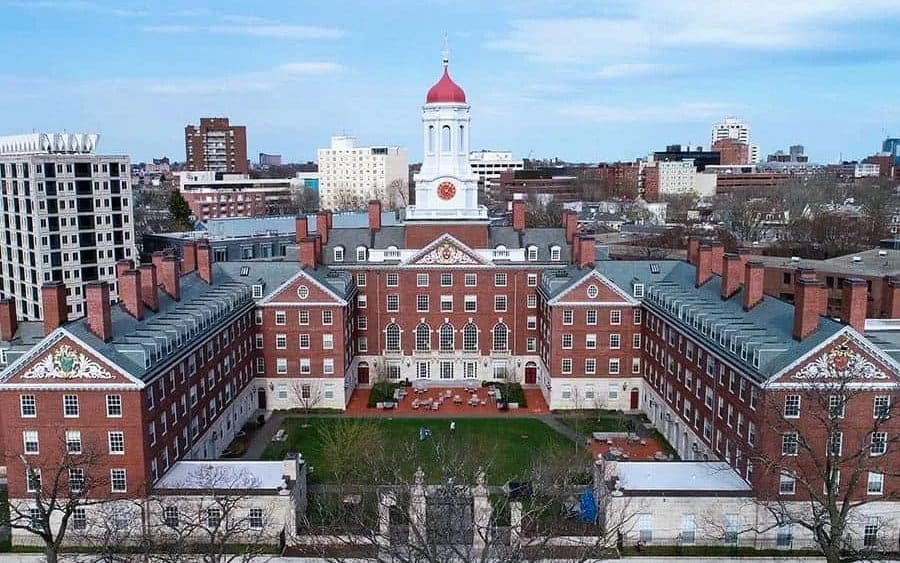
How undergraduate life is organised. First-year students live in dormitories around Harvard Yard, grouped into four neighbourhoods — Crimson, Elm, Ivy and Oak — and eat together in Annenberg Hall. In the second semester of first year, on Housing Day, every student is assigned to one of Harvard's 12 upperclass Houses, each holding 350 to 500 students, where they live for the remaining three years. 100% of first-years and 97% of all undergraduates live in university housing — this is a residential college in the fullest sense, not a commuter campus.
What Can You Study at Harvard?
Harvard College offers more than 3,700 courses across 50 concentrations — its word for a major — plus 50 secondary fields, joint and double concentrations, and a petition route for a custom one. Rather than repeat a prospectus, here is what Harvard undergraduates *actually graduated in* between July 2024 and June 2025, from Harvard's own Common Data Set.
- Social sciences — 27% of bachelor's degrees. This is Harvard's centre of gravity: Economics, Government, Sociology, Social Studies.
- Mathematics and statistics — 14% · Biological and life sciences — 13% · Computer and information sciences — 11%.
- History — 7% · Physical sciences — 6% · Psychology — 5% · Engineering — 4%.
- Visual and performing arts — 3%, with English, philosophy and religious studies, foreign languages, and area, ethnic and gender studies at 2% each.
- Business, medicine and law: 0%. Harvard College conferred no undergraduate degree in business or marketing, no health professions degree and no law degree. Those are graduate schools only.
1. The Social Sciences — Economics and Government
Economics and Government are Harvard's two largest concentrations, and this is the well-worn path for an Indian student aiming at consulting, finance, policy or a later MBA or law degree. Note where the strength is *not*: engineering accounts for only 4% of Harvard's bachelor's degrees.
2. Quantitative Subjects — Mathematics, Statistics and Computer Science
Mathematics and statistics (14%) and computer and information sciences (11%) together account for a quarter of Harvard's bachelor's degrees, a share that now rivals the social sciences. Graduate work runs through the John A. Paulson School of Engineering and Applied Sciences (SEAS), whose master's programmes are administered by Harvard Griffin GSAS and priced separately: an SEAS master's in computational science and engineering or in data science costs $67,504 for the first year in 2026-27.
3. Harvard Business School — Why the MBA Comes Later in Your Journey
HBS is a graduate school. There is no undergraduate business degree at Harvard, and the route into HBS runs through the working years — which means an ambitious eighteen-year-old's real HBS strategy is choosing the right undergraduate degree and first job now. The MBA Class of 2027 has 943 students, 37% international, from 62 countries, with an average of 4.9 years of work experience (middle 80%: three to seven), a median GPA of 3.76, a median GMAT of 685 (730 on the older 10th-edition scale) and median GRE scores of 164 Verbal and 164 Quantitative. For the Class of 2029, which matriculates in autumn 2027, Round 1 closes 9 September 2026 at 12:00 noon ET with decisions on 10 December, and Round 2 on 5 January 2027 with decisions on 25 March — and HBS states plainly that "applications received after the Round 2 deadline will not be considered."
4. Law, Public Policy and the Rest
Harvard Law School runs the three-year JD and the one-year LL.M. — the latter the realistic route for an Indian law graduate, since it requires a first law degree, which an Indian LLB or five-year integrated LLB satisfies. The Harvard Kennedy School runs the MPP, MPA, the two-year MPA/ID built around economics and development, and the mid-career MC-MPA. Harvard Griffin GSAS houses every arts-and-sciences PhD — and it is where the funding picture flips completely in your favour.
Most Popular Routes for Indian Students at Harvard: the HBS MBA; the Harvard Law LL.M.; the Kennedy School MPP and MPA/ID; SEAS master's programmes in computational science and engineering and data science; GSAS PhDs across economics, statistics, computer science, the sciences and South Asian studies; and, at undergraduate level, Economics, Applied Mathematics and Computer Science.
Admissions for Indian Students
Undergraduate — Harvard College
- Common Application only — Harvard does not accept the Coalition Application. Fee $90, with hardship waivers.
- Restrictive Early Action closes 1 November, decisions mid-December. It is non-binding — you have until 1 May to reply — but while it is open you may not apply early to any other private institution. Regular Decision closes 1 January, decisions at the end of March.
- The SAT or ACT is required. Harvard's Common Data Set records it as "Required to be considered for admission" for applicants for Fall 2027, with 1 March the last date scores may be received. Where the SAT and ACT are genuinely inaccessible, AP results, IB actual or predicted scores, GCSE or A-Level results, or national leaving-exam results may substitute.
- The scores you are competing against. Of students who enrolled in fall 2025, 79% submitted the SAT and 27% the ACT. The 25th-to-75th percentile ranges were SAT Evidence-Based Reading and Writing 720–770, SAT Math 730–790 and ACT Composite 33–35. Harvard publishes no SAT composite range, so ignore anyone quoting one as official.
- Written work: five short-answer questions of 150 words each, alongside the Common App essay. Recommendations: two teachers in *different* academic subjects, plus a Secondary School Report from your counsellor.
- Interviews are not guaranteed. Harvard cannot interview all applicants, and states that "the absence of an interview will not adversely affect your candidacy" — so read nothing into not getting one.
Two testing myths — and the edge you gain by knowing better. First, Harvard is not test-optional. It reversed that policy in April 2024, and its own data return confirms the SAT or ACT is required for Fall 2027 entry — yet pages saying "test-optional through 2030" are still circulating widely on Indian sites. Second, Harvard College does not require IELTS or TOEFL at all, and states that TOEFL, IELTS and Duolingo "cannot be used to meet the standardized testing requirement." The IELTS 7.0 figure you have seen attached to Harvard belongs to Harvard Griffin GSAS, a different school with a different application. One warning against over-correcting: the Ivies have genuinely diverged on testing, so check each one separately. Princeton, for instance, publishes that its "test optional policy continues to be in place for first-year applicants applying for fall 2026 and fall 2027 entry," and requires tests only from fall 2028. Apply to four of these universities in one cycle and you may face four different rules — so before you book a test date, talk to us and let us help you keep the testing plan for your whole list straight.
On Class XII: Harvard publishes no percentage conversion, and we will not invent one. Unlike UK universities, which state that A*AA equals 87%, Harvard gives no board-by-board equivalence and names no minimum percentage. Its admissions data return is unhelpful in a revealing way — not a single factor is marked "very important". Rigour of school record, GPA, test scores, essays, recommendations, extracurriculars, character, talent and even alumni relation are all merely *"considered."* Two things are explicitly not considered: class rank, and level of applicant's interest — so skip the campus-visit theatrics and emails to admissions officers, and pour that energy into the things Harvard actually reads: your record, your essays and your recommendations.
Graduate — A Different Application Every Time
- Harvard Griffin GSAS accepts a three-year Indian bachelor's outright. Its requirement is "a three- or four-year undergraduate degree from an institution of recognized standing" — covering a standard BA, BSc or BCom. Application fee $105. The GRE is required only "for select programs", not universally, and deadlines are set by each programme rather than centrally.
- No blanket WES requirement at GSAS — you upload your own transcripts electronically. Other Harvard schools set their own rules on credential evaluation, so confirm rather than assume.
- HBS assesses three-year degrees case by case. It asks for the equivalent of a US bachelor's from an accredited institution; some three-year international degrees qualify and some do not. Check yours with MBA Admissions before you commit.
- PhD applicants apply to a department, not to Harvard. Fit with a named faculty member matters more than any test score, and the funding is attached to the department.
English Language Requirements
- Harvard College: none. No English proficiency exam is required of first-year or transfer applicants, and English tests cannot substitute for the SAT or ACT.
- Harvard Griffin GSAS: IELTS Academic 7.0 with a minimum 6.5 in Speaking, or TOEFL iBT 5.0 with 4.5 in Speaking on the new scale — equivalent to TOEFL iBT 95 with 23 in Speaking for tests taken before 21 January 2026, when TOEFL changed its scoring.
- The waiver matters to Indian applicants. GSAS waives the requirement if your undergraduate degree came from an institution where English is the primary language of instruction — true of many Indian universities, but it is your institution's status that decides it, not your fluency. A graduate degree does not satisfy the requirement, and the separate route of petitioning on the basis that much of your programme was taught in English applies only to US institutions. Confirm your position with the programme in writing before you skip the test.
- Some programmes set higher scores than the GSAS floor, and the professional schools set their own — never assume the university-wide minimum applies to you.
The Real Cost
- Harvard College 2026-27: tuition $62,226 · fees $6,216 · housing $14,250 · food $8,942 — a billed subtotal of $91,634. Add personal expenses ($2,500), books ($1,000) and transportation ($0–$5,000) for a total cost of attendance of $95,134 to $100,134. Health insurance is $4,954 on top unless a family plan covers you.
- Harvard Griffin GSAS 2026-27: full tuition $59,048 in years one and two, dropping to $15,352 in years three and four, then a $3,906 continuation fee. Living expenses over ten months: $35,400 on campus, $37,700 off.
- SEAS master's 2026-27: $67,504 for the computational science and engineering SM or the data science SM; the second year of the two-year variants is $33,752.
- Harvard Law School JD 2026-27: tuition $84,400 plus a $1,944 health fee, housing $18,900, food $6,760 and insurance $4,954 — a total cost of attendance of $126,650. The LL.M. was $80,760 in tuition against a total budget of at least $121,800 in 2025-26, the most recent year published.
- Harvard Kennedy School 2026-27: MPP and MPA tuition and fees $72,106, total cost of attendance $103,759. MPA/ID $106,058; MC-MPA $117,178.
- Harvard Business School 2026-27: a published cost of attendance of $130,318 for a single student over a nine-month year — tuition $84,760, health fees and insurance $6,898, housing and food $28,000 — so budget roughly $260,000 across the two years before any aid.
The number that matters is cost of attendance, not tuition. Your Form I-20 — the document that gets you an F-1 visa interview — is issued against the full COA, not the tuition line. When a website quotes you "Harvard costs $62,226," it has quoted the smallest component of a figure that is $100,134 before health insurance. Plan against the full number from day one, because the US consulate will — and remember that for most families the aid described below brings the real bill far under the sticker. If you would like help building that honest budget, talk to us before you rule anywhere out on price.
Financial Aid for Indian Students
This is where Harvard separates itself from almost every university on earth, and where Indian coverage of it is most consistently wrong. Three sentences from Harvard's own aid pages do the work: *"Need-blind admissions. Your financial need and your aid application will never affect your chance of being admitted to Harvard."* *"International students are eligible for exactly the same aid as American students."* *"We will never require you to take out loans."* Harvard adds that admissions and aid are handled the same way for every applicant regardless of nationality or citizenship, and that all students compete in the same pool for all places in the incoming class.
- Family income below $100,000 with typical assets: free. The expected parent contribution is zero, aid covers tuition, fees, food and housing, and Harvard adds a $2,000 start-up grant in first year and a $2,000 launch grant in junior year.
- Family income between $100,000 and $200,000: "Free Tuition Plus." Aid covers at least the full cost of tuition, and fees, food and housing depending on your circumstances. Above $200,000, aid is still available case by case.
- "Free" does not mean you contribute nothing. Harvard still expects a student contribution of about $3,500 a year from term-time work. The summer work expectation was abolished in 2020-21, but the term-time one was not.
- Harvard meets 100% of demonstrated need — its own data return records the average percentage of need met as exactly 100.0% for first-years and for all undergraduates.
- 55% of undergraduates receive a Harvard scholarship, 25% of families pay nothing at all, and the average parent contribution is about $13,000.
- International undergraduates in 2024-25: 805 received need-based aid averaging $83,013 each, totalling $66,826,244.
- Only 16% of the Class of 2025 borrowed anything at all, at an average cumulative $22,926 — against a four-year sticker price approaching $400,000.
- Home equity and retirement assets are typically not counted in Harvard's assessment of what your family can pay — which matters a great deal to Indian families whose wealth sits in property.
The single correction that saves Indian families the most money. Harvard awards no merit scholarships, no academic scholarships and no athletic scholarships — at any level, to anyone. Its own words: aid is "completely need-based" with "no merit-based awards, and we have no preferential policies that give some students more attractive awards than others." The evidence is in its data return, not just its marketing. The Common Data Set 2025-26 ticks only need-based aid as available to international undergraduates, leaves non-need-based unticked, and records the number of undergraduates awarded any non-need-based scholarship or grant as 0 — zero first-years, zero across the whole college — with 0 athletic scholarships at an average value of $0. The Ivy League awards none by rule. A perfect Class XII score and a national olympiad medal will help you get *in*; they will not reduce your bill by a dollar. Any site advertising a named "Harvard Merit Scholarship" or "Harvard Scholarship for Indian Students" is describing something that does not exist. Knowing this early is an advantage: instead of chasing phantom scholarships, put your effort into a strong CSS Profile — because the need-based route is real, it meets 100% of demonstrated need, and it is the door Harvard actually holds open.
Graduate Funding Works Completely Differently
- 1. GSAS PhD — fully funded, five years minimum
- Harvard Griffin GSAS states that its packages "typically provide full support (tuition, fees, and basic living expenses) for a minimum of five years — the first four years of study, plus the final year (i.e. the dissertation completion year)." Tuition and the Harvard University Student Health Program are paid in full across those years. The twelve-month stipend was raised to at least $50,000 from 2024-25 and has increased each 1 July since, though Harvard does not publish the current figure centrally — ask your department for the number in writing. Tuition and health grants now extend past the fifth year where the expected time to degree is longer.
- 2. GSAS and SEAS master's — largely self-funded
- The honest counterpart to the PhD position. Harvard's own guidance for master's students says most "fund themselves with a combination of personal funds and loans." A handful of programmes offer a limited number of partial tuition scholarships at admission, and some engineering students hold teaching appointments, but there is no guaranteed package. If you are budgeting for a Harvard master's, budget for the whole thing.
- 3. HBS MBA — need-based only, and substantial
- Around 50% of MBA students receive a need-based scholarship from HBS, and the 10% with the greatest financial need receive full-tuition scholarships. HBS awarded $47 million in FY25; the average need-based scholarship is about $100,000 over the two years, with the majority falling in a $30,000 to $70,000 range. There is no merit money. These are grants, not loans, and are not repaid.
- 4. Harvard Law LL.M. — need-based, and everyone with need got something
- Harvard Law states that LL.M. support is "primarily based on the applicant's demonstrated financial need." In 2025-26, 56% of the LL.M. class received need-based aid from Harvard and a further 50% received grants from other Harvard sources or external funders such as Fulbright. The average grant was about $37,000, roughly half of tuition, and everyone who demonstrated need received something. The school is candid about "funding limitations", so start on external funding early.
- 5. Harvard Kennedy School — apply, but plan without it
- HKS states that "a number of scholarships and fellowships are available — whether you are a U.S. or international student", but publishes neither the proportion of students funded nor an average award, and we will not guess at one. Treat HKS aid as something to apply for rather than a figure to budget around, and pursue external Indian funders in parallel.
How to actually apply for undergraduate aid. International applicants file the CSS Profile (Harvard's code is 3434) and an IDOC packet — not the FAFSA, which is for US citizens. The deadlines match your admissions round: 1 November for Restrictive Early Action, 1 February for Regular Decision. You submit your parents' Indian income tax documents, or a Tax Non-Filer Statement plus a salary certificate or employer letter if they do not file. Translations need not be official — you may write the English translation on the document yourself. Aid decisions go out on or about 1 April.
Life at Harvard — An Honest Picture
Harvard sits in Cambridge, Massachusetts, a dense, walkable university city across the Charles River from Boston, sharing it with MIT a mile down the road. The campus is not a fenced estate but a set of red-brick blocks folded into the town. 86% of first-year students come from outside Massachusetts, and with 97% of undergraduates in the Houses, the social centre of gravity is genuinely on campus.
The most honest thing we can tell you about Harvard and India — and a correction. In fall 2025 Harvard enrolled 545 students from India, on its own published table of enrolment by country of citizenship. Much of the Indian press reported that as a 31% collapse from 788. Harvard's own data does not support that comparison: its figure for the year before was 578, and the peak was 603 in fall 2023. The real movement is a fall of about 6% in one year and 10% over two — a drift downward, not a collapse. In the same period Chinese enrolment rose 4.5% to 1,452, and Harvard's total international enrolment reached a record 6,749. We are not going to speculate about causes Harvard has not stated. The number that actually matters to an undergraduate applicant is smaller and starker: of those 545, just 31 are at Harvard College. The rest are in the graduate and professional schools — 115 at Harvard Business School, 107 at GSAS, 71 at the Kennedy School, 67 at the Extension School. If a large Indian undergraduate cohort matters to you, weigh that number honestly — and then look at the organisations and resources below before you decide what it means for you.
- Dharma, Harvard's Hindu Students Association, was founded in spring 1997 and runs pujas, festival celebrations, discussion groups and visits to Hindu temples around Greater Boston. It maintains a prayer space in the basement of Canaday Hall open 24 hours a day, seven days a week — a rare thing at a US university.
- The South Asian Association (SAA) is the main undergraduate South Asian society and, by Harvard's own student accounts, the primary source of community for South Asian students on campus.
- Academic South Asia is genuinely strong. Harvard has a full Department of South Asian Studies at 1 Bow Street offering an undergraduate concentration, an AM and a PhD, plus a Sanskrit collection in Widener Library and the university-wide Lakshmi Mittal and Family South Asia Institute. Very few US universities take the region this seriously.
- The winter is long and genuinely cold. Snow from December into March is normal, and it is a different order of cold from anything in India. Buy proper winter clothing before you arrive, not after the first storm.
- Boston is the compensation. Cambridge is small, but it sits inside one of the world's great university metros, on a subway line, with everything a major American city provides — South Asian restaurants and groceries included.
Harvard and the Federal Government — Where It Actually Stands
Every aggregator site either ignores this or panics about it. An Indian family deciding on Harvard deserves a dated, non-alarmist account, so here it is.
- 22 May 2025 — the Department of Homeland Security revoked Harvard's SEVP certification, the authorisation that lets a US university issue Form I-20 and enrol international students. Harvard sued the same week.
- 20 June 2025 — the US District Court for the District of Massachusetts issued a preliminary injunction blocking the revocation. The Harvard International Office told students the order "allows Harvard to continue enrolling international students and scholars while the case moves forward," and that students "should continue to apply for or renew their visas through the normal application process."
- 23 June 2025 — a second injunction blocked the related presidential proclamation that would have suspended entry of newly admitted foreign nationals coming to Harvard.
- 5 September 2025 and 12 January 2026 — Harvard filed its opposition to the motion to dismiss, then its response brief in *Harvard v. DHS*. The litigation continues.
- As of August 2026 — Harvard's SEVP certification has not been revoked, the injunctions stand, and Harvard is enrolling international students normally.
The strongest evidence is not legal but numerical. In the middle of all this, Harvard's international enrolment reached its highest recorded level — 6,749 students, about 28% of the university, up by roughly fifty on the year. The Harvard International Office's most recent bulletins, in July 2026, concern routine regulatory matters — visa processing in Africa, the new duration-of-status rule — rather than Harvard's eligibility to enrol anyone. That is not a guarantee, and litigation can turn. But it is a very different picture from the one implied by headlines eighteen months old.
Career Outcomes and Staying On
One honest caveat first: Harvard does not publish a first-destination survey or a median starting salary, unlike many US and UK universities. We looked; the Mignone Center for Career Success puts none out, and we will not reprint an aggregator's number as though Harvard had said it. What we can be precise about is the immigration path, which is where Indian graduates actually get caught out.
- Post-completion OPT gives you 12 months of work authorisation in a field directly related to your degree. You must have been in active F-1 status for two consecutive semesters and be physically present in the US when you apply.
- STEM OPT adds 24 months, for a total of 36. Three hard conditions: your degree must appear on the ICE STEM Designated Degree Program List and have been awarded within the past ten years by an SEVP-certified school; your employer must be enrolled in E-Verify; and you and the employer must complete Form I-983, the training plan.
- Check your specific programme's STEM designation before you enrol, not after. Whether a Harvard master's carries a STEM CIP code is a programme-level fact, and the gap between 12 and 36 months of work rights is the gap between one shot at the H-1B lottery and three.
A change is coming that most 2026 guides have not caught up with. DHS published a final rule on 17 July 2026, effective 15 September 2026, replacing the long-standing "duration of status" framework with a fixed period of admission based on programme length and capped at a maximum of four years for F and J visa holders, set by the programme end date on your Form I-20. You may be admitted up to 30 days before the report date on the I-20, and the period to leave after finishing is cut from 60 days to 30. Students needing longer than the admitted period must file an extension of stay with USCIS, submit biometrics and demonstrate continued eligibility. Two details soften it: students already in duration-of-status when the rule takes effect get up to four years to finish before the date-certain regime applies to them, and anyone who properly files for post-completion OPT or STEM OPT on or before 18 March 2027 is excused from filing a separate extension-of-stay application for that period. OPT and STEM OPT themselves survive the rule.
Then there is the H-1B lottery — and we will be straight with you, because a clear view of it is what lets you plan: it is genuinely a lottery, and the rules recently changed. The last complete published cycle is FY2026, when USCIS selected 120,141 registrations from 343,981 eligible ones — about 35%. From FY2027 onward a DHS final rule dated 29 December 2025 and effective 27 February 2026 replaced the flat draw with a weighted selection based on the OEWS wage level your salary meets. A registration at wage level IV is entered into the pool four times, level III three times, level II twice — and level I once. This is the single most decision-relevant fact in this guide for a master's applicant, because a fresh graduate on an entry-level salary is a level I registration. DHS's own analysis of the rule put the chance of selection at 15.29% for level I registrations and 30.58% for level II — so an experienced hire has roughly double your odds, and a senior one roughly four times. A Harvard degree does not change the draw itself — but the wage level of the job you take does, and that is a lever you can actually work: choose your programme, your STEM designation and your first role with this in mind, and your odds are something you build rather than something that happens to you.
The $100,000 H-1B payment — the most misreported immigration story of the year. Presidential Proclamation 10973, signed 19 September 2025 and effective 21 September 2025, restricts H-1B entry unless the petition is accompanied by a $100,000 payment. Read the proclamation itself and the scope is far narrower than the headlines suggested: it applies to petitions for beneficiaries who are currently outside the United States, and the Secretary of Homeland Security may waive it where hiring is in the national interest. If you graduate here and move from OPT to H-1B without leaving the country, this is not aimed at you — but travelling abroad afterwards is where the question gets complicated. It is also time-limited: by its own terms it expires twelve months after taking effect, on 21 September 2026, unless extended, with a recommendation on extension due after the lottery. Position as of August 2026 — take advice on your own facts, not from a forum.
Is Harvard Right for You?
If you are academically exceptional and your family cannot write a $100,000 cheque every year, Harvard is arguably the single best-value university in the world — and that is not a paradox. Need-blind admission regardless of citizenship, 100% of demonstrated need met, no loans required, zero parental contribution under $100,000 of income, and an average of $83,013 to each of 805 international undergraduates in one year is a package almost nothing else can match. Add a 98% retention rate and a $56.9 billion endowment behind it, and the case is hard to argue with. For the same calibre with a different flavour, Yale runs a comparable need-blind, full-need policy for international applicants.
Go in with clear eyes, too — that is what strong applicants do. A 4.2% acceptance rate means even excellent students need a balanced list, and Harvard publishes little about how it weighs your file — not one factor in its admissions data return is marked more than "considered" — which is precisely why every element of your application has to earn its place. There is no merit money whatsoever, so a strong record wins you admission while the aid decision rests on your family's need, which Harvard meets in full. The Indian community is small — 545 across the university, 31 in the College — and has drifted downward over the past two years. And if you want business or finance specifically, the University of Pennsylvania offers what Harvard structurally cannot: an undergraduate business degree, at Wharton. The approach that works is simple: make Harvard the ambitious anchor of a well-built plan with several strong applications, each done properly — and give it your very best shot.
Let's Build Your Harvard Plan Together
Everything in this guide points the same way: Harvard is demanding, but it is navigable with a precise plan — the right test strategy, five 150-word answers that actually say something, a CSS Profile filed on time, and a clear-eyed read on whether your programme carries a STEM designation. That is exactly the work we do. Falcon Nova Consultants has helped hundreds of Indian students win places at top universities in the US and UK, and we would be glad to map your route next. Book your free, no-obligation counselling session through our contact form — you will leave with an honest read on your profile and a concrete next step, whatever you decide.
Book Your Free Counselling Session