The name over the gate came from Madras. By Yale's own account, Elihu Yale spent years at the East India Company's post at Fort St George and worked his way up — "first as a clerk, then as a writer, eventually becoming governor of the East India Company in that lucrative outpost of the British empire". The university's historians call him "British governor-president in Madras", and the fort's own records show him in that office by 1687. Years later he sent a struggling college in Connecticut the proceeds of nine bales of goods, along with 417 books and a portrait of King George I. The trustees sold the lot, and in 1718 renamed themselves Yale College.
The institution itself was founded in 1701 at Saybrook as the Collegiate School and moved to New Haven in 1716. Yale is unusually direct about the uncomfortable half of the story. Its own Yale and Slavery Research Project, whose book-length report by the historian David W. Blight was published in February 2024, records that the East India Company's commerce out of Madras "sanctioned and regulated part of the Indian slave trade", and that "Yale himself oversaw many sales, adjudications, and accountings of enslaved people" for the company. It reproduces an entry from the Fort St George Consultation Books in 1687 in which Yale and his agents, over Yale's signature, "Order'd that ten Slaves be sent upon each of the Europe ships for St. Helena, to supply that Island". Yale does not hedge the conclusion: "Some portion of Yale's considerable fortune, amassed while British governor-president in Madras, derived from his myriad entanglements with the purchase and sale of human beings." What remains undocumented, the report says, is whether or how many people he personally owned. It is a strange piece of history for an Indian student to inherit, and worth knowing before you wear the sweatshirt.
What matters now is more practical. Start researching Yale as an international student and you will meet one genuinely unusual set of facts: Yale is one of a handful of American universities that will admit you without looking at whether you can pay, and will then cover the entire bill if you cannot. You will also meet two claims that were true a year ago and are false today. This guide sets out how the money actually works, what it costs when it does not, and what changed in 2026. For the wider picture, start with our overview of what it takes to study in the USA.
Yale University at a Glance
Three numbers deserve a second look. First, Yale is small — 15,657 students in total, of whom fewer than 7,000 are undergraduates. That is roughly a third the size of a large Indian central university, and about a fifth the size of an American state flagship. Second, the headline 24% international share is university-wide and is carried by the graduate and professional schools. In Yale College itself the Common Data Set records 706 international undergraduates, or roughly one in ten. Yale's factsheet names India as the second-most-represented country after China, and its Office of International Students & Scholars publishes the actual count, which almost no guide quotes: 298 Indian students in Yale's 2024 OISS report, against 1,368 from China and 238 from Canada, within a total of 3,913 international students. Third, the student-to-faculty ratio depends on who is counting: Yale's own facts page advertises 5:1, while the standardised Common Data Set calculation, which every American university files on the same definition, returns 8.8 to 1 for autumn 2025 — based on 11,376 students and 1,299 faculty. Both are true. Only one is comparable across universities, and it is the larger one.
"Indian numbers are collapsing at American universities." Not at Yale — and here is the actual series. A great deal of 2026 commentary claims Indian enrolment in the United States has fallen off a cliff, usually citing a single year-on-year comparison. Yale publishes its own count every year through OISS, and the run is this: 208 Indian students in 2020, 249 in 2021, 270 in 2022, 304 in 2023 and 298 in 2024 — a rise of 43% across five years, and a dip of six students, about 2%, in the most recent reported year. Yale's total international population rose across the same period, from 2,592 to 3,913. One flat year is not a collapse, and a six-student change in a cohort of three hundred is noise rather than a trend. Two cautions: these are OISS visa-status counts, which run slightly higher than the enrolment figures Yale's institutional research office reports on a different definition, and 2024 is the most recent year Yale has published — so anyone quoting you a 2025 or 2026 Indian headcount for Yale is not reading Yale's data.
The Residential College System — And How It Compares to Oxbridge
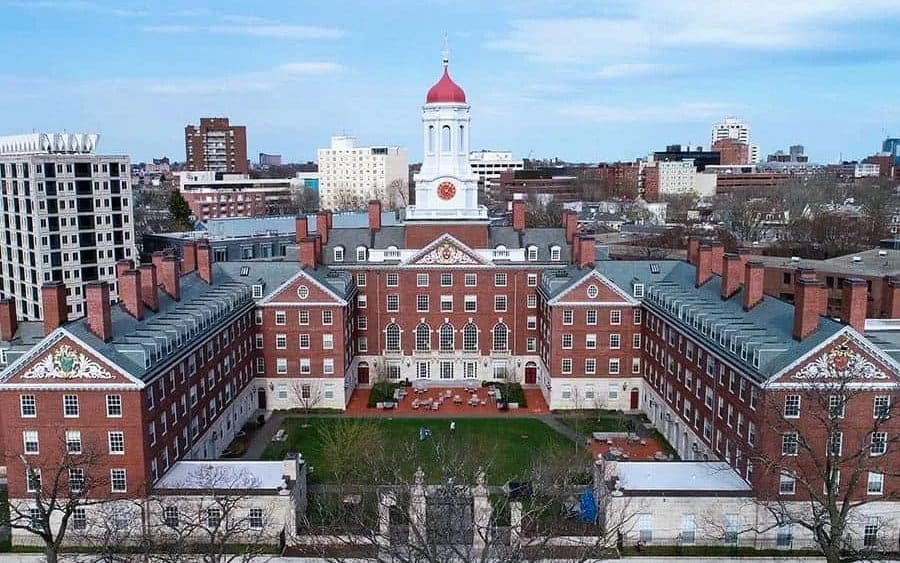
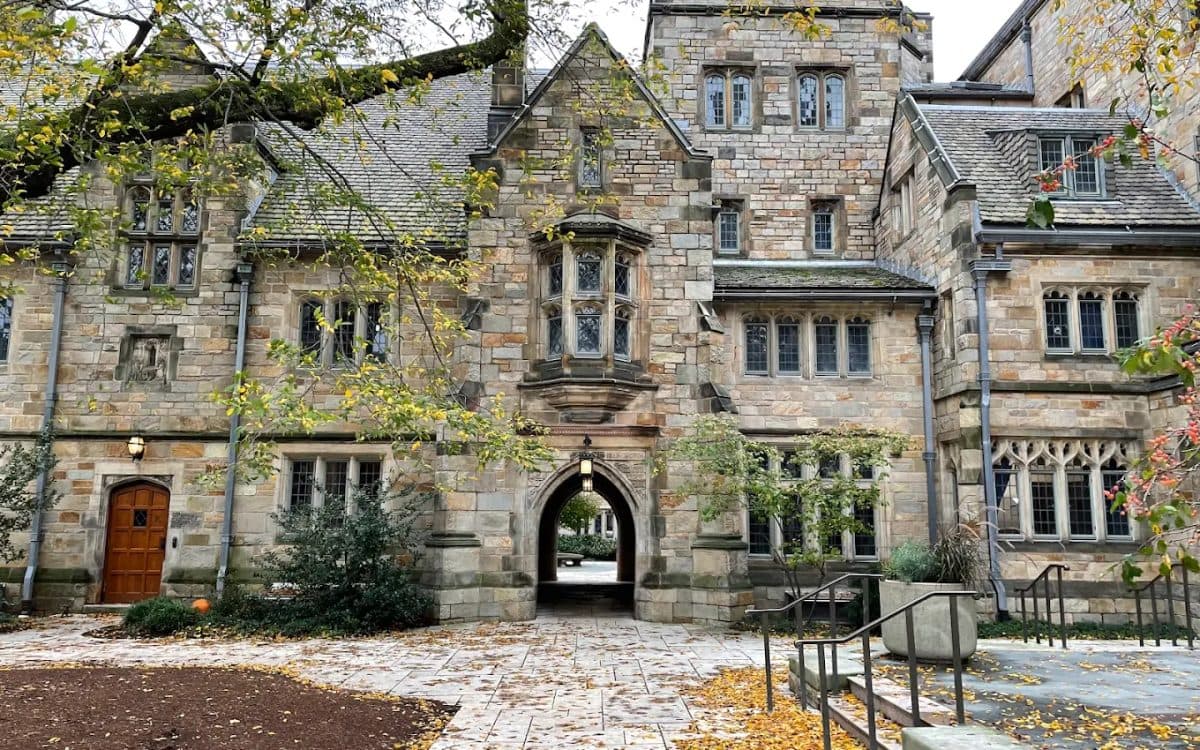
Yale has 14 residential colleges, and every undergraduate is randomly assigned to one on arrival and stays there for four years. The system was instituted in 1933, endowed by Edward S. Harkness, who had admired the social intimacy of Oxford and Cambridge and paid $15.7 million to reproduce it in Connecticut. The first seven colleges opened that September; the two newest, Benjamin Franklin and Pauli Murray, opened in August 2017 — Pauli Murray being the first Yale college named for a woman and for an African American.
If you have read our UK guides, note the structural difference. At Oxford and Cambridge the college admits you and teaches you. At Yale the college does neither — Yale's own admissions office says the colleges have "nothing to do with classes or majors". You are admitted to Yale, assigned to a college at random, and taught entirely by departments. What the college gives you is student suites, a dining hall, a library, a gym, a café, a courtyard and a few hundred people who become your year group. It is the Oxbridge social architecture with the academic architecture removed.
- Every college has its own dining hall, and undergraduates eat there rather than in a central refectory — the single biggest difference from most American campuses.
- Intramural sport runs across 13 sports between the 14 colleges, and it is the main engine of college rivalry.
- College teas bring visiting writers, politicians, scientists and actors into the colleges for small-group conversation — one of the genuinely distinctive things about being a Yale undergraduate.
- Each college has its own library, gym, café and student suites, so a great deal of your life happens within one courtyard.
- Assignment is random and permanent. You cannot choose your college, and there is no subject affiliation — a Physics student and a Drama student sit at the same table.
What Can You Study at Yale?
1. Law — and an honest note about the rankings
Yale Law School is the most selective law school in the United States by admit rate. For the Class of 2028 it received 5,647 applications, admitted 226 and enrolled 204 — roughly 4% — with a median LSAT of 174 and a median GPA of 3.96, and an 88% yield. 89% of entrants had at least a year out of college before starting. It is tiny, it is famously ungraded in the first term, and it produces a disproportionate share of American judges, senators and law professors.
Correction, and it is recent. Almost every Indian study-abroad page still calls Yale "the #1 law school in America". That stopped being true on 7 April 2026, when U.S. News published its 2026 law school rankings: Stanford held first place, Yale fell one place to #2, and the University of Chicago rose one place to share second with it. Yale's teaching, faculty and clerkship pipeline are unchanged by a table. But if a counsellor quotes you a #1 ranking as a reason to apply, they are working from stale material — and you should wonder what else they have not checked.
2. Music, Drama and Art
This is the most underexploited fact about Yale among Indian applicants. At the Yale School of Music, in the school's own words, "all students admitted to the School receive a full tuition award and fellowship, with the exception of those who have earned awards from other agencies" — a policy running since 2005, funded by a gift from Stephen and Denise Adams. It says *all students*, and there is no citizenship carve-out, so an Indian musician admitted to the School is covered. Yale's drama and art schools sit in the same league of global reputation; Yale's student accounts office publishes 2026-27 tuition of $40,750 for the Drama School and $50,198 for the School of Art. If you have seen a claim that the drama school is tuition-free, ask its admissions office to confirm the current position in writing before you build a plan around it.
One caveat, because this is where the excitement usually outruns the reading. A tuition award is not the whole bill: you still pay for housing, food, books, fees and health insurance, and Yale's hospitalisation coverage alone is $3,764 for 2026-27. The School of Music also states plainly that federal loans are not available to international students — so you must arrange living costs before arrival and evidence them for the I-20. Plan those costs before you apply rather than after you are admitted, and the tuition award will do exactly what it promises.
3. Yale School of Management
SOM was founded in 1976 — young, by Yale standards — and rebuilt its MBA around the Integrated Curriculum in 2006-07. Instead of a functional core of separate finance, marketing and operations courses, the first year runs team-taught Organizational Perspectives courses named for the people an organisation has to answer to: Employee, Innovator, Operations Engine, Sourcing and Managing Funds, Competitor, Customer, Investor, The Global Macro-economy, State and Society and Executive. The MBA Class of 2027 has 367 students, 41% international, from 47 countries, with a median GMAT of 740 (median GMAT Focus 675) and an average of five years' work experience. SOM's orientation towards government, non-profits and social impact is not marketing — it is the reason the school exists.
4. History, Political Science and South Asian Studies
Yale's humanities and social sciences are its historic core, and History and Political Science in particular carry the same weight in American academia that Yale Law does in the profession. For Indian students there is a specific draw: the South Asian Studies Council at the MacMillan Center runs an undergraduate major in South Asian Studies, advanced language certificates, and teaches Hindi, Sanskrit and Telugu. It hosts the Modern South Asia Workshop — the sixteenth edition was held in Colombo in 2026 — and the Majlis student organisation for undergraduates and graduates alike.
Most Popular Courses for Indian Students: the Yale SOM MBA and the specialised master's in Asset Management, Systemic Risk and Global Business & Society; the LLM at Yale Law School; PhD programmes in Economics, Political Science, Computer Science, Statistics and Data Science, and the biological sciences; the Jackson School of Global Affairs MPP; MPH at the School of Public Health; and the MEM and MESc at the Yale School of the Environment.
If anyone mentions Yale-NUS, it no longer exists. The Singapore liberal arts college that Yale ran with the National University of Singapore closed on 30 June 2025; the Class of 2025 was its final cohort, and NUS College replaced it. There is no longer an Asian back door to a Yale-affiliated degree.
Admissions for Indian Students
Undergraduate — Yale College
- Apply through the Common Application, the Coalition Application on SCOIR, or QuestBridge. Yale has no preference between them.
- Single-Choice Early Action closes 1 November, with decisions in mid-December. Regular Decision closes 2 January, with decisions in late March. Admitted students reply by 1 May.
- Two teacher recommendations from core academic subjects — languages, mathematics, sciences, social studies — plus a counsellor letter, an official transcript covering all completed secondary work, and a mid-year report with your first-semester Class XII grades.
- Optional supplementary material may be submitted for Visual Art, Dance, Music, Film or STEM research. For a strong Indian applicant with a genuine portfolio or a published project, this is the most underused part of the application.
- What Yale actually weights. Its Common Data Set marks the rigour of your secondary school record, class rank, GPA, the essay, recommendations, extracurricular activities, talent and personal character as "very important", and standardised test scores merely as "considered". The test is a gate, not the case.
- Yale issues no fee waivers of its own, but honours the eligibility criteria of whichever application platform you use.
The single most important correction in this guide. Most sites still describe Yale as "test-flexible", meaning you could satisfy its testing requirement with AP or IB scores instead of the SAT or ACT. That was true for the 2024-25 and 2025-26 cycles — Yale's own Common Data Set for autumn 2025 entry describes "a test-flexible policy which requires all first-year and transfer applicants to submit standardized test scores" chosen from four options: ACT, AP, IB or SAT. It is no longer true. On 27 May 2026 Yale announced that all first-year and transfer applicants must submit ACT or SAT scores, beginning with the next admissions cycle — the one opening in autumn 2026 for entry in 2027. The change came from the Presidential Council on Yale College Admissions, formed by President Maurie McInnis in 2025, and restores the policy Yale ran before 2020. Yale's international page is now explicit: "Scores from other exams, including international leaving exams or English proficiency exams will not fulfill Yale's testing requirement." Your CBSE, ISC or state board result does not substitute, AP and IB are encouraged but supplementary, and international applicants get no exemption. Yale College Dean Pericles Lewis said "SAT and ACT scores are strong predictors of a student's future Yale academic performance"; 92% of the class entering in autumn 2026 submitted one anyway, and 90% of the class before it. Scores may be self-reported, but Yale warns that a discrepancy with your official report "may result in the withdrawal of an offer of admission". The practical takeaway is simple: schedule your SAT or ACT early, report it accurately, and you will be working from the current rulebook while much of your competition is still reading last year's.
One quiet advantage in the Early Action rules. Yale's Single-Choice Early Action bars you from applying early to other private American universities — but it explicitly permits applications to non-binding early programmes at public institutions, to rolling admissions, to later ED and EA rounds notifying after 1 January, and to institutions outside the United States. That last clause matters: the UCAS deadline for Oxford and Cambridge is 15 October, and applying there does not conflict with a Yale SCEA application. Very few Indian applicants realise they can run both tracks in the same autumn. One rule to plan around: if Yale denies you in the early round, you cannot be reconsidered in Regular Decision that year — so use the early track when your application is genuinely ready, not merely early.
On your odds, plainly. Yale received 54,919 applications for the Class of 2030 and admitted 2,328 — 4.2%, from 75 countries and more than 1,650 schools. 779 of those admits came through Early Action. The early round's rate looks about three times friendlier, but it also contains recruited athletes and legacy candidates, so the advantage for an unhooked international applicant is far smaller than the headline suggests. There is no published admit rate for overseas applicants, and we checked the two places it would sit: Yale's own facts page carries no admissions rate at all, and the residency table in item C1 of its Common Data Set — the table that would break applicants down into in-state, out-of-state and international — is filed blank. Some peers do publish it; Yale does not. What Yale does publish is the enrolment: 155 of the 1,633 students who entered in autumn 2025 were international, and while the admitted class spanned 75 countries, the class that actually arrived came from 46. There is also no published Class XII percentage that gets you in. Yale reads the whole file, and a 98% CBSE average is table stakes, not a case. For the right applicant that is encouraging news: the file is won on the parts you control — the essay, the recommendations, the activities Yale marks "very important" — not on a cutoff you either clear or miss.
Graduate and Professional Study
- A three-year Indian bachelor's is accepted at the Graduate School of Arts and Sciences. Yale states it in as many words: where a country grants a bachelor's-equivalent degree in three years, "completion of a three-year degree will meet the application requirement". This is the single biggest Indian-specific question in US graduate admissions, and Yale's answer is a clean yes.
- No WES report is demanded. GSAS asks only that academic records and recommendations be in English or accompanied by a certified translation, and that you do not translate them yourself. Individual professional schools may differ — check before you pay for an evaluation.
- A master's is not required for PhD entry, and GRE policy varies by programme rather than being set centrally. Check your department's page, not the graduate school's.
- Deadlines cluster in December and early January. For fall 2027 entry: 1 December 2026 for the biological sciences, chemistry, economics and psychology among others; 15 December 2026 for computer science (PhD), mathematics, physics and American studies; 2 January 2027 for a third group, which is also the deadline for fee-waiver requests.
- The GSAS application fee is $105, with waivers available including for international applicants. Decisions arrive February to March, with a 15 April reply deadline.
English Language Requirements
- Undergraduate: an English proficiency test is required of non-native English speakers who have not had two or more years of enrolment in an English-medium school — and it is required in addition to the SAT or ACT, never instead of it. Most CBSE, CISCE and IB students in India are therefore exempt from the English test; check your school's medium of instruction before booking one.
- Accepted tests: TOEFL, IELTS, Cambridge English Qualifications, the Duolingo English Test and InitialView (a recorded interview). Yale does not list PTE Academic, despite what several aggregator pages claim.
- Yale's stated competitive scores: IELTS 7.0 or higher, Duolingo 120 or higher, Cambridge English 185 or higher on B2 First, C1 Advanced or C2 Proficiency, and for TOEFL 5 or higher for tests taken after 21 January 2026, or at least 100 for tests taken before it — the scale changed on that date, so make sure you are comparing against the right one.
- Graduate (GSAS): TOEFL or IELTS is required of almost all applicants whose native language is not English — but there is an exemption that catches many Indian applicants. If you studied in residence for at least three years at an institution where English is the primary language of instruction, you are exempt. An advanced degree does not itself earn the exemption.
- GSAS sets no admission minimum — departments do. Separately, incoming doctoral students who have not reached the speaking score needed to teach in a Yale classroom (IELTS 8.0, TOEFL 26 before 21 January 2026, or TOEFL 5.5 on or after that date) must attend a Summer English Language programme at Yale in August before matriculating. Budget the extra weeks and the travel.
The Real Cost
- Yale College 2026-27, as billed: tuition $72,500, housing $12,080, food $9,520 — $94,100.
- Then the additions: Yale Health Hospitalization & Specialty Care $3,764, student activities fee $185, senior class dues $155.
- Yale's published cost-of-attendance budget for 2026-27 is $97,985, adding $1,000 for books and course materials and $2,700 for personal expenses. Travel is estimated separately and varies with your home address, so an Indian student should add flights on top.
- Fees rise every year. Tuition went from $69,900 in 2025-26 to $72,500 in 2026-27 — a 3.7% increase. Budget a four-year degree at more than four times the year-one figure.
- Graduate and professional tuition and fees, 2026-27: Law School (JD/LLM/MSL) $81,818 · School of Management $91,400 · School of Medicine $79,350 · Architecture $66,660 · Jackson School of Global Affairs $65,320 · Public Health (two-year MPH) $57,931 · Nursing (MSN, first year) $57,369 · School of the Environment $56,470 · Graduate School of Arts and Sciences $52,400 · Art $50,198 · Music $42,000 · Drama $40,750 · Divinity $31,192.
- The Yale SOM MBA in full: $91,400 tuition and programme fee, $22,991 housing, food and utilities, $5,525 personal, $3,856 transport, $1,440 books, $3,764 health insurance — a total single-student budget of $128,976 a year.
The number that matters for your visa is not tuition. US universities issue the Form I-20 against the total cost of attendance, and the consulate expects you to evidence funds against that figure, not against tuition alone. For Yale College that is $97,985 plus travel, not $72,500; for the SOM MBA it is $128,976, not $91,400. Many Indian families arrange a loan against the tuition line and only discover the gap at the financial-documentation stage — a scramble you can avoid entirely by working from the COA from day one. Sequencing the loan, the liquid funds and the I-20 paperwork is exactly what our counsellors walk families through — talk to us before you fix your loan amount.
Financial Aid for Indian Students
Here is where Yale becomes genuinely different from almost every university an Indian student will consider. Yale's admissions office states it without hedging: "A family's ability to pay is not a factor in the admissions process — for any student, anywhere in the world." Its financial aid office adds that offers "meet 100% of demonstrated need — regardless of a student's citizenship or immigration status — without requiring loans". Both halves matter. Many American universities are need-blind for Americans and quietly need-aware for internationals; Yale is one of a handful that is need-blind for everyone. Two practical details Indian families miss: aid awards take into account the relative difference between the US economy and your home country's economy, and once you enrol you are not required to reapply for aid every year.
- 1. Zero parent share — family income below $100,000
- Announced on 27 January 2026 and effective for students entering in 2026-27. Families with typical assets and annual incomes below $100,000 pay nothing: the award covers tuition, housing, the meal plan, estimated travel costs, hospitalisation insurance and a $2,000 start-up grant. The threshold was $75,000 before this change, and $65,000 before 2020. In rupee terms, $100,000 is roughly Rs 88 lakh a year — which places a very large share of Indian applicant families inside the band.
- 2. No tuition — family income below $200,000
- Families with typical assets and incomes below $200,000 receive a need-based scholarship that meets or exceeds the full cost of tuition. Housing, food and other costs are assessed separately against demonstrated need. Roughly Rs 1.75 crore a year, which covers the overwhelming majority of Indian households with a child applying abroad.
- 3. What international undergraduates actually receive
- This is the number to quote to a sceptical parent, and it comes from Yale's own Common Data Set for 2025-26: 459 international undergraduates were awarded institutional need-based aid, at an average of $84,185 each and a total of $38,640,976. Yale's filing also records that non-need-based aid is not available to international undergraduates at all. Across Yale College the average need-based scholarship is $75,220, 55% of students receive need-based aid, 21% pay nothing, and 88% of graduates leave with no student loan debt.
- 4. What a family at your income actually pays
- Yale publishes the arithmetic rather than making you guess. On its own table of what the typical Yale family pays, an annual income of $100,000 gives a cost of $0; $150,000 gives $10,000; $200,000 gives $20,000; $250,000 gives $43,000; $300,000 gives $53,000; and $350,000 gives $63,000. Read the shape of that curve before you rule Yale out: the jump is between $200,000 and $250,000, not at the bottom. These are US-dollar incomes assessed with typical assets, and Yale weighs your family against Indian economic conditions, so run your own numbers through Yale's MyinTuition estimator rather than converting from this table.
- 5. Travel home twice a year
- Yale states that financial aid offers for international students include allowances for housing, meals and travel to and from campus twice each year. That is unusual and worth naming — most US aid packages leave a New Haven-to-Delhi return fare entirely to the family.
- 6. The form you must not miss — CSS Profile, not FAFSA, and a different deadline
- Item H7 of Yale's Common Data Set records exactly one form for international first-year aid applicants: the CSS Profile. The FAFSA appears only under item H8, for domestic applicants, so it is not your route. The deadlines differ by citizenship and almost nobody flags it — for Early Action, financial aid materials are due 1 November for US citizens and permanent residents but 1 December for international citizens, with Regular Decision on 15 February and transfer applicants on 1 April. Miss it and the need-blind promise never reaches you, because Yale has no way to assess a need you did not document.
- 7. PhD funding at the Graduate School
- Every admitted PhD student at GSAS receives a fellowship covering tuition of $52,400 for 2026-27, a minimum twelve-month stipend of $52,046, comprehensive health insurance including hospitalisation and specialty care for the student, a legal spouse and children, and a family support subsidy for students with children under 18 — typically for a minimum of five years. Yale puts the cumulative value at more than $500,000 per doctoral student across enrolment. This is not competitive; it is the standard offer.
The insight that saves Indian families the most wasted effort: Yale awards no merit scholarships — so aim your energy where the money actually is. Its own statement is that "Yale awards all financial aid on the basis of financial need in the form of scholarships, not loans" — and its Common Data Set proves it by arithmetic rather than assertion. In the 2025-26 filing, the non-need-based column is $0 across federal, state and institutional scholarships, and the number of enrolled students with no financial need who were awarded non-need-based aid is zero. So every listing you find for a "Yale University Merit Scholarship", a "Yale Global Scholars Award" for degree students, or a named Yale scholarship for Indian nationals is fabricated or is a misdescription of something else entirely. The system is refreshingly clear: if your family can pay, you will pay, and if it cannot, Yale will cover it. Knowing that early is an advantage — it means your effort goes into the CSS Profile and honest need documentation, the one path that leads to Yale's very real money, instead of chasing awards that do not exist.
Graduate funding works on completely different logic, and the split is sharp. A funded PhD is one of the best financial propositions in global higher education — full tuition, a stipend above $52,000, health cover, typically for at least five years. A professional master's is largely self-funded: GSAS itself says that "most students pursuing Master's degrees do not receive financial support from the Graduate School", and the Law, Management, Public Health and Environment schools offer partial scholarships against very large sticker prices rather than full rides. If you are choosing between a funded PhD elsewhere and an unfunded Yale master's, do that arithmetic before the brand does it for you — it is one of the most consequential comparisons in this guide, and exactly the kind of decision our counsellors help students weigh. Talk to us before you commit either way.
Life at Yale — An Honest Picture
New Haven is a city of about 134,000 people at the 2020 census — Connecticut's third largest, roughly the size of a mid-sized Indian district town, and comprehensively dominated by the university. The campus is not fenced off from it; Yale's Gothic quadrangles sit directly among city blocks, which is part of the charm and part of the anxiety. New York's Grand Central is about two hours away on Metro-North's New Haven Line, and Union Station also carries Amtrak's Acela and Northeast Regional services on the Northeast Corridor.
The safety question, answered with numbers rather than reassurance. New Haven's reputation among Indian parents is worse than its current record, but the record is not spotless either. At the city's annual crime review on 14 January 2026, Mayor Justin Elicker and Acting Police Chief David Zannelli presented New Haven Police Department figures showing overall crime down 23.9% on 2024, violent crime down 40%, property crime down 22.6% and reported gun violence down 44%, with 257 fewer violent-offence reports year on year, vehicle thefts falling from 1,033 to 708, and major crime down from 2,321 incidents in 2019 to 1,346 in 2025. Zannelli described ten-year lows in non-fatal shootings, robbery, aggravated assault and confirmed shots fired. The exception is homicide, which rose from 15 in 2024 to 16 in 2025. Sixteen killings in a city of 134,000 is a serious number and we will not wave it away. Two pieces of context: it is a city-wide figure, and the campus has its own separate record. Yale publishes a Clery Act annual security report and runs a Public Safety Transparency Hub carrying daily crime logs. We could not pull the current annual report to an automated fetch, so we are not going to borrow a campus crime number from a study-abroad site that did not read it either — go to the transparency hub and read the log yourself, which is the only version nobody has summarised for you. Yale also runs 24/7 walking escorts within the campus footprint, blue-phone emergency call boxes and the LiveSafe app. Use them, and behave as you would in any American city after dark.
- Indian and South Asian student life runs through the Hindu Students Organization (HSO), the South Asian Graduate & Professional Association (SAGA), Majlis at the South Asian Studies Council, and the Asian American Cultural Center, founded in 1981.
- Hindu Life at Yale is a staffed chaplaincy within the Yale Chaplain's Office, directed by Dr Asha Shipman and based in Breathing Space, in the basement of Welch Hall on Old Campus, with prayer, meditation and tech-free rooms, festival observances including Raksha Bandhan, Krishna Janmashtami and Ganesh Chaturthi, and social events built around chaat and dosas. It is explicitly open to Hindus and non-Hindus, undergraduates, graduates, post-docs and staff alike. The Chaplain's Office also serves Muslim, Sikh, Jain and Buddhist communities.
- Food: Greater New Haven has a working set of Indian restaurants, and Hindu Life maintains a directory of local South Asian businesses and places of worship — Connecticut has several Hindu temples, though none in New Haven itself. It is a smaller scene than New Jersey or Queens, so if your definition of settling in involves a Patel Brothers within walking distance, arrive with clear expectations — and lean on the campus South Asian organisations above, which exist for exactly this.
- Dining: every residential college has its own dining hall, and Yale Hospitality runs a dietary-requirements programme. Vegetarian provision is routine; confirm specifics with Yale Hospitality directly rather than trusting a forum post.
- Winter is real. New Haven's average January temperature is around −1°C, and the city averages roughly 90 cm of snow a year. If you have never lived through a northern-hemisphere winter, budget for a proper coat, boots and about three weeks of feeling miserable in February.
- Flying home: there is no direct India service from New Haven. Most students route through JFK or Newark, both reachable by train and shuttle, with Bradley near Hartford as a secondary option. Yale's international aid packages include a travel allowance for two return trips a year.
Career Outcomes and Staying On
- 95.3% of the Yale College Class of 2025 were employed or enrolled in graduate school within six months of graduating, on a 90.7% knowledge rate.
- Mean starting salary $94,028 among graduates employed full-time in the United States.
- Top five industries: financial services, education, technology, consulting and healthcare — an unusually broad spread for an Ivy, and a reflection of how many Yale graduates go into public service and academia.
- Yale SOM's MBA cohort is 41% international from 47 countries, which tells you something about how comfortable its recruiters are with visa sponsorship.
- Yale Law School's graduates dominate clerkships, academia and public-interest law in the US in a way no other school matches.
On staying to work, the mechanics matter more than the brand. Post-completion OPT gives you 12 months of work authorisation after your degree. If your programme sits on the DHS STEM Designated Degree Program List, you can apply for a 24-month STEM OPT extension — 36 months in total. That distinction is everything: a STEM-classified master's gives you three attempts at the H-1B lottery, a non-STEM one gives you a single attempt. The cap is 85,000 a year — 65,000 general plus 20,000 reserved for holders of a US master's or higher — and USCIS confirmed it had reached both caps for FY2027.
The H-1B maths has changed for entry-level graduates — and knowing it now, before you choose a programme, is the most decision-relevant insight in this guide. For FY2026, USCIS ran a straight lottery: of 358,737 registrations submitted and 343,981 eligible, 120,141 were selected — about 35%. From FY2027 it runs a weighted selection instead, based on the highest OEWS wage level your offered salary equals or exceeds. The final rule states that registrations "assigned wage level IV will be entered into the selection pool four times, those assigned wage level III will be entered into the selection pool three times, those assigned wage level II would be entered into the selection pool two times, and those assigned wage level I will be entered into the selection pool one time". A fresh master's graduate on an entry-level salary is a level I registration — one entry against four for a senior hire in the same occupation. DHS acknowledged the consequence in the rule itself, writing that to the extent it "may disadvantage recent graduates and entry level alien workers seeking positions corresponding to a lower wage level, these positions may instead be made available to U.S. graduates and workers starting out in their careers". The rule was published on 29 December 2025 and took effect on 27 February 2026; USCIS has confirmed both the 65,000 and 20,000 caps were reached for FY2027. It does not change your degree's value; it changes the odds attached to your first salary. Treat any employer conversation about wage level as a material part of the offer, and build a career plan with more than one good outcome — students who understand this rule before choosing a programme are planning with it rather than being surprised by it. Position as of August 2026.
A change every Indian applicant starting in 2026 must know about. On 17 July 2026 the Department of Homeland Security published a final rule eliminating "duration of status" for F-1 students, effective 15 September 2026 (Federal Register document 2026-14439). Instead of being admitted for the length of your studies, you will receive a fixed "Admit Until Date" on your Form I-94: in the rule's own words, a period of authorised stay "based on program length, with a maximum of four years and a 30-day grace period" — the grace period having been cut from 60 days to 30. Extending your I-20 alone will not extend your lawful stay; you must file Form I-539 before your I-94 expires, or travel and seek readmission. The rule does not eliminate OPT or STEM OPT, and students already admitted for duration of status who timely file Form I-765 for post-completion OPT or a STEM extension on or before 18 March 2027 will not need a separate extension-of-stay application. One caveat worth carrying: the notice classifies this as a major rule subject to congressional review, and states that if the effective date changes at the conclusion of that review, DHS will publish a further document to set the actual date. This is the state of play as of August 2026; treat any guide that does not mention it as out of date, and check Yale's Office of International Students & Scholars before you book flights.
The $100,000 H-1B payment, and why it is more narrowly drawn than you have been told. Presidential Proclamation 10973, signed 19 September 2025 and effective 21 September 2025, restricts H-1B entry unless the petition is accompanied by a $100,000 payment. The proclamation's operative language limits it to petitions for beneficiaries who are currently outside the United States, and the Secretary of Homeland Security may waive it where the hiring is in the national interest. If you graduate from Yale and move from OPT to H-1B without leaving the country, this is not aimed at you — though international travel afterwards is where the question gets complicated. It is also time-limited: by its own terms it expires twelve months after taking effect, on 21 September 2026, unless it is extended, with a recommendation on extension due after the lottery. Position as of August 2026 — take advice on your own facts rather than from a forum.
Is Yale Right for You?
Yale is the strongest undergraduate financial proposition in this series, and Indian families consistently rule it out for the wrong reason. A university that admits you without regard to your ability to pay, meets 100% of demonstrated need without loans, pays everything for families under $100,000, assesses your parents against Indian economic conditions rather than American ones, and flies you home twice a year is not an expensive university — it is a free one for most people who get in. Add a 14-college residential system that gives you the Oxbridge social experience inside an American research university, a student-to-faculty ratio of 8.8 to 1 on the comparable national measure, and a Law School and a music school with few peers anywhere. If that describes what you want, apply — and compare it against Princeton, which runs a similar aid model at a similar scale.
The honest trade-offs matter just as much, because knowing them is how you choose well. If your family can comfortably pay, Yale offers no merit discount — no merit award exists — so you would write cheques for close to $98,000 a year plus flights that a strong applicant might convert into a large scholarship elsewhere; weigh that trade deliberately. If you want a self-funded professional master's, the sticker prices are steep and the funding is thin, so run the arithmetic before the brand runs it for you. If you want a big Indian community, a large-city job market on your doorstep and a year-round climate you recognise, New Haven — small, quiet and genuinely cold in winter — may not be your best fit, and Columbia in New York deserves an equally serious look. And yes, Yale turns away about 96 of every 100 people who apply — which is exactly why the winning strategy is a list where Yale is the ambitious reach, supported by universities you would genuinely be happy to attend.
Ready to Build Your Yale Application?
Yale pairs one of the world's most selective admissions processes with one of its most generous aid policies — need-blind admissions, 100% of demonstrated need met without loans, and zero parent contribution below $100,000. What Yale rewards is early, precise planning: an SAT or ACT score now that the test-flexible route has closed, a CSS Profile filed by the right deadline so the need-blind promise actually reaches you, and a balanced shortlist where Yale is the ambitious anchor. Falcon Nova Consultants has helped hundreds of Indian students win places at top US and UK universities. Book your free, no-obligation counselling session and let us build that plan with you — every deadline, every form, every detail that decides Ivy League applications.
Book Your Free Counselling Session