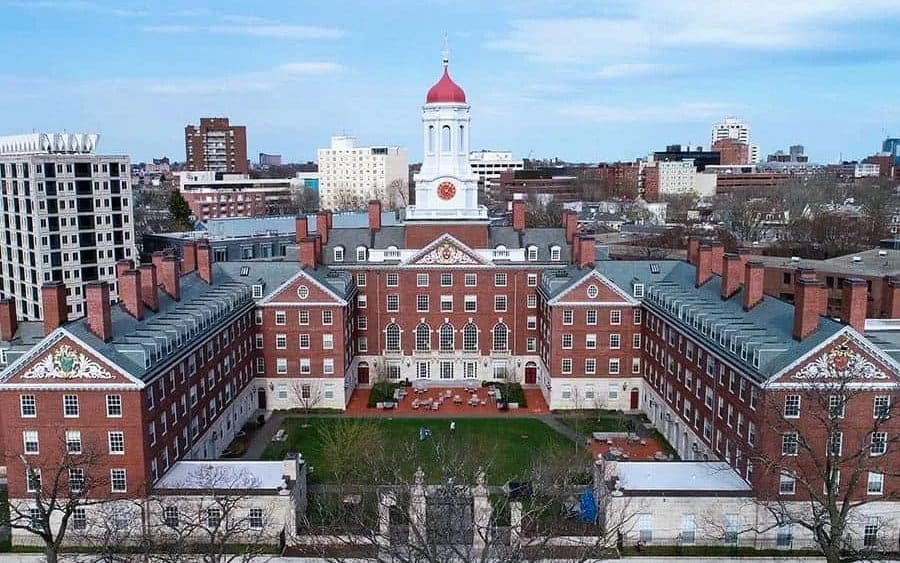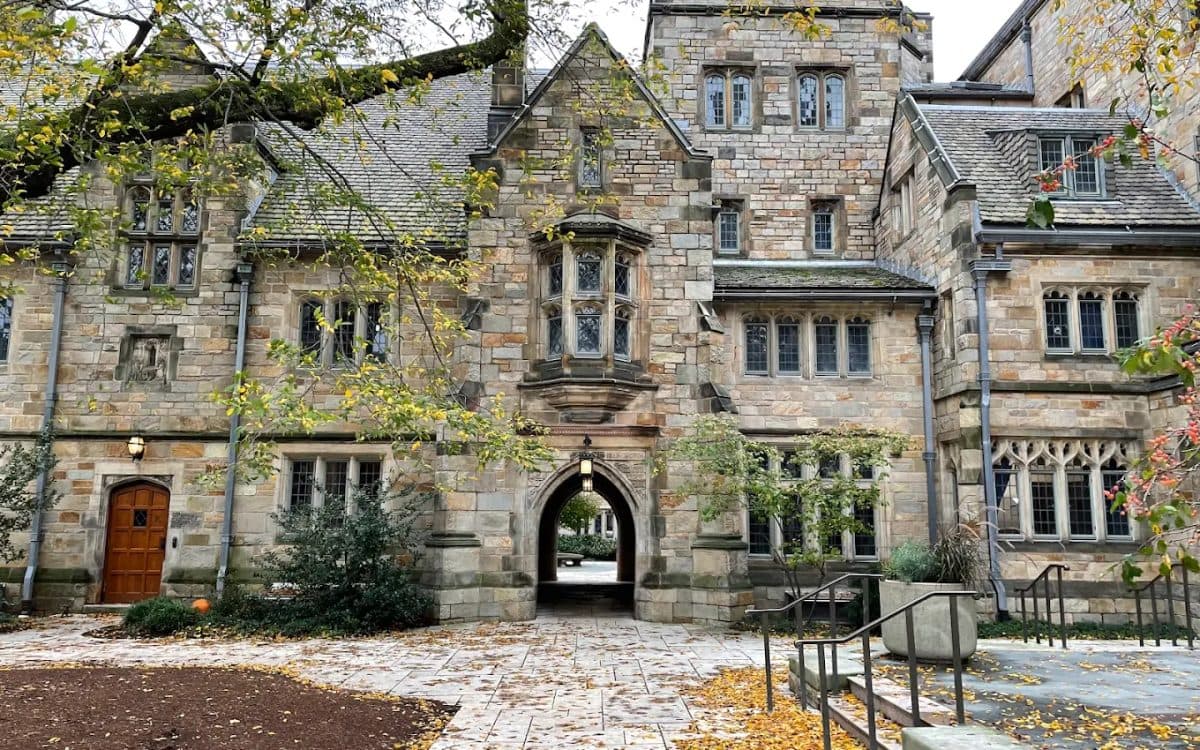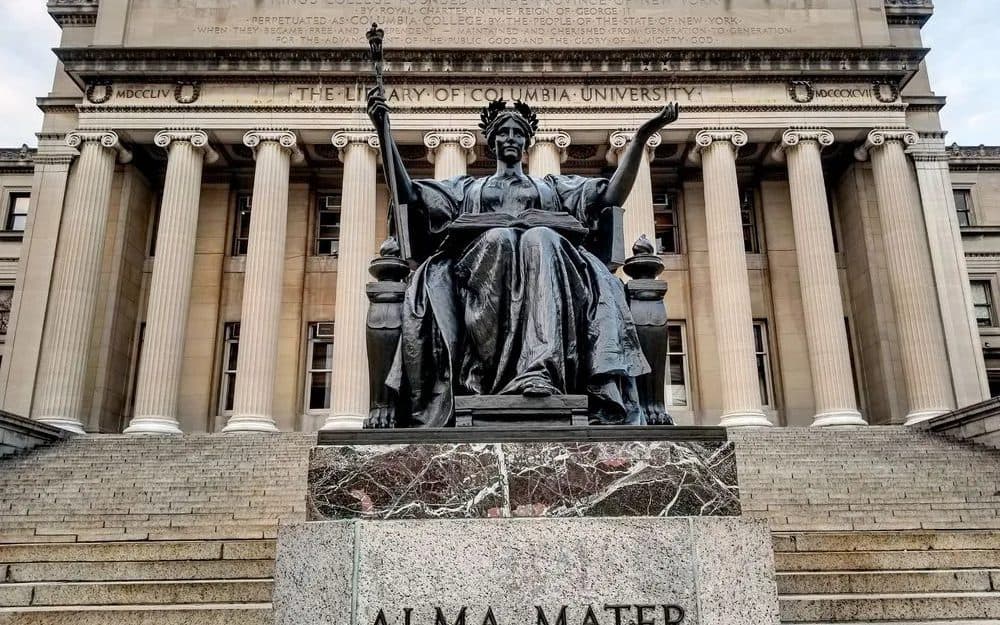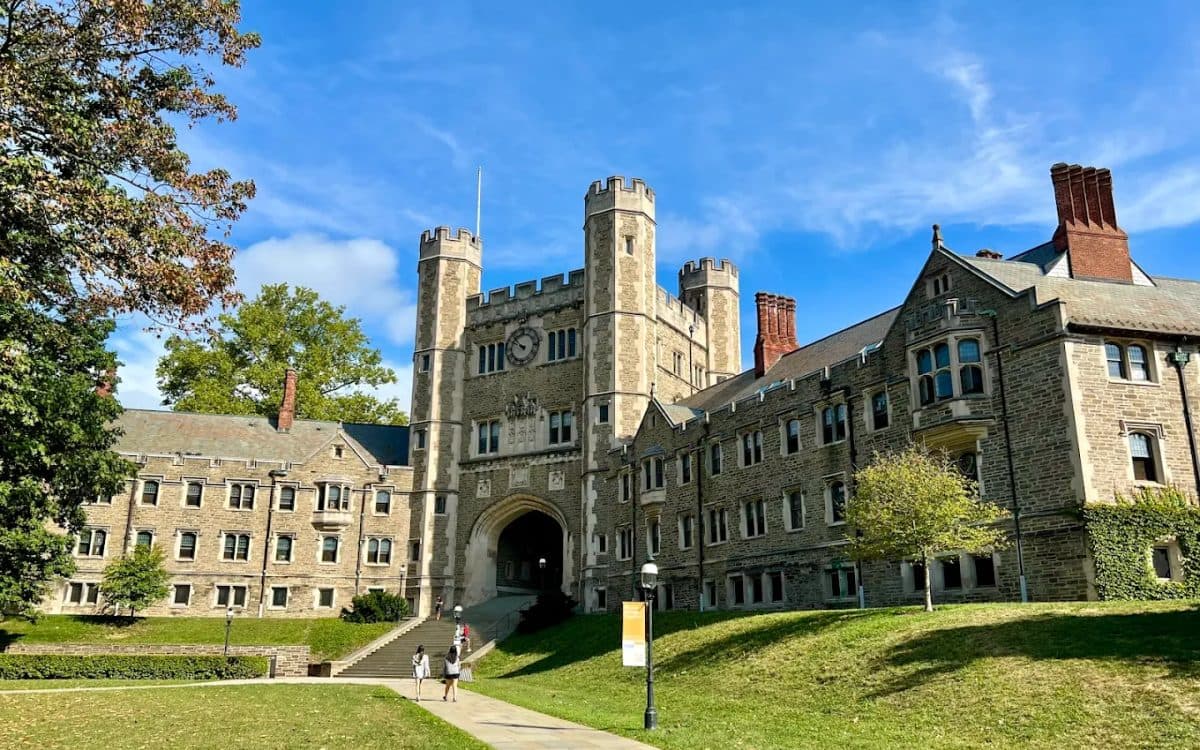
The building at the centre of Princeton's campus was once the capitol of the United States. Nassau Hall, completed in 1756, was where George Washington drove out British troops in 1777 — and where, in Princeton's own words, the Continental Congress met in 1783 in a building "which served as the United States Capitol from June until November". Students still walk past it to lectures.
Princeton was founded in 1746 as the College of New Jersey, in Elizabeth, New Jersey, by the Presbyterian Synod, and moved to the town of Princeton when Nassau Hall was finished a decade later. It did not take its present name until 1896. Along the way it made a decision that still defines it: it has no law school, no medical school and no business school — the only Ivy League university with none of the three.
It is also 7th in the world in the ShanghaiRanking Academic Ranking of World Universities 2025 and joint 3rd in the Times Higher Education World University Rankings 2026, with Mathematics ranked 1st on earth. If you are an Indian student weighing where to study in the USA, that combination — enormous depth, no professional schools, 9,281 students in total — is the thing to understand before anything else. This guide covers what it actually takes to study at Princeton University as an international student: the money, the odds, the structure, and the parts other guides get flatly wrong.
Princeton at a Glance
That endowment figure is not decoration. Princeton has roughly $36.4 billion for 9,281 students after an 11% return in FY2025, and it spends the proceeds on two things above all: undergraduate financial aid — $342 million in 2026-27, more than 60% of it funded by dedicated endowments — and a doctoral programme that is funded for every candidate. Almost nothing at Princeton is subsidising a professional school, because there isn't one.
The Senior Thesis — What Makes Princeton Structurally Different
Most American universities let you write a thesis. Princeton makes you. In the university's own words: "At Princeton, every senior writes a thesis or, in the case of some engineering departments, undertakes a substantial independent project." There is no opt-out, no honours track you can decline, no alternative capstone. It is the degree.
How the independent work sequence runs. In junior year you write one or more junior papers (JPs) — a smaller piece of original research that usually seeds the thesis topic. In senior year you write the thesis itself, working one-on-one with a faculty member who guides the project, with University funds available to travel for research inside the United States or abroad. The thesis now carries academic weight, not just prestige: for A.B. students from the Class of 2026 onwards it counts as two credit-bearing courses, the degree requirement is 33 credits for the classes of 2026 and 2027, and it rises to 34 credits from the Class of 2028. B.S.E. students are unaffected — their 36-credit requirement already included two thesis credits.
Understand what this means practically. For two years you are not a student in a lecture hall; you are a junior researcher with a supervisor, a deadline and a bound document with your name on it. For an Indian student coming from a system built on end-of-year examinations, that is a genuine adjustment — and it is also the single best preparation for a PhD application anywhere in the world. There is no version of this degree without the thesis, so ask yourself the honest question now: if the idea of producing eighty to a hundred pages of original research with a Princeton professor beside you excites you, this is your university — and if it does not, discovering that before you apply is a gift, because it frees you to choose a campus built around what you actually want.
- Two undergraduate degrees: the A.B. (Bachelor of Arts) across 37 majors, and the B.S.E. (Bachelor of Science in Engineering) across six engineering departments. B.S.E. students are about 25% of each class.
- More than 50 interdepartmental minors and certificate programmes sit on top of the major — this is how most students build an interdisciplinary profile.
- First-Year Seminars are capped at 15 students and Princeton offers approximately 75 a year, each hosted by a residential college — and precepts, small weekly discussion groups, run alongside most lecture courses.
- On the student-faculty ratio, check which number you are being sold. Princeton advertises 5:1 on its own admissions pages. The standardised Common Data Set figure for fall 2025 is 8:1 — 9,219 students to 1,148 faculty. Both are honest measurements of different things, but only the second one compares like with like against other universities.
What Can You Study at Princeton?
Princeton is not a broad university and does not pretend to be. It is extraordinarily deep in a narrow set of fields. In the ShanghaiRanking Global Ranking of Academic Subjects 2025 it places 1st in the world for Mathematics, 2nd for Physics, 6th for Economics and 7th for Computer Science and Engineering, with 28 subjects ranked in total.
1. Mathematics — First in the World
Princeton's mathematics department is, by the most rigorous research-output measure available, the best on earth (ARWU 2025). Mathematics accounts for only about 2% of Princeton bachelor's degrees, which tells you it is a small, intense, self-selecting department rather than a mass-enrolment one. One clarification worth having: the Institute for Advanced Study, also in the town of Princeton and endlessly confused with the university, is a separate, independent institution and not part of Princeton University. Do not put it on an application list.
2. Physics and the Physical Sciences
2nd in the world for Physics (ARWU 2025), with the physical sciences producing 6% of Princeton's bachelor's degrees. For a strong Indian PCM candidate this is the classic route into a funded American PhD — and it is worth noticing that Princeton's laboratory investment has no medical school competing for it.
3. Economics and the Social Sciences
The social sciences are Princeton's largest undergraduate field, at 20% of all bachelor's degrees, and Economics ranks 6th in the world (ARWU 2025). Princeton economics has an unusually empirical, policy-facing character, and it feeds directly into the two structures below.
4. Engineering, Computer Science and ORFE
Engineering is 18% of Princeton's bachelor's degrees and computer and information sciences a further 14% — together nearly a third of the graduating class, which surprises people who think of Princeton as a humanities institution. The department Indian applicants gravitate to is Operations Research and Financial Engineering (ORFE), which sits at the intersection of probability, optimisation and finance and is the academic home of much of the Master in Finance taught through the Bendheim Center for Finance. The MFin is a two-year, STEM-designated programme that requires neither the GRE nor the GMAT — and reports an average acceptance rate of about 5% over the last five years.
5. The School of Public and International Affairs (SPIA)
SPIA is Princeton's closest thing to a professional school, and it is the reason public administration and social services account for 9% of Princeton bachelor's degrees. At graduate level it runs the two-year Master in Public Affairs (MPA) and the one-year mid-career Master in Public Policy (MPP). Its funding model is set out below and is, for an Indian applicant, probably the most attractive single offer in this entire article.
The correction that matters most: Princeton has no MBA, no JD and no MD. Several large Indian study-abroad sites publish Princeton pages headed "UG, PG & MBA", listing programmes that do not exist. Princeton has no business school, no law school and no medical school, and it is the only Ivy League university with none of the three. The Common Data Set settles it by evidence rather than assertion: of 1,337 bachelor's degrees conferred in 2024-25, not one fell under business and marketing, law, or the health professions — all three rows are blank in a table that totals 100%. If your plan is an MBA, look at Penn and Wharton. If it is law or medicine, look at Harvard. Princeton is a superb *pre*-law and *pre*-med undergraduate education — just go in with a clear plan for where the professional degree comes afterwards, because it will not be on the same campus, and the strongest applicants know that from day one.
Most Popular Fields for Indian Students at Princeton: Computer Science and the B.S.E. engineering departments, ORFE and the Master in Finance, Economics, Mathematics, Physics, Electrical and Computer Engineering, and the SPIA MPA. At graduate level the overwhelming majority of Indian students at Princeton are doctoral candidates, not master's students — 114 of the 203 Indian students on campus in 2024-25 were graduate students, and Princeton's graduate school is doctoral by design.
Admissions for Indian Students
Undergraduate — The Numbers You Are Actually Facing
Princeton no longer publishes an admission rate. Its own admission-statistics page gives you the class size, the countries represented and the aid percentage — and no applicant or admit numbers at all. The figures below come from its Common Data Set 2025-26, which is the authoritative source and covers fall 2025 entry, the Class of 2029.
- 42,303 applied, 1,868 were admitted, 1,408 enrolled — an overall acceptance rate of 4.4%.
- For applicants outside the United States the rate is 2.3%: 10,567 applied and 241 were admitted. In-state applicants were admitted at 5.0% and out-of-state at 5.2%. Applying from India roughly halves your odds against a domestic applicant — and knowing that number is exactly what lets you plan intelligently: it tells you how much weight your essays, recommendations and wider list need to carry, and 241 students from outside the US did clear this bar last year.
- One definitional point, because it works in your favour. The Common Data Set records that residency split "based on known physical address at time of application", not citizenship — so 2.3% is precisely the rate for someone applying from an address in India, which is exactly your situation. Princeton separately reports that 14.1% of the Class of 2029 are international citizens, a different measure of a different thing.
- No Early Decision. Princeton runs Single-Choice (restrictive) Early Action, closing 1 November with decisions in mid-December. It is non-binding, but its restrictions mean you generally cannot apply early to another private US university in the same round.
- Regular Decision closes 1 January, decisions are released by 1 April, and you reply by 1 May. The transfer deadline is 1 March.
- Application fee $75, waivable on financial grounds — and applying for a waiver has no effect on your admission decision.
- The waitlist is not a plan. In the Class of 2029 round, 1,370 students were offered a place on it, 1,086 accepted, and 36 were admitted.
The testing myth, corrected. Since Princeton announced in October 2025 that it would bring back the SAT and ACT, dozens of Indian sites have reported that scores are "required from 2026". They are not. Princeton's own page states that "for first-year and transfer applicants seeking to enroll in fall 2027, Princeton remains test optional", and that the requirement begins with the 2027-28 admission cycle — meaning applicants enrolling in fall 2028. If you are applying this autumn, submitting a score is optional, and Princeton says explicitly that "there are no minimum test score requirements". Do not generalise from this to other universities, either: as of August 2026 Yale, Harvard and Cornell already require the SAT or ACT, and Columbia requires it from the 2027-28 cycle — applying to four of these in one season means reading four different rules. If you do submit to Princeton, look at what the submitters scored: SAT 1490–1560 with a 1530 median, ACT 34–35. Only 60% submitted an SAT and 20% an ACT.
- Class XII: Princeton publishes no percentage cut-off for any Indian board and evaluates each applicant within the context of their own educational system. In practice you are competing against a class whose average school GPA is 3.96, with 72% holding a perfect 4.0 — so bring the strongest CBSE, CISCE or state-board profile you can: at this level, marks open the door, and the rest of your application is what walks through it.
- Self-report all AP and IB scores on the application; Princeton recommends it explicitly. There are no minimum test score requirements.
- Essays and recommendations carry disproportionate weight here. With a 2.3% rate for applicants from outside the US, marks are the entry ticket, not the argument.
- Financial aid deadlines run with the admission deadlines — 1 November for Early Action, 1 February for Regular Decision. Because Princeton is need-blind, applying for aid does not weaken your application.
Graduate — Read This Before You Apply
Princeton's Graduate School is small, doctoral and department-driven, and this is where most Indian applicants misjudge it. In 2024-25 Princeton awarded 463 research doctorates and 653 master's degrees — and a large share of those master's were taken *en route* to a PhD rather than as standalone qualifications. If you want a one-year taught master's in a professional subject, Princeton usually does not have one, and you will be better served by a university built for it, such as Columbia.
- Three-year Indian bachelor's: accepted in principle. The Graduate School's stated rule is that "no degree with a normal program length shorter than three years will be considered equivalent to a bachelor's degree" — so a standard three-year BA, BSc or BCom clears the published minimum, with the department making the academic judgement. Because that judgement sits with the department and not with a central admissions office, get confirmation in writing from the department you are applying to before you pay for a credential evaluation.
- One application per year, one programme. The Graduate School permits a single application per year, to one department, programme or combined programme. You cannot spread your bets across departments the way you can at many US universities.
- Deadlines are departmental and early. Computer Science, for example, closed 15 December for Fall 2026 entry. Assume a December deadline and work backwards from it; do not wait for a January window that will not come.
- GRE policy is departmental too. The Master in Finance requires neither the GRE nor the GMAT, and states that not submitting will not affect your application — though the median quantitative GRE among entering classes is 167.
- Credential evaluation is departmental. Some American graduate programmes require a WES or equivalent evaluation of an Indian transcript and some do not. A WES report costs money and takes weeks, so establish whether yours needs one before you order it.
- A structural shift worth planning around for 2026-27. Princeton's FY2027 budget is $3.407 billion, a 2.1% rise — the smallest in many years outside the pandemic. The Priorities Committee report behind it signalled the beginning of a "gradual reduction of graduate student enrollment", put graduate student support down 0.6% for exactly that reason, and asked most academic and administrative units to cut 1 to 2% of spending annually for several years. The graduate stipend rate rises 2.25%. Cohorts are getting smaller, not larger — so assume your department admits fewer people than the numbers you read from three years ago, and make your application correspondingly sharper: a precise research fit with named faculty beats a broad one everywhere, and it beats it most where seats are scarce.
English Language Requirements
- Undergraduate: TOEFL, IELTS Academic, the Duolingo English Test or PTE Academic, if English is not your native language and you attend a school where English is not the language of instruction. You are exempt if you have spent at least three years at a secondary school where English is the primary language of instruction. Princeton publishes no minimum score — which is not the same as there being no standard.
- Graduate — and this is the exemption most Indian applicants miss. The Graduate School accepts TOEFL, IELTS or the Duolingo English Test — not PTE, which is accepted at undergraduate level — and sets no minimum overall score. You are exempt from testing altogether if your undergraduate instruction was entirely in English, as certified by the institution, or if you have completed at least two years of full-time graduate study taught entirely in English. Most Indian applicants from English-medium universities qualify: get the certification letter from your college registrar rather than booking a test.
- The speaking sub-score still bites after you are admitted. Princeton's own Bendheim Center states it plainly for the Master in Finance: admitted students scoring below 27 on the TOEFL iBT speaking section must sit an English placement test on arrival, and those who do not pass it enrol in English Language Program classes alongside the degree.
- Departments can be stricter at the application stage. Computer Science requires TOEFL Speaking 28 (6 on the new scale), or IELTS Speaking 8, to be considered for its MSE — and its Fall 2026 round accepted only TOEFL, IELTS or the Duolingo English Test.
The Real Cost of Princeton in 2026-27
The number that matters for your I-20 and your visa interview is not tuition — it is the cost of attendance (COA), which is what the university certifies you can fund. Princeton publishes it in full.
- Tuition: $68,140 — and, unusually, it does not vary by subject or by year of study. An engineering student and a classics student pay the same, in every year.
- Housing: $13,010 · Food: $9,110 · Required fees: $314. That is $90,574 billed directly.
- Books and course materials: $1,050 · personal expenses: $3,000 — not billed, but real.
- Total published cost of attendance: $94,624.
- Transportation is excluded from that figure. Princeton estimates it separately at $50 to $5,000; an Indian student flying home should plan at the top of that range, and two return flights a year will consume most of it.
- Health insurance: students not covered by a family health insurance policy must purchase Student Health Plan coverage. Budget for it as a certainty, not a maybe.
The single most useful thing an Indian family can know about Princeton: never stop at the sticker price. Princeton's cost of attendance is among the highest published anywhere — and federal College Scorecard data puts its *actual* average net price at $6,128, because the aid is need-based, generous and open to you. So run the Net Price Calculator before you make any decision about affordability — and if you would like help working out what these numbers mean for your family, talk to us before you strike any university off your list on cost.
Financial Aid for Indian Students
The correction every Indian applicant needs: no Ivy League university awards merit scholarships, and at Princeton the evidence is unusually blunt. Its Office of Financial Aid answers the question in a single word — asked whether it offers merit awards, Princeton says: "No. All financial aid awards are based solely on need." Its Common Data Set 2025-26 goes further and reports the number of undergraduates awarded any non-need-based scholarship or grant aid as 0, with the entire non-need-based aid table left blank. So when an aggregator lists a named "Princeton Scholarship for International Students" with a dollar value and an application form, that award does not exist. There is nothing to apply for, no essay to write and no separate deadline. What exists is better: need-based grant aid, never repaid, awarded to Indian families on exactly the same terms as American ones.
- 1. Need-blind admission — including for international applicants
- Princeton states that its need-blind admission policy "covers all admission applicants, including international students", and that there is no disadvantage in the admission process for aid applicants. Your financial information is not seen by the admission committee. The group of American universities that does this for international applicants is genuinely tiny, and it is worth checking each one in its own words rather than assuming the Ivy League behaves as a bloc. Harvard: "international students are eligible for exactly the same aid as American students", under need-blind admissions. Yale: "a family's ability to pay is not a factor in the admissions process — for any student, anywhere in the world". Against that: Penn "practices need-aware admissions for students who are not citizens or permanent residents of the U.S., Canada, or Mexico" — which means every Indian applicant. Cornell calls its international undergraduate process "need-aware" outright. Columbia reviews US citizens need-blind and warns that competitive international candidates applying for aid may be deferred out of the early round. At Princeton, applying for aid costs you nothing in the admission decision.
- 2. Full demonstrated need, met with grants — and no loans since 2001
- If you are admitted, Princeton meets 100% of your demonstrated need, and the Common Data Set confirms it: average percentage of need met, 100.0%. "The full need of every admitted international student is met just as it is for U.S. students." In 2001 Princeton became the first university in the country to eliminate loans from its financial aid packages, and it has never reintroduced them. The result: 89% of recent seniors graduated debt free, and federal data puts median debt among those who did borrow at $10,320.
- 3. What international students actually receive
- This is the number worth knowing, and almost nobody reports it. The Common Data Set 2025-26 records that 597 international undergraduates were awarded institutional aid, averaging $86,736 each and totalling $51,781,584. It also records that only need-based institutional aid is available to them — the non-need-based box is unticked. With 758 international degree-seeking undergraduates on campus, roughly four in five are on aid, and the average award is larger than the entire billed cost of tuition.
- 4. The income thresholds — $150,000 and $250,000
- From 2025-26, most families with incomes up to $150,000 a year pay nothing at all, and most families with incomes up to $250,000 pay no tuition. Neither statement carries a residency qualifier. Read the next tier more carefully: Princeton's wording is that many families living in the U.S. with incomes up to and beyond $350,000 receive grant aid, and the worked contribution table it publishes ($200,000 income contributing $12,500, $250,000 contributing $25,000) is explicitly footnoted as families "residing in the United States" with assets under $175,000 and one child in college. The policy applies to you; those particular worked figures were not calculated for a family in India. Run the Net Price Calculator rather than reading across from the table.
- 5. What the aid is worth overall
- The average need-based grant for full-time undergraduates in 2025-26 was $80,837, against a tuition, fees, housing and food package of $86,680 that year. Approximately 70% of undergraduates are expected to receive aid in 2026-27, from a budget of $342 million — up 5.4% — of which more than 60% comes from dedicated University endowments rather than the operating budget.
- 6. PhD funding — the most generous route in
- Princeton offers financial support for all PhD students throughout their period of regular enrolment: full tuition, University student health plan coverage and a base stipend intended to cover living expenses. Funding sources differ by division and can vary term to term, and may include internal fellowships, teaching and research assistantships and external fellowships. Nationality is irrelevant to this — an Indian doctoral student is funded on the same basis as an American one. Note the 2.25% stipend rise for 2026-27 and the signalled reduction in cohort sizes.
- 7. SPIA — full funding for every MPA and MPP student
- The School of Public and International Affairs states it plainly: "We fully fund all graduate students with 100% of tuition and required fees which includes health insurance for the length of their program — two years for the MPA, one year for the mid-career MPP, and five years for the PhD," plus a stipend for living expenses. It adds that "our full funding is for everyone, both domestic and international students," and that admission is need-blind. For an Indian student aiming at policy, development or international affairs, a fully funded master's at a university ranked joint third in the world (THE 2026) is close to unmatched — and there is no separate scholarship application to submit.
**Where Princeton's funding does *not* reach: taught master's programmes outside SPIA. The Graduate School's central funding commitment is to doctoral candidates, so programmes such as the Master in Finance** are largely self-funded, with departmental assistantships the only common route to support. If you are an Indian applicant whose plan is a self-funded professional master's, price Princeton honestly against universities that build scholarship budgets around exactly that student.
Life at Princeton — An Honest Picture
Princeton is a 600-acre campus in a town of about 30,000 people in central New Jersey, roughly 55 miles from both New York and Philadelphia — the university's own description. It is wealthy, wooded, extremely safe-feeling and small. It is not a city, it does not behave like one, and no amount of proximity to New York changes that on a Tuesday night in February. Go in understanding this: the campus *is* the social world — and, as the numbers below show, it is a deliberately well-built one.
The most honest thing we can tell you about Princeton. The Davis International Center's 2024-25 country report counted 203 Indian students at Princeton in total — 38 undergraduates, 114 graduate students, 6 non-degree and 45 on OPT, out of 2,944 international students overall. India is the third-largest country of origin after China (845) and Canada (229), but the absolute numbers are tiny: 38 Indian undergraduates across the entire university. One piece of good news — Indian enrolment at Princeton is not falling. The equivalent 2023-24 report counted 197 Indian students, 39 of them undergraduates, so the numbers are flat to slightly up. Do not read that as a guarantee: Princeton has not published a 2025-26 country report, and at this scale a handful of students moves the percentage entirely, which is why we give you absolute numbers rather than percentages. Two further honesty notes. We could not source a list of Princeton's South Asian student organisations, or named Indian restaurants, temples or grocers in the town, from any first-party page — so we are not going to name them, and you should treat any site that does with suspicion. And whatever a general aggregator tells you about Indian enrolment collapsing across the Ivy League, check it against that university's own country-of-citizenship data before you believe it. Princeton's says otherwise.
- Housing is solved. Princeton has seven residential colleges, first- and second-year students must live in one, housing is guaranteed for all four years, and 96% of students live on campus. You will not be hunting for a flat in your first week — a genuine advantage over most American universities.
- The eating clubs are the thing to understand. Most juniors and seniors dine at one of the 11 historic coed clubs along Prospect Avenue. Six are "bicker" clubs — selective, admitting by interview — and five are "sign-in", allocating places by lottery. In 2025, 83% of sophomores took part in Street Week, the selection period. Clubs cost more than the college dining plan, and the gap between club fees and the university's board allowance has been a live campus argument for two decades. We could not verify a current club fee, so ask for the figure in writing before you assume aid covers it. The alternatives — food co-ops, independent dining, staying in a residential college — are normal choices, not consolation prizes.
- More than 500 student organisations, 38 sport clubs and 19 chaplaincies — the chaplaincies matter if faith community is part of what you need from a campus.
- Getting out is easier than the map suggests. The Princeton rail station — the shuttle everyone calls the "Dinky" — connects campus to the Northeast Corridor line at Princeton Junction, and northbound NJ Transit trains from there run direct to New York City and Newark Liberty International Airport. That last point matters: your flight home to India leaves from a station on your own train line. Philadelphia needs a southbound transfer to SEPTA at Trenton.
- Winter is real. Central New Jersey gets sub-zero temperatures, ice and several snowfalls a year. If you have lived only in Bengaluru, Chennai or Mumbai, budget for a proper coat and boots in your first month — this is not an optional purchase.
Career Outcomes and Staying On
Princeton's own first-destination reporting is not published in a form we could verify, so rather than repeat employer names we cannot source, here is the federal data. The US Department of Education's College Scorecard reports median earnings for Princeton graduates of $72,064 one year after completion, $108,590 four years after and $113,450 five years after — with median debt among borrowers of $10,320. The Common Data Set puts first-year retention at 99% and the six-year graduation rate at 97%. The harder question is whether you can stay. As of August 2026 the US immigration position for Indian students is the most volatile it has been in years, and any guide that does not say so is out of date.
- OPT gives you 12 months of post-completion work authorisation. STEM OPT adds a 24-month extension — 36 months in total — but only for degrees on the DHS STEM-designated list. Princeton's engineering, computer science and ORFE degrees qualify, and the Master in Finance is explicitly STEM-designated. Many humanities and social science degrees are not. Check the CIP code on your I-20, not the course title.
- The F-1 rules change on 15 September 2026. A DHS final rule published 17 July 2026 ends "duration of status" and replaces it with a fixed admission period equal to your programme length, capped at four years. Staying beyond it requires an extension of stay application, with biometrics. For a five-year Princeton PhD, that means a mid-degree filing that did not previously exist.
- The post-completion grace period is being cut from 60 to 30 days under the same rule. Your window to leave, change status or start OPT halves.
- There is a transition concession worth knowing. Students who timely file the Form I-765 for post-completion OPT or a STEM OPT extension on or before 18 March 2027 will not have to file an extension-of-stay application. If your timeline is close to that date, it is worth planning around.
- Caveat, stated honestly: the rule is classified as a major rule under the Congressional Review Act, so its implementation could still move. Confirm the position with Princeton's Davis International Center before you make plans around it.
- H-1B is a lottery, and the odds are no longer equal. In the FY2026 season USCIS received 358,737 registrations, of which 343,981 were eligible and 120,141 were selected — about 35% — against a statutory cap of 65,000 plus 20,000 for US master's holders. A DHS final rule of 29 December 2025, effective 27 February 2026, replaced the pure random draw with weighted selection by wage level from the FY2027 season onward.
- Read that weighting carefully, because it is aimed at you. A registration at OEWS wage level IV enters the selection pool four times, level III three times, level II twice — and level I only once. DHS published what that does to the odds: against 29.59% for everyone under the old random draw, it projects 15.29% for level I, 30.58% for level II, 45.87% for level III and 61.16% for level IV. A fresh master's graduate on an entry-level salary is a level I registration — the toughest odds in the pool, roughly halved. This is not a reason to abandon the US; it is a reason to plan your finances so they work with or without the lottery. Before you borrow ₹60 lakh against a US job offer that does not exist yet, build a plan that succeeds either way — and if you want a second pair of eyes on that plan, talk to us before you commit.
- And there is the $100,000 payment. A presidential proclamation effective 21 September 2025 restricts H-1B entry unless the petition is accompanied by a $100,000 payment, aimed at beneficiaries outside the United States. By its own terms it expires, absent extension, twelve months after that date — so its status around September 2026 is genuinely unresolved. Take immigration advice on your specific situation; do not take it from a forum.
Is Princeton Right for You?
Princeton is the best-funded undergraduate education an Indian student can realistically apply for. It is need-blind for you, it meets your full demonstrated need with grants, it has not asked a student to borrow since 2001, and its international undergraduates on aid average $86,736 a year each against a $94,624 sticker. Add mathematics ranked first in the world, physics second, an economics department in the global top ten, seven residential colleges, 99% first-year retention, and a senior thesis that turns every undergraduate into a researcher — and the case is close to unanswerable. If you want the same Ivy prestige with a larger cohort and a full spread of professional schools on the same campus, weigh it against Cornell.
Now the clear-eyed side, because every good plan is built on one. 2.3% of applicants from outside the United States were admitted last cycle — this is a reach for every applicant alive, no matter how strong, which is why it belongs at the top of a balanced list rather than standing alone. There are 38 Indian undergraduates in the whole university, so the desi community is intimate rather than large — some students thrive on exactly that, and it is worth knowing honestly which kind you are. It is a small suburban town, not a city. Graduate cohorts are being deliberately reduced. And if your plan involves an MBA, a JD or an MD, Princeton does not offer one — apply to Penn for Wharton, and choose Princeton for what it actually is. Apply because you want to spend four years writing something original at a university with $36.4 billion standing behind 9,281 students. That ambition is precisely what this place was built for — and with the right list around it, aiming this high is a choice you can make with a clear head.
Your Princeton Story Starts With a Plan
Princeton is won on the parts most applicants under-prepare: the essays, the recommendations, and the case for why your independent work belongs on a campus built around the senior thesis. That is exactly the work worth doing carefully, and not alone — a 2.3% international admit rate rewards the applicant with a sharper story and a stronger list around it. Falcon Nova Consultants has helped hundreds of Indian students secure places at top universities in the US and UK. Book your free, no-obligation counselling session through our contact form, and let our team build the list, the timeline and the application around you — need-blind aid, thesis fit, deadlines and all.
Book Your Free Counselling Session