Here is the insider fact about Dartmouth that puts Indian applicants ahead: its testing policy names CBSE and ICSE by name. Dartmouth requires testing, but for students outside the US it accepts final results from national exams, alongside the SAT, ACT, AP, IB and A-Levels — and knowing exactly how that option works for your board and your timing lets you choose the route that shows you at your best. Combine that with need-blind admission for international students since the Class of 2026, 100% of need met without loans, and the smallest undergraduate body in the Ivy League, and Dartmouth becomes one of the most interesting Ivy options for an Indian student.
Founded in 1769 in Hanover, New Hampshire, Dartmouth is a college in name and a research university in substance, with graduate and professional schools including the Thayer School of Engineering, the Tuck School of Business and the Geisel School of Medicine. For students planning to study in the USA, this guide explains what it takes to study at Dartmouth College as an international student — the admissions route, the 2026-27 costs, how need-blind aid works for Indian families, and how the D-Plan shapes your four years.
Dartmouth College at a Glance
With 4,715 undergraduates, Dartmouth is the most intimate Ivy. Its Common Data Set puts the student-to-faculty ratio at 7.9:1, which means professors know your name and undergraduates can join research early — a real advantage when you later apply for jobs or graduate school.
Need-Blind vs Need-Aware: How Dartmouth Compares
Dartmouth extended need-blind admission to all international citizens from the Class of 2026, and is one of only a handful of US institutions to do so. Here is how the Ivy League compares for international first-year applicants:
| University | International applicants | Need met |
|---|---|---|
| Dartmouth | Need-blind (from Class of 2026) | 100% of demonstrated need, no loans |
| Brown | Need-blind (from Class of 2029) | 100% of demonstrated need |
| Harvard | Need-blind | 100% of demonstrated need |
| Yale | Need-blind | 100% of demonstrated need |
| Princeton | Need-blind | 100% of demonstrated need |
| Columbia | Need-aware | 100% for admitted students |
| Cornell | Need-aware | 100% for admitted students |
| Penn | Need-aware | 100% for admitted students |
What this means for your family. At a need-blind school, asking for aid cannot count against you. If your family has any real need, apply for aid with your admission application — it is the simplest way to make sure Dartmouth's full commitment applies to you from day one.
What Can You Study at Dartmouth?
Undergraduates study in the Arts and Sciences, with majors across the humanities, social sciences, sciences and engineering, and the option to design a custom major. Economics, Government, Computer Science and Engineering Sciences are strong draws for Indian students. Engineering is taught through Thayer, which lets you combine a liberal-arts degree with engineering depth. At graduate level, Tuck runs Dartmouth's MBA, and the Guarini School of Graduate and Advanced Studies runs Dartmouth's master's and PhD programmes.
The D-Plan — Dartmouth's Year-Round Calendar
- Four ten-week quarters
- Dartmouth runs fall, winter, spring and summer terms, and you choose which to be in residence for within set rules.
- Required residence terms
- The fall, winter and spring of your first year, two of the three quarters of your senior year, and one summer quarter.
- Leave terms
- At least one leave term during a fall or spring, and usually at least one summer. Students use them for internships, research and study abroad — including off-season internships when fewer students are applying.
Why the D-Plan helps international students. An off-cycle leave term can make it easier to fit in an internship or research project. For an F-1 student, any off-campus work must be authorised, so talk to Dartmouth's Office of Visa and Immigration Services before planning a leave-term internship in the US.
Admissions for Indian Students
- Deadlines: Binding Early Decision 1 November; Regular Decision 2 January. Confirm dates for your cycle on Dartmouth's admissions site.
- What you submit: the Common Application and the Dartmouth Writing Supplement, your school report and counsellor and teacher evaluations. Dartmouth also encourages a Peer Recommendation — a letter from a friend — and may offer an alumni interview; it also accepts InitialView interviews from international students.
- Testing — five options for students outside the US: SAT or ACT (superscored); three AP exams; IB predicted or final results; A-Level predicted or final results; or final results from a national exam such as CBSE or ICSE — final, not predicted, and available by February, otherwise Dartmouth asks you to use another option. Enrolled fall 2025 students who submitted SATs scored 1440-1550 in the middle 50%.
- The numbers: for the Class of 2030, Dartmouth admitted 5.8% of 28,863 applicants. In the fall 2025 cycle, 8,163 international students applied and 154 enrolled; Early Decision admitted 768 of 3,552 applicants. Dartmouth has not published an international admit rate.
- Early Decision and aid: Dartmouth states that all students are eligible for the same need-based aid "regardless of how or when they apply", so ED does not cost you aid. It is binding, so choose it only if Dartmouth is clearly first on your list.
Your testing strategy is a real decision. An SAT in the 1500s strengthens any Dartmouth application. Dartmouth's national-exam option is a genuine alternative only when your final board results are in hand by February — for example if you apply after Class XII, or if Dartmouth confirms results you already hold can count. Which route shows your strengths best, and fits your timing, is worth working out with us before you register for anything.
English Language Requirements
Dartmouth requires an English exam — TOEFL, IELTS, Duolingo, or Cambridge C1/C2 — only if your first language is not English and your curriculum has not been delivered in English for at least two years. Most Indian students at English-medium schools will not need one. Dartmouth's testing policy does not set minimum scores; if you do need a test, a strong score gives you the most room, and the admissions office can confirm expectations.
The Real Cost of Dartmouth in 2026-27
| Item (2026-27, three terms) | Amount |
|---|---|
| Tuition | $71,697 |
| Fees | $2,157 |
| Housing | $13,032 |
| Food | $8,496 |
| Books, course materials and supplies | $1,005 |
| Personal expenses | $2,040 |
| Published cost of attendance | $98,427 |
| Health insurance (unless equivalent cover certified) | $5,216 |
| Computer (basic package) | $1,700 |
| One-time first-year fees | $519 |
- Health insurance is required. Dartmouth says all students must buy the Student Group Health Insurance Plan unless they can certify equivalent coverage — for most Indian students that means budgeting $5,216.
- Travel is budgeted at a minimum of $250, far below the cost of flights to India, so plan your own figure for trips home.
- The D-Plan changes the maths. Costs are adjusted by term, so a year with a leave term or a summer term will look different from a standard three-term year.
The budget to plan on. For a family paying in full, first-year costs add up to roughly $98,427 + $5,216 insurance + $1,700 computer + $519 first-year fees + flights — comfortably over $105,000. Have funding documents ready at that level for your I-20. For families with need, Dartmouth's aid changes the picture completely.
Financial Aid for Indian Students
- 1. Need-blind, 100% of need met
- Dartmouth "guarantees to meet 100% of the demonstrated need of all admitted students who apply for aid, regardless of citizenship." Its 2025-26 Common Data Set reports that every undergraduate with need who received aid had it fully met, with an average need-based grant of $73,787.
- 2. No loans
- Dartmouth's no-loan policy means "you are not expected to borrow a loan to meet your demonstrated need." Aid is made up of scholarship, grant and student employment.
- 3. The income thresholds — for all citizenships
- Dartmouth's universal need-blind policy sets no parent contribution for families with income and typical assets of $65,000 or less, and a full-tuition scholarship without loans for families at $125,000 or less. Both apply to all admitted students regardless of citizenship.
- 4. What international students receive
- Dartmouth's Common Data Set for 2025-26 reports 483 international undergraduates receiving institutional aid, averaging $87,562 each and $42.3 million in total. Only need-based institutional aid is listed as available to international students.
- 5. What you file
- International first-year aid applicants submit the CSS Profile plus parents' tax returns from the country of residence or an employer statement. Check Dartmouth's financial aid site for your cycle's deadlines and file on time.
- 6. Work expectations
- Dartmouth's international aid page sets no summer earnings expectation in the first year; later years include a $1,500 student work contribution, and packages include an estimated $2,450 from term-time work.
Graduate Students
Graduate aid works differently: Dartmouth states that aid for graduate students is administered by each graduate programme. Guarini tuition for 2026-27 is $23,899 per term, and Dartmouth estimates annual living costs including $22,260 for housing and $18,250 for food, with health insurance at $5,216. Ask your programme directly about funding, assistantships and any international fee before you apply.
Life in Hanover
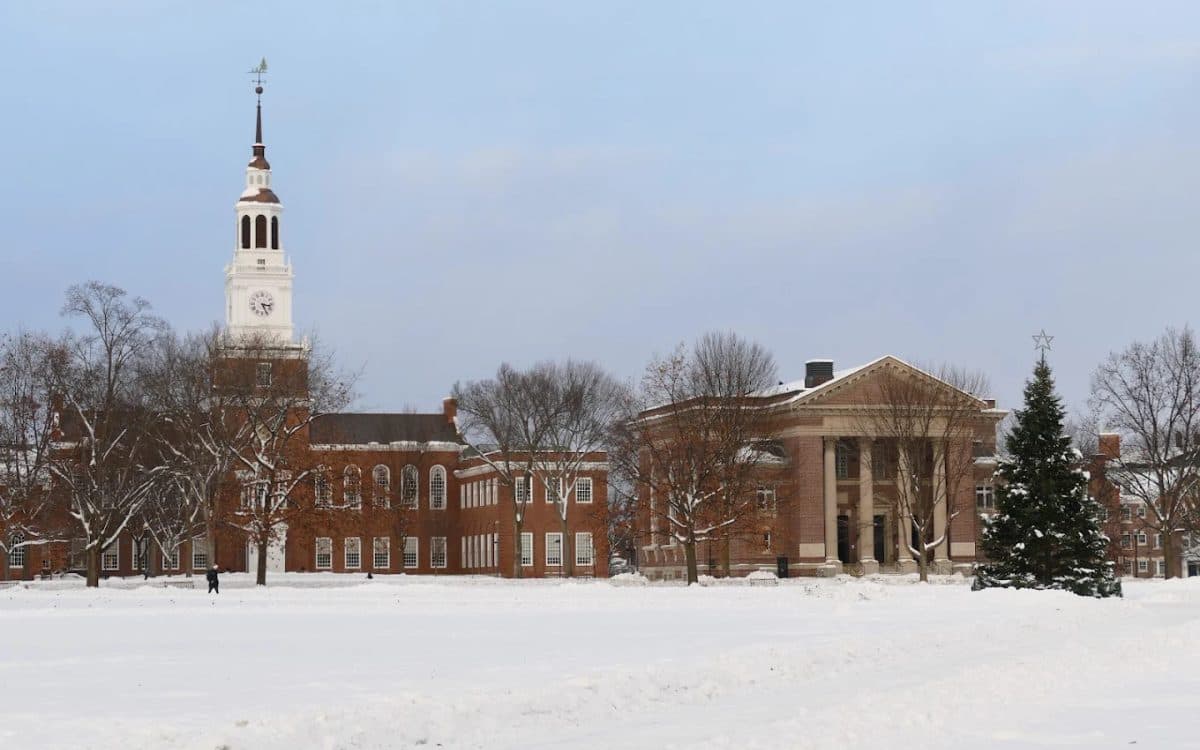
Hanover is a small New England town, and Dartmouth is its centre. Life revolves around the Green, the residential communities and the outdoors — Dartmouth actively supports students who want to explore the outdoors. Winters are long and snowy, as the photograph above shows, so budget for a proper coat, boots and layers in your first weeks. Many students find the close-knit, campus-centred life is exactly what makes Dartmouth special.
- Support for international students: Dartmouth runs an International Student Experience Office and an Office of Visa and Immigration Services, and its financial aid can extend to support such as winter clothing and meal funding during breaks.
- Getting there: Hanover is rural and there are no direct flights to India nearby, so plan for a connection through a larger US hub and onward travel to campus. Dartmouth's admissions site has a parking and travel page with current options.
- Community: with students from 59 countries in the admitted Class of 2030, you will find an international community — look up current South Asian and cultural student groups before you arrive.
After Dartmouth — Work Rights in the US
- OPT gives 12 months of work authorisation after graduation, with a 24-month STEM extension for degrees on the DHS STEM designated list, such as Computer Science and Engineering. Check your major's CIP code.
- The H-1B is selected by lottery, and from FY2027 DHS uses a wage-weighted selection that favours higher wage-level offers. Plan with Dartmouth's career centre early.
- F-1 rules are changing. A DHS final rule published in July 2026 replaces "duration of status" with a fixed admission period from 15 September 2026. Ask Dartmouth's Office of Visa and Immigration Services how it applies to your programme, including D-Plan leave terms.
Applying from Bangalore and Karnataka
Dartmouth's testing policy makes it especially worth a close look for students in Bangalore and across Karnataka — and a few local details help you plan with confidence.
- CBSE and ICSE schools in Bangalore: Dartmouth names CBSE and ICSE among the national exams whose final results can meet its testing requirement for students outside the US, provided they are final and available by February. Class XII results usually come later, so ask Dartmouth whether any results you already hold can count — and book the SAT or ACT in good time if not.
- Karnataka PUC students: the Karnataka School Examination and Assessment Board's II PUC exams are not named in Dartmouth's list. Ask the admissions office whether your PUC results can count; if not, plan for the SAT or ACT, which works for any board.
- Graduate applicants from Karnataka universities: Dartmouth does not publish a list of Indian institutions for graduate admission, and each programme handles its own admissions and aid. Whether you studied at VTU, Bangalore University, IISc, NITK Surathkal, or a college such as RV, PES, BMS or Manipal, ask your chosen programme directly how it assesses your degree.
- Visa interview locations: the US Mission in India lists visa services at the Embassy in New Delhi and the Consulates General in Chennai, Hyderabad, Mumbai and Kolkata — Chennai and Hyderabad are the closest to Bangalore. Through the official scheduling system you book two appointments, one at a Visa Application Centre (VAC) for fingerprints and photo and one for the interview, so plan the trip around both. The official ustraveldocs site also lists a document drop-off location in Bangalore (J.P. Nagar), but that is for applicants eligible to skip the interview; as a first-time student visa applicant, plan on an in-person interview and check the current rules on the official site when you book.
- Flying out of Kempegowda International Airport (BLR): expect a one-stop (or longer) itinerary to the US East Coast, connecting via a major hub in the Gulf, Europe or the US. Compare routes early for the August arrival and each winter break.
- Talk to us in Hebbal or online: Falcon Nova's office is on the 7th floor of Kirloskar Business Park in Hebbal, North Bangalore, and you can book free counselling in person or online. If you would like help planning this, book a session.
Is Dartmouth Right for You?
Dartmouth is an excellent choice if you want Ivy League academics in a small, close community where professors teach undergraduates directly and the D-Plan gives you room to build experience. For Indian families, the combination of need-blind admission, full need met and no loans — plus a testing policy that recognises CBSE and ICSE results — makes it one of the most accessible Ivy options to apply to. Compare it with Brown if you want a more flexible curriculum in a city, and with Princeton if you want another undergraduate-focused, need-blind Ivy.
If you would rather be in a large city, a campus such as Columbia may suit you better — and knowing that early is a strength. At 5.8% overall, Dartmouth is a reach for everyone, so build a thoughtful list around it and put your best work into the Writing Supplement and Peer Recommendation.
Ready to Build Your Dartmouth Application?
Dartmouth applications turn on choices most applicants never think about: whether to submit the SAT or rely on CBSE or ICSE results, who should write your Peer Recommendation, whether binding Early Decision suits you, and how to file the CSS Profile so Dartmouth's no-loan aid applies from the start. Falcon Nova Consultants has helped hundreds of Indian students plan applications to top US universities. Book a free, no-obligation counselling session and we will help you build a Dartmouth application that shows who you are.
Book Your Free Counselling Session